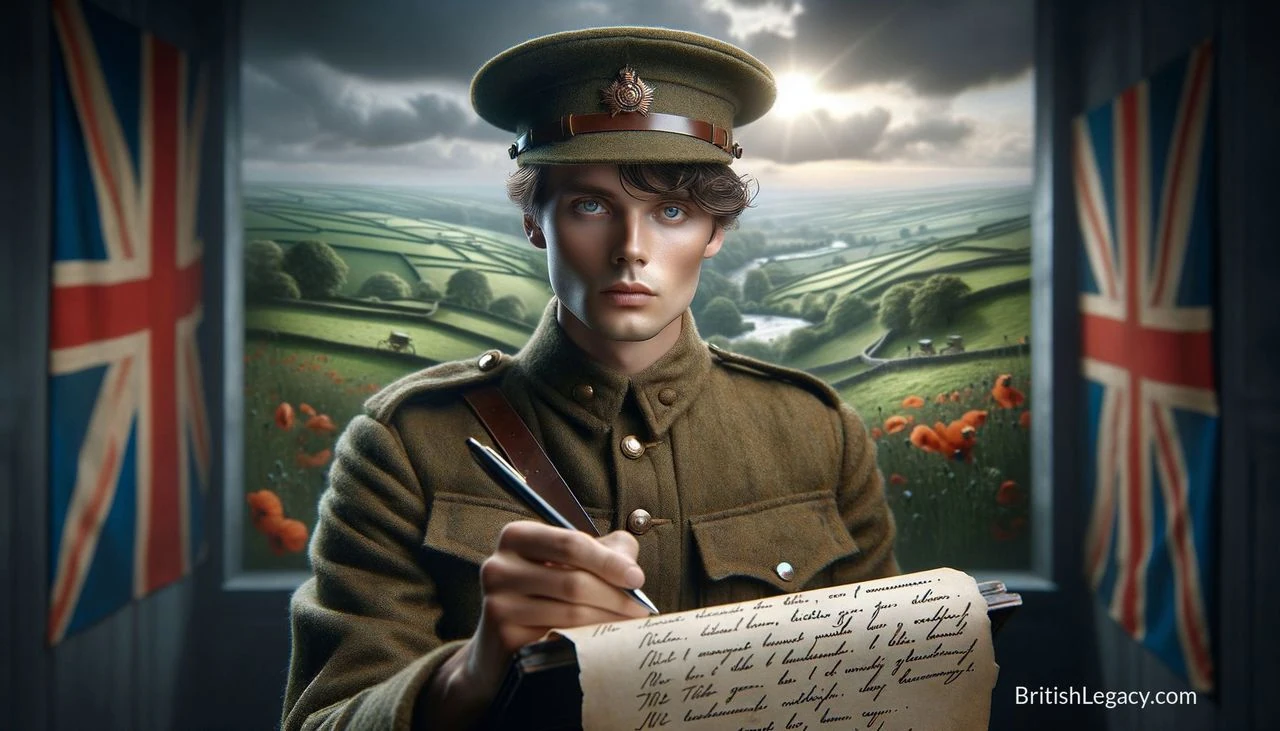
Rupert Brooke’s sonnet “The Soldier” imagines that, if its speaker dies abroad, the ground holding him will become “for ever England”. Published as Britain entered the First World War, the poem gave memorable form to a particular kind of patriotic idealism. Brooke did not live to see the campaign at Gallipoli: he died at sea in April 1915, aged 27, while travelling there. His reputation rests both on the sonnets that made him a public voice of the war’s opening months and on the way his death became entwined with their meaning.
Rugby and Cambridge
Brooke was born in Rugby, Warwickshire, on 3 August 1887, the son of William Parker Brooke, a schoolmaster, and Ruth Mary Brooke, a school matron. He attended the local preparatory school Hillbrow before going to Rugby School, where his father worked. In 1906, he entered King’s College, Cambridge, to study classics. There he joined the Apostles, became president of the university Fabian Society, helped found the Marlowe Society drama club and acted in productions, including the Cambridge Greek Play.
Cambridge connected Brooke to writers and friends who would shape his adult life. He formed friendships in the university’s literary and theatrical circles, and made the acquaintance of people including George Mallory. He also became associated with the Bloomsbury group and the Georgian poets. His literary life extended beyond Cambridge: he spent time among the Dymock poets in Gloucestershire, a circle that included Robert Frost and Edward Thomas, and lived at Grantchester. The Old Vicarage there gave its name to one of his best-known poems, written while he was homesick in Berlin in 1912.
Brooke’s early writing explored beauty, youth and love. His work and travels were not confined to poetry: after an emotional crisis in 1912, he travelled in the United States and Canada, writing travel diaries for The Westminster Gazette, then continued across the Pacific and spent months in the South Seas. In 1913, a thesis on John Webster and Elizabethan drama earned him a fellowship at King’s College. These years placed him within several overlapping literary worlds before military service made him widely known as a war poet.
The sonnets and the war
Britain entered the war in August 1914. Brooke joined the Royal Navy and was commissioned as a temporary sub-lieutenant in the Royal Naval Volunteer Reserve. He served with the Royal Naval Division, an infantry formation made up of Royal Navy and Royal Marine personnel not needed at sea, and took part in the siege of Antwerp in October. The sonnets that would define his public reputation emerged in this first phase of the conflict, before the war’s later poetry had fully registered its brutality.
On 11 March 1915, The Times Literary Supplement published two of Brooke’s sonnets, “IV: The Dead” and “V: The Soldier”. The latter was read from the pulpit of St Paul’s Cathedral on Easter Sunday, 4 April. It begins:
“If I should die, think only this of me:
That there's some corner of a foreign field
That is for ever England.”
The lines imagine death abroad not simply as loss but as a continuing bond between the dead soldier and England. That idea of sacrifice and national belonging struck a chord with readers in the early years of the war. It also represents a particular moment in its literary history: Brooke’s idealism stands in contrast to the later poetry of Wilfred Owen and Siegfried Sassoon, whose work confronted the suffering and despair of trench warfare.
The five sonnets appeared together in 1914 & Other Poems, first published in May 1915, after Brooke’s death. The collection’s rapid reprinting testified to the strength of public interest: it went through 11 further impressions in 1915 and had reached its 24th impression by June 1918. Brooke’s reputation was therefore shaped not only by the poems themselves but by their circulation after his death, when “The Soldier” could be read as both a poem and a memorial.
Death at sea and remembrance
Brooke sailed with the British Mediterranean Expeditionary Force on 28 February 1915. After severe gastroenteritis in Egypt, he developed streptococcal sepsis from an infected mosquito bite. He died on 23 April aboard the French hospital ship Duguay-Trouin, moored in a bay off Skyros in the Aegean, while on his way to the Gallipoli landings. As the expeditionary force was due to leave, he was buried that night in an olive grove on the island. His grave remains there.
His death, so soon after the publication of his war sonnets, contributed to the image of Brooke as a gifted young poet lost before his work could fully develop. That image should not obscure the particulars of his achievement: his published work includes poems beyond “The Soldier”, and his literary associations stretched from Cambridge and Grantchester to Dymock. Nor should the sonnet be mistaken for a complete account of the war. Its idealised language belongs to the conflict’s early public mood, before the experiences described by later war poets became central to its literary memory.
Brooke’s name is remembered in several places. In 1985, he was one of 16 First World War poets commemorated on a slate monument in Poets’ Corner at Westminster Abbey. His name is also recorded on Grantchester’s village war memorial. A statue unveiled in 1988 stands in Rugby, his birthplace; another, by Paul Day, was placed in the garden of the Old Vicarage, Grantchester, in 2006. The cross that once marked his Skyros grave was brought to Rugby by his mother and is now held at Rugby School, where it is displayed with memorials to other former pupils.
Why Rupert Brooke deserves a place in British Legacy
Brooke deserves a place in British Legacy because his poetry records a recognisable moment in Britain’s experience of the First World War. “The Soldier” gave its readers a concentrated expression of patriotic feeling: the imagined dead man remains connected to England even when buried abroad. Its force is literary, but also historical. Read alongside “The Dead” and the collection 1914 & Other Poems, it shows how a poet helped shape the language through which the war’s first months were understood. The poem’s continuing presence in public memory also makes it possible to consider how ideas of duty, sacrifice and national belonging were expressed—and how those ideas changed as the war went on.
His significance is not limited to one sonnet or to the circumstances of his death. Brooke’s education at Rugby and Cambridge, his involvement in several literary circles, his writing about Grantchester and his travels all form part of a short but varied literary life. His work entered public remembrance through publication, readings and memorials: from St Paul’s Cathedral and the rapidly reprinted collection to the sites at Westminster Abbey, Rugby and Grantchester. These concrete connections give his legacy a British setting without reducing it to praise. Remembering Brooke means recognising both the achievement of his poetry and the limits of its early-war vision, alongside the human cost that later generations of war writers would describe differently.
Sources
Rupert Brooke — Wikipedia revision 1378664694
Adapted in part from Rupert Brooke by Wikipedia contributors, under CC BY-SA 4.0. Text has been edited and combined with the existing article; this adapted text is shared under the same licence. Contributor history.