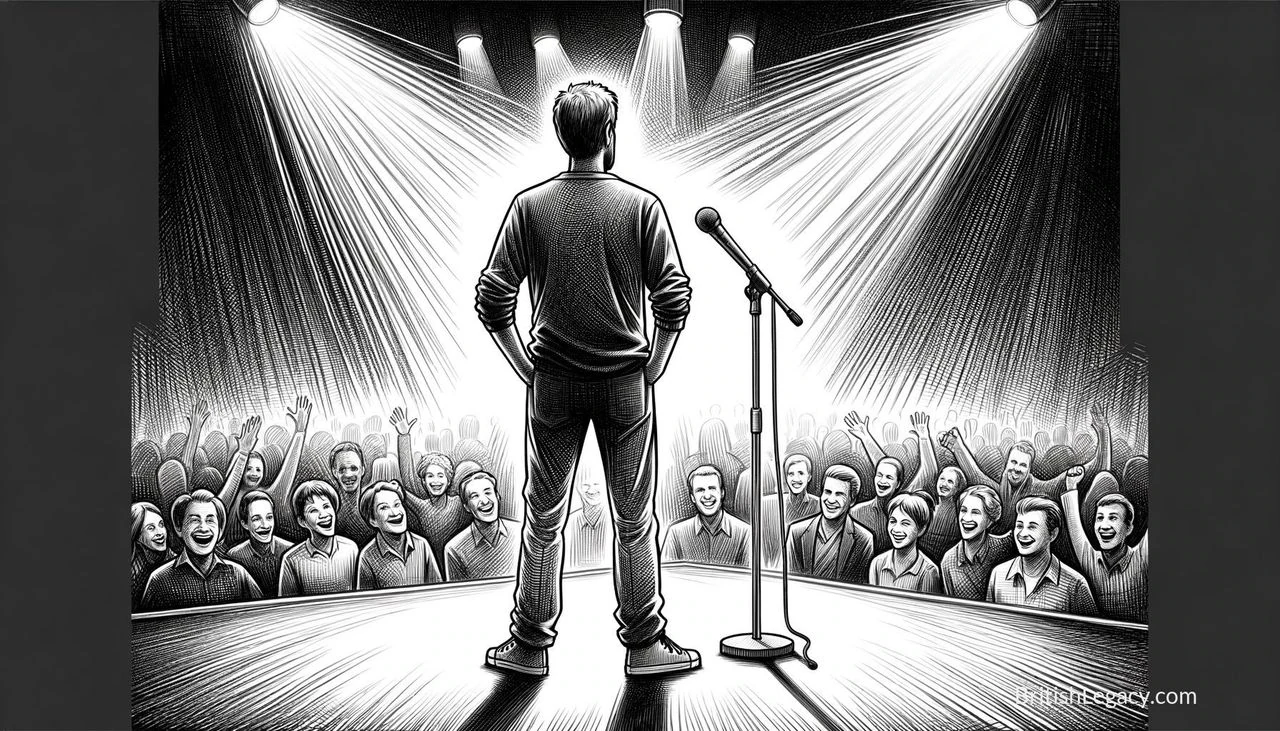
Russell Howard’s comedy career has moved between the intimacy of live stand-up and the weekly business of making television about the news. His first major television vehicle, Russell Howard’s Good News, gave him room to turn current affairs and lighter stories into brisk comic commentary. Later work ranged from a long-running Sky series to tours across several continents. The through-line is a performer who has made audience connection central to both formats.
Early years and first stages
Howard was born in Bath on 23 March 1980 and grew up in nearby Radstock, Somerset. His parents are Dave and Ninette Howard; his younger siblings are twins Kerry and Daniel, born in 1982. He attended several schools, including Bedford Modern School, Hanham High School and Perins School in New Alresford, before studying economics at the University of the West of England in Bristol. The university connection places his education in the city with which the existing account also associates him, though it gives Bath as his birthplace.
Howard’s professional work began in 1999, across stand-up, television and radio. A 2004 commission for BBC Radio 1’s comedy series The Milk Run gave him a role as writer, singer and performer. He also appeared on BBC Radio 4 programmes including Political Animal and Banter. On television, he became a regular panellist on BBC Two’s Mock the Week, appearing until 2010, and featured on programmes such as 8 Out of 10 Cats, Would I Lie to You? and Live at the Apollo.
Radio also brought him together with fellow comedian Jon Richardson. From 2006 to 2008, they co-hosted The Russell Howard Show on BBC Radio 6 Music. Howard later explained that he found radio restrictive: he preferred being able to gauge an audience’s response while performing. That contrast between a live crowd and a broadcast format would remain part of his career, as he moved between studio shows and touring.
Good News and topical comedy
Howard’s best-known early television series began on BBC Three on 22 October 2009. Commissioned for an under-25 audience, Russell Howard’s Good News ranged across major news stories and lighter items from the week. Its format allowed Howard to comment on public affairs while also finding space for the unusual and amusing. Rather than treating the news as a succession of solemn headlines, the show mixed topical comedy with smaller stories that might otherwise have received less attention.
The programme ran for ten series, alongside a best-of edition and a Christmas special. Its ninth series moved to BBC Two in October 2014, and it was voted BBC Three’s best-ever programme during the channel’s tenth-birthday celebrations in 2013. The transfer between channels reflects the show’s wider reach, while its format helps explain its appeal: Howard could respond to the week’s events, but the lighter material kept the programme from being only a conventional news review.
His topical work continued in different forms. In 2017 he began presenting The Russell Howard Hour on Sky, a series that ran until December 2022. He also presented Russell Howard’s Stand Up Central for Comedy Central in 2015 and 2016. Across these programmes, he returned to current affairs and social observation, adapting his delivery to television rather than simply transferring a live set to the screen.
Stand-up, tours and other work
Live performance has remained a substantial part of Howard’s career. His early touring included Adventures and Dingledodies; the latter sold more than 125,000 tickets and included three sold-out performances at the Hammersmith Apollo. He was named best theatre show at the 2009 Chortle Comedy Awards. Later tours included Right Here Right Now, Wonderbox, Round the World and Respite. The tour schedules extended beyond Britain and Ireland to Europe, North America, Australia and New Zealand.
Recordings brought some of those performances to audiences beyond the theatre. A show from the Adventures tour was released as Russell Howard Live, recorded at London’s Bloomsbury Theatre; the Dingledodies release captured a performance at Brighton Dome. Later releases included Wonderbox, recorded at Bristol Hippodrome, and the Netflix special Recalibrate. Howard also made his United States television debut on Conan in 2011 and performed on The Tonight Show Starring Jimmy Fallon in 2015.
His work has not been confined to stand-up and topical presentation. In 2015, he made his acting debut in the BBC Two comedy-drama A Gert Lush Christmas, which he co-wrote and in which he played Dan Colman. His sister Kerry also appeared. Other television work included the travel series Russell Howard & Mum: USA Road Trip, featuring his mother, Ninette, and a guest appearance on Taskmaster. These projects show a career that has moved among panel shows, scripted comedy, travel television and live performance.
Public life and charitable work
Howard has spoken about his family in his act, including his younger brother Daniel’s epilepsy. In 2010, he ran the London Marathon with his brother and sister to raise money for the Epilepsy Society. He finished in four hours and 15 minutes, beating his target time, and sponsorship raised more than £7,000. That is a specific example of a charitable effort connected to his public work, rather than a general claim about his character.
He has also supported environmental campaigning. In 2009, he appeared at Friends of the Earth’s LIVEstock comedy and music event at the Hammersmith Apollo, backing the organisation’s Food Chain Campaign for planet-friendly farming. These activities sit alongside a career in which comedy has sometimes provided the occasion to draw attention to causes beyond entertainment.
Why Russell Howard deserves a place in British Legacy
Howard’s place in British Legacy rests on a body of work that connects British television comedy with the live circuit. Russell Howard’s Good News made a recognisable weekly format out of topical comment and lighter stories; its move from BBC Three to BBC Two and its later recognition as the channel’s best-ever programme record the scale of its audience. His subsequent Sky series continued his engagement with current affairs, while his BBC and commercial television appearances made him a familiar presence across different kinds of comedy programming.
His live career adds another dimension. Large UK audiences attended tours such as Dingledodies and Right Here Right Now, while later tours took his stand-up to audiences in Europe, North America, Australia and New Zealand. Recordings and television specials extended that work beyond the venues where it began. The result is a career built not around one programme alone, but around movement between stage, radio and television. His marathon fundraising for the Epilepsy Society and support for an environmental campaign also provide concrete examples of public activity beyond performance. Together, those achievements make his story relevant to British comedy’s reach at home and abroad.
Sources
Russell Howard — Wikipedia revision 1378550818
Adapted in part from Russell Howard by Wikipedia contributors, under CC BY-SA 4.0. Text has been edited and combined with the existing article; this adapted text is shared under the same licence. Contributor history.