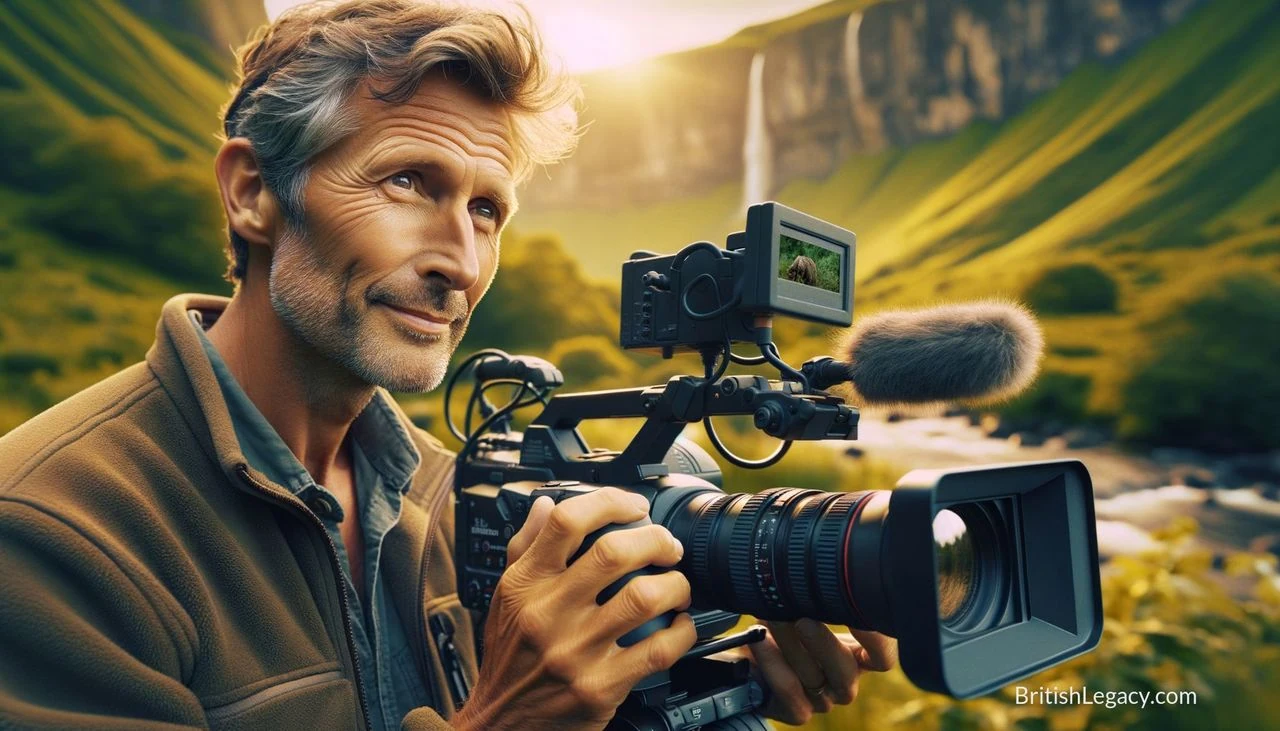
Simon King’s television career began long before his best-known work on Big Cat Diary, Springwatch and Autumnwatch. He was born in Nairobi in 1962, moved to Bristol with his family in 1964, and appeared on television as a child. By 1984 he had made his first film for television; over the following decades he became a cameraman, presenter and maker of more than 80 natural-history films.
Early appearances, then a film of his own
King was born Simon Henry King in Nairobi, where his father, John, worked for the British Forces Broadcasting Service. His mother was Eve King, née Shulman. In 1964 the family moved to Bristol after his father took a reporting job with the BBC’s Points West. King later attended Henbury School, from 1974 to 1979.
His earliest screen work came as a child actor, not as a documentary filmmaker. At ten, he appeared in television films including The Fox (1973) and Secret Place (1974). In 1976 he accompanied naturalist Mike Kendall in the BBC series Man and Boy, which followed their search for British wildlife. These projects were directed or produced by his father.
In 1980–81 King presented County Camera, a seven-part series made for Westward Television and filmed in south-west England. His first film for television as a filmmaker followed in 1984: The Willow, a study of wildlife around a single willow tree, broadcast as part of the BBC series The World About Us. A second film for the series, The Hidden Land, explored wildlife around hotels on Spain’s Costa del Sol. King went on to make more than 80 natural-history films as a principal cameraman, director or producer, as well as presenting many others.
From the BBC Natural History Unit to the “Watch” broadcasts
King made two series of King’s Country and presented King’s Country Diary for the BBC. His work also included dramatised wildlife programmes such as Rannoch the Red Deer, Dusk the Badger and Shadow the Peregrine. He presented King and Company and A Walk on the Wildside, a series that took two and a half years to make.
From 1992, he worked on programmes for the BBC Natural History Unit. Early presenting credits included Nature Detectives and Wild Nights with Simon King, as well as live “Watch” broadcasts. He was a regular presenter of BBC Two’s Tracks, fronted Watch Out and filmed around the world for Hot Shots, a series about how natural-history films are made.
For BBC One’s Big Cat Diary, King filmed and presented alongside Jonathan Scott and Saba Douglas-Hamilton. The series followed lions, leopards and cheetahs in Kenya’s Masai Mara Game Reserve. He later co-presented BBC Two’s annual Springwatch and Autumnwatch, working first with Bill Oddie and Kate Humble, and later with Chris Packham and Martin Hughes-Games. The broadcasts brought viewers to wildlife locations around the British Isles, including Shetland, Mull, the London Wetland Centre and the Somerset Levels.
Filming animals and the people who watch them
King’s work has ranged from British wildlife to large-scale international productions. He received BAFTA awards for his camera work on Life in the Freezer and Planet Earth. For the latter, he filmed a slow-motion sequence of a great white shark leaping from the water to catch a Cape fur seal. He also had principal camera credits on Wild Africa and The Blue Planet, and was part of the camera team for the 2011 Disney film African Cats.
His work could involve risk as well as careful observation. In 2007, while filming for Natural World in Kenya, King and an assistant were attacked by a rabid cheetah. They received rabies jabs and did not develop the disease; the cheetah later died. The incident was documented in the programme Toki’s Tale.
King’s public-facing work has not been confined to wildlife films. He made instructional videos for Ordnance Survey, helping viewers use a compass, read a map and understand grid references. In 2009 he received the Royal Geographical Society’s Cherry Kearton Medal and Award. In 2011, the Royal Photographic Society awarded him an Honorary Fellowship, recognising his connection with photography through his work and attainments.
Recognition and a career rooted in British broadcasting
King was appointed an Officer of the Order of the British Empire in the 2010 New Year Honours for services to wildlife photography and conservation. The honour sits alongside a career built across British television: from his early south-west England work to BBC Natural History Unit productions and live broadcasts from sites around the country.
That career has also taken him far beyond Britain. His films have ranged from the Masai Mara to the Costa del Sol, while series such as Wild Africa, The Blue Planet and Planet Earth brought wildlife from different environments to television audiences. King’s contribution has been both behind and in front of the camera: filming animal behaviour, presenting programmes and showing how natural-history productions are made.
Why Simon King deserves a place in British Legacy
Simon King’s place in British Legacy rests on a sustained contribution to British wildlife broadcasting. He began in television as a child, but built a distinct professional record as a cameraman, filmmaker and presenter. His work for the BBC included programmes that explored wildlife at home and abroad, while his live presenting on Springwatch and Autumnwatch brought viewers to named locations across the British Isles. Those broadcasts made particular places and their wildlife part of a shared national television experience, rather than treating nature as something distant or confined to the most dramatic international landscapes.
His achievements also show the range of skills behind natural-history television. King has made films, worked as a principal cameraman, presented series and helped audiences understand the practical craft of filming wildlife. His BAFTA-recognised camera work on Life in the Freezer and Planet Earth, his long-running work on Big Cat Diary, and his recognition by the Royal Photographic Society and the Royal Geographical Society mark different aspects of that career. His OBE acknowledged services to wildlife photography and conservation. Taken together, these achievements connect British broadcasting, photography and public attention to the natural world, giving his career a specific and lasting place in the country’s cultural record.
Sources
Simon King (broadcaster), revision 1379507858
Adapted in part from Simon King (broadcaster) by Wikipedia contributors, under CC BY-SA 4.0. Text has been edited and combined with the existing article; this adapted text is shared under the same licence. Contributor history.