
Sir Ken Robinson spent much of his career challenging the idea that education should privilege a narrow band of academic achievement. An educator, author and speaker, he made the case for a broader curriculum, more individual approaches to learning and a serious place for the arts. His work began in British education and public policy; a widely watched TED talk later carried those arguments to an international audience.
A Liverpool education and an early interest in drama
Kenneth Robinson was born in Liverpool on 4 March 1950, one of seven children in a working-class family. He contracted polio at the age of four and spent eight months in hospital. The effects of the illness led him to attend Margaret Beavan Special School before moving on to Liverpool Collegiate School and Wade Deacon Grammar School in Cheshire.
At Bretton Hall College of Education, he studied English and drama, gaining a Bachelor of Education degree in 1972. He went on to complete a PhD at the University of London in 1981. His research examined drama teaching in secondary education, including a survey of curricular drama in 259 schools. That focus on the place of creative subjects in formal education remained central to his later work.
Robinson's early publications and projects reflected that interest. In 1977, he and Lynn McGregor and Maggie Tate produced Learning Through Drama, the report of a Schools Council drama-teaching project. He was principal author of The Arts in Schools: Principles, Practice, and Provision in 1982, and his subsequent writing addressed the arts in higher and further education. These works established a substantial professional interest in how creative practice could sit within schools and other educational settings.
Arts education, research and public policy
From 1985 to 1988, Robinson directed the Arts in Schools Project, an initiative to develop arts education in England and Wales. It connected more than 2,000 teachers, artists and administrators through a network of over 300 initiatives. The project also influenced the formulation of the National Curriculum for England. During these years, Robinson chaired Artswork, the UK's national youth arts development agency, and advised the Hong Kong Academy for Performing Arts.
In 1989 he became Professor of Arts Education at the University of Warwick, where he remained until 2001 and later held the title of professor emeritus. His academic career gave him a base from which to work across education and the arts, while his public work increasingly addressed how education systems define ability and achievement.
In 1998, he chaired the National Advisory Committee on Creative and Cultural Education, a UK government commission examining creativity, education and the economy. Its report, All Our Futures: Creativity, Culture and Education, argued for creativity to be treated as a fundamental part of education, rather than a secondary concern beside literacy. The report brought together the concerns that had shaped his work: the breadth of what schools teach, the status given to the arts and the opportunities available to pupils with different interests and strengths.
Robinson also worked on cultural policy beyond the committee. He helped develop a strategy for creative and economic development as part of the peace process in Northern Ireland. Published as Unlocking Creativity, the plan was implemented across the region. He also mentored the Oklahoma Creativity Project. These projects show how his interest in creativity extended from classroom practice to wider questions of regional development and public policy.
Taking an argument to a worldwide audience
In 2001, Robinson moved with his wife and children to Los Angeles to become senior adviser for education and creativity to the J. Paul Getty Trust. The appointment extended his work beyond the British institutions in which his career had developed. He also continued to speak and write about education for audiences well beyond universities and government committees.
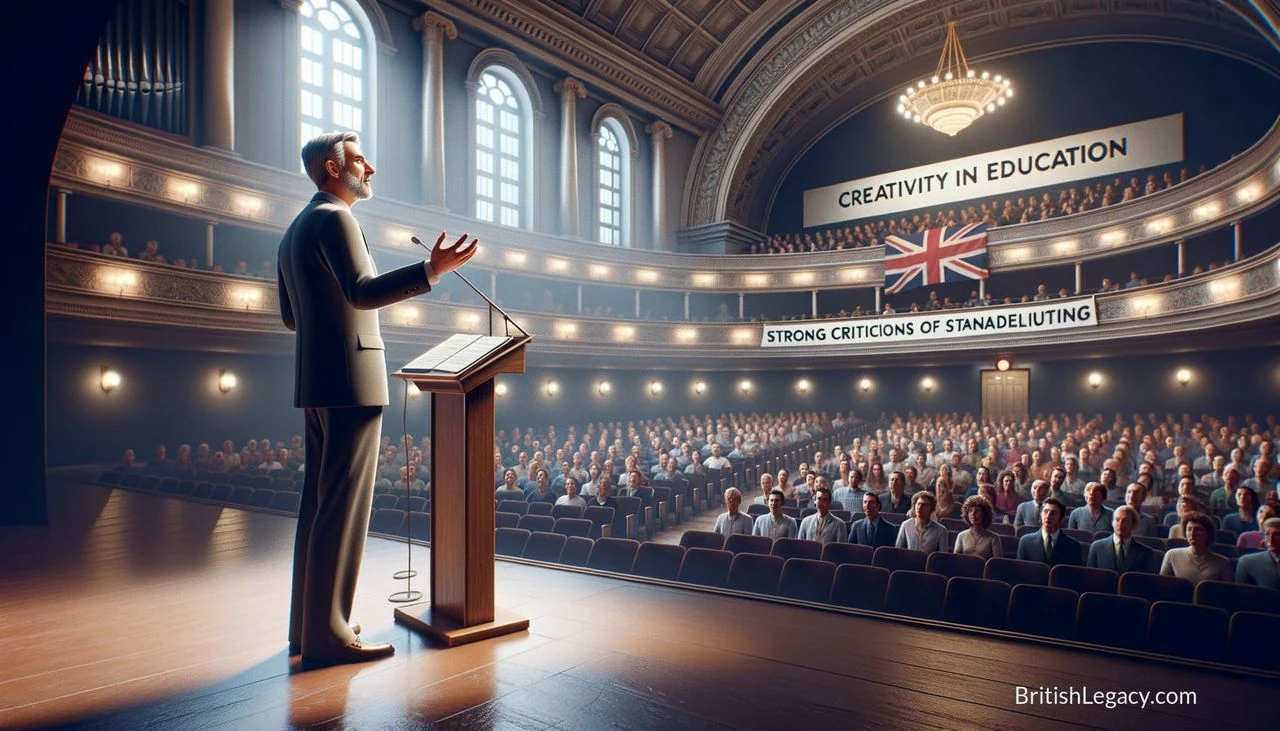
His 2006 TED talk, “Do Schools Kill Creativity?”, became his best-known public intervention. Robinson used humour and accessible examples to question whether education systems placed too much weight on standardised tests and traditional academic subjects, at the expense of the arts and other forms of ability. At the time of his death, the presentation had received 66.3 million views on the TED channel, with millions more on YouTube; it had been translated into 62 languages. Those figures locate the talk's reach, while its subject remained the argument Robinson had developed over decades of work.
He gave two other TED talks on creativity in education. In 2013, “How to Escape Education's Death Valley” set out three principles he considered important to human flourishing and criticised aspects of American education culture. A speech on changing education paradigms, animated by the Royal Society of Arts in 2010, also found a large online audience. Together, these talks helped make his educational arguments familiar internationally, though the work behind them included research, teaching, policy advice and writing.
Robinson described education as an organic rather than mechanical system. He called for a broad curriculum, for learning to be adapted to individual pupils, and for teaching that fostered curiosity. He also argued that creative teaching depended on high-quality teacher training and development. In this view, reducing the emphasis on standardised testing was not an end in itself: it would give schools and teachers more scope to respond to the people they taught. His critique was directed at conformity and standardisation, and at the assumption that a single measure could capture the range of human ability.
Books, honours and later life
Robinson's books carried related themes to readers outside education policy. Out of Our Minds: Learning to Be Creative, published in 2001, examined how creativity was undervalued. The Element: How Finding Your Passion Changes Everything, published in 2009, described the meeting of personal talent and passion. His later titles included Finding Your Element, Creative Schools, written with Lou Aronica, and You, Your Child, and School. His writing sat alongside earlier work on drama and the arts in education, rather than replacing it.
Among Robinson's honours were the LEGO Prize for international achievement in education, the Peabody Medal for contributions to arts and culture in the United States, and the Benjamin Franklin Medal of the Royal Society of Arts for contributions to cultural relations between the United Kingdom and the United States. He received honorary degrees from institutions including the Open University, the Central School of Speech and Drama, Birmingham City University and the Liverpool Institute for Performing Arts.
In 2003, Robinson was knighted for services to the arts. He died at his home in London on 21 August 2020, aged 70. His career connected a Liverpool education, British research and policy work, university teaching, international advice and an unusually wide public reach. The route from a drama-teaching project to a talk viewed around the world did not change the central question of his work: how can education make room for more than one kind of talent?
Why Sir Ken Robinson deserves a place in British Legacy
Robinson's place in British Legacy rests on work that was both distinctly connected to British education and influential beyond it. He trained at Bretton Hall, researched drama teaching at the University of London, directed a project to develop arts education in England and Wales, and became Professor of Arts Education at Warwick. As chair of the 1998 National Advisory Committee on Creative and Cultural Education, he helped bring the place of creativity in education into a national policy discussion. His report, All Our Futures, made a specific case: creativity should be treated as fundamental to education, not as an optional extra.
His contribution also lay in making that debate accessible. Robinson brought questions about standardised testing, curriculum breadth and different abilities to audiences well beyond government and academic circles. The international reach of “Do Schools Kill Creativity?” carried an argument developed through years of teaching, research and policy work to millions of viewers. His writing, public talks and advisory roles consistently pressed for education to recognise diversity, encourage curiosity and leave teachers room to respond to individual learners. That is a substantive British legacy: a body of educational work rooted in British institutions and public debate, which helped people around the world question what schools value and whom their systems serve.
Sources
Ken Robinson (educationalist), revision 1376849052 · Ken Robinson (educationalist)
Adapted in part from Ken Robinson (educationalist) by Wikipedia contributors, under CC BY-SA 4.0. Text has been edited and combined with the existing article; this adapted text is shared under the same licence. Contributor history.
.jpg)