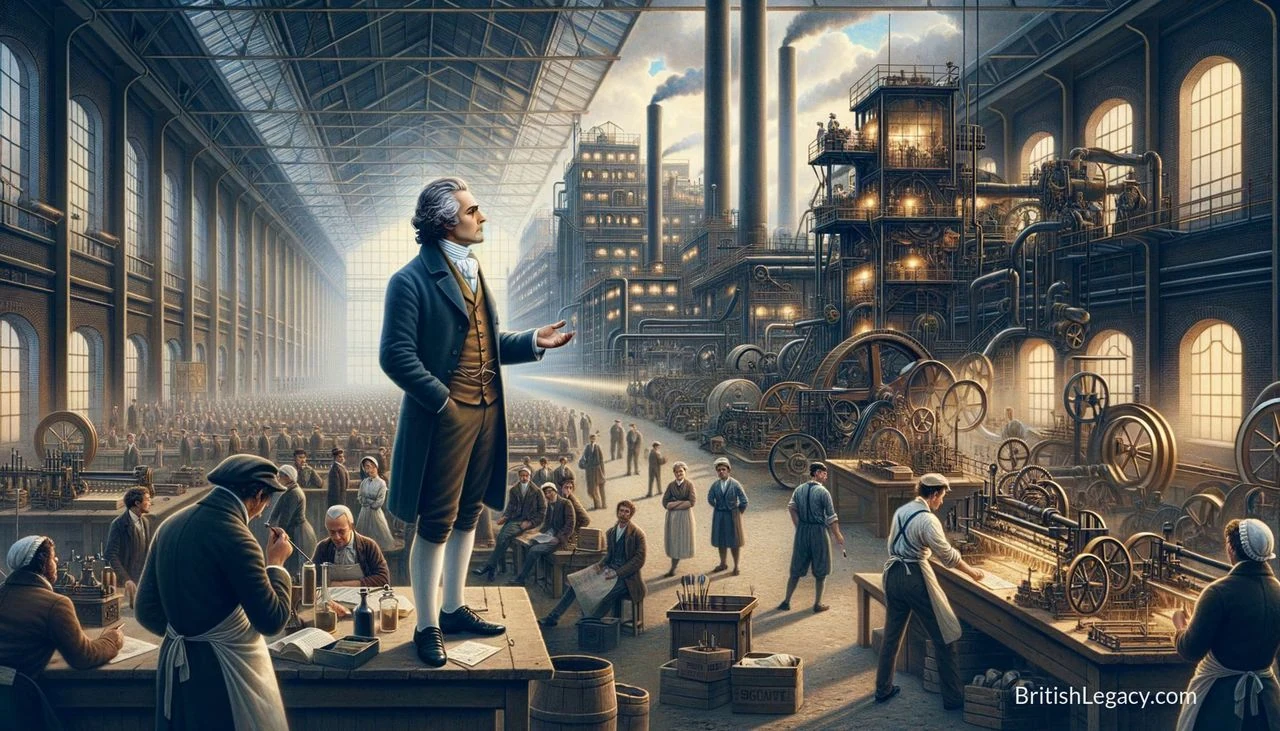
Richard Arkwright’s rise from barber and wig-maker to one of the leading entrepreneurs of the early Industrial Revolution was built on machinery, organisation and the power needed to run both. His spinning frame, later adapted to use water power, helped make cotton yarn on a new scale. At Cromford in Derbyshire, he brought mechanised carding and spinning together in a factory that became a model for industrial production. His achievement was not simply the invention of a machine: it was the creation of a system linking machinery, power, workers and cotton.
From Preston barber to textile innovator
Arkwright was born in Preston, Lancashire, on 23 December 1732, the youngest of seven surviving children. His father, Thomas, was a tailor and Preston Guild burgess. His parents could not afford to send him to school, so his cousin Ellen taught him to read and write. He was apprenticed to a barber, Mr Nicholson, in Kirkham, and began his working life in that trade. By the early 1760s he had established a barber’s shop in Churchgate, Bolton.
Arkwright also developed a waterproof dye for fashionable wigs. The income from that work later helped fund his experiments with cotton machinery. His route into the textile industry was therefore not a sudden leap from one trade to another, but a progression from practical work and a small business to investment in mechanical innovation.
In 1768, Arkwright and the clockmaker John Kay worked on a spinning machine in Preston. The following year Arkwright patented a spinning frame that used wooden and metal cylinders to draw out and twist cotton fibres. It could produce thread with less reliance on skilled hand-spinning, and its yarn was suitable for warp threads. The machine was initially horse-powered; its later adaptation to water power gave it the name by which it became best known: the water frame.
Machinery, patents and Cromford
Spinning was only one part of the process. In 1775 Arkwright patented an improved carding engine, which prepared raw cotton as a continuous skein before spinning. The machine used successive rollers turning at different speeds to draw out the fibres. Together, mechanised carding and spinning made it possible to concentrate more of cotton production in a single factory.
Arkwright and John Smalley first established a small, horse-driven factory in Nottingham. To finance expansion, Arkwright formed a partnership with the hosiery manufacturers Jedediah Strutt and Samuel Need. In 1771 the partners built the water-powered mill at Cromford, Derbyshire. It combined carding and spinning, employed 200 people, and showed how water power could be harnessed to operate machinery on an industrial scale. Arkwright built a second, larger mill there in 1776.
His business expanded beyond Cromford. He built or acquired mills in places including Bakewell, Wirksworth and Manchester, and worked with David Dale on mills at New Lanark. At Haarlem Mill in Wirksworth, where he installed a steam engine in 1777, the engine replenished the millpond that powered the waterwheel rather than driving the machinery directly. His mill at Birkacre, Lancashire, was destroyed during anti-machinery riots in 1779.
Arkwright’s effort to control his inventions through patents met resistance. A broad patent obtained in 1775 was challenged by competitors. In 1781 he began legal proceedings to defend his rights; the case concluded against him in 1785 because the patent specifications were deficient. The court also heard claims that the spinning frame had been invented by his employee John Kay or by Thomas Highs, Kay’s former employer. The dispute is an important qualification to any simple account of Arkwright as the sole inventor: his lasting importance also lay in developing and deploying machinery as an entrepreneur.
A new industrial workplace
As the Cromford operation grew, the local population could not supply all the labour Arkwright wanted. He brought in workers from elsewhere and built cottages near the mill. The factory’s scale depended not only on machinery but on attracting and organising a workforce. Arkwright established tightly timed working arrangements: two 13-hour shifts a day, with bells marking the working day and the change of shift. Workers who arrived after the gates closed could lose the day’s work and an additional day’s pay.
Whole families were employed, including children as young as seven; the minimum age was later raised to ten. Towards the end of Arkwright’s tenure, children made up nearly two-thirds of the mill’s 1,150 employees. Workers were allowed a week’s holiday each year on condition that they stayed in Cromford. These details show the human terms of the factory system alongside its organisational innovation. The mills created employment and a new industrial community, but the work was governed by long shifts, strict discipline and the employment of very young children.
Arkwright’s factories were not simply places where every stage of textile production, from raw cotton to finished cloth, took place under one roof. The significance of Cromford was that it brought mechanised carding and spinning together and organised production around powered machinery. That combination helped establish a pattern of factory manufacture which other industrialists could adapt.
Public life and later years
Arkwright became wealthy and influential, though accounts of him describe a forceful and difficult business partner. He eventually bought out his partners and continued building mills. He served as High Sheriff of Derbyshire and was knighted in 1786. In 1788 he bought an estate near Cromford and began building Willersley Castle. A fire damaged the building in 1791; it was rebuilt after his death.
Arkwright died at Rock House, Cromford, on 3 August 1792, aged 59. His fortune was reported as £500,000. He was buried at St Giles’ Church, Matlock; his remains were later moved to the family chapel near the castle, now St Mary’s Church, Cromford. He did not live in Willersley Castle, which was completed after his death and occupied by his son Richard Arkwright junior.
Why Sir Richard Arkwright deserves a place in British Legacy
Arkwright’s place in British history rests on the way he joined technical development to industrial organisation. His spinning frame, its adaptation to water power, and his carding engine helped make cotton yarn in greater quantities and with less dependence on skilled hand-spinning. At Cromford, he and his partners put powered carding and spinning into a single mill and built a business around that combination. The factory system did not spring fully formed from one person’s invention, but Arkwright’s mills demonstrated how machinery, power, capital and a concentrated workforce could be organised together.
That achievement had consequences beyond increased output. Cromford’s growth brought workers from outside the area and led to housing being built near the mill. Its disciplined shifts and employment of entire families, including young children, also expose the costs borne by workers as industrial production changed. Remembering Arkwright fully means holding both sides of that history together: the engineering and enterprise that helped transform British manufacturing, and the demanding labour arrangements that accompanied them. His career is a specific British legacy because it connects Lancashire’s textile trades and Derbyshire’s water-powered mills to a model of production that reshaped work and industry.
Sources
Richard Arkwright (revision 1377858703)
Adapted in part from Richard Arkwright by Wikipedia contributors, under CC BY-SA 4.0. Text has been edited and combined with the existing article; this adapted text is shared under the same licence. Contributor history.