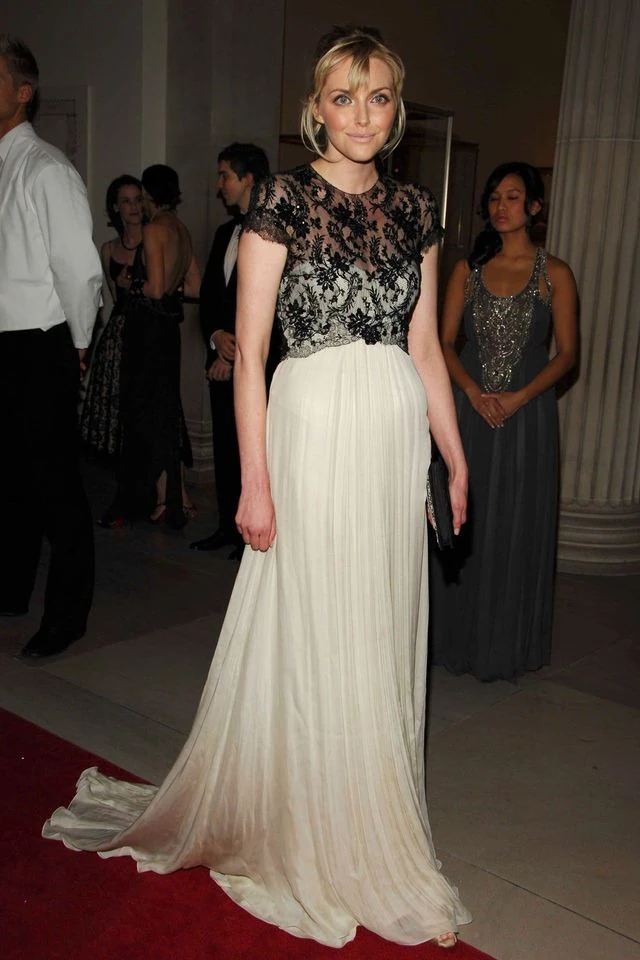
Sophie Dahl’s career has moved between the fashion pages and the printed page. First known as a model, she went on to publish fiction and cookbooks, write for magazines and create picture books for children. That range connects her work to several strands of contemporary British cultural life: fashion, publishing, food television and children’s literature.
A childhood across homes and schools
Dahl was born Sophie Holloway in London on 15 September 1977. Her parents were the actor Julian Holloway and the writer Tessa Dahl. Through her mother, she is the granddaughter of author Roald Dahl and American actor Patricia Neal; her paternal grandfather was the actor Stanley Holloway. Her parents separated shortly after she was born.
Dahl’s childhood was marked by frequent moves. She attended ten schools and lived in 17 homes, in places that included London, New York and India. In her teens she lived with her mother in Balham. She has described her childhood as “an odd one, but with such magic”. As a child, she visited both sides of her family: her maternal grandparents in Great Missenden, Buckinghamshire, and her paternal grandparents in East Preston, West Sussex.
At 18, Dahl moved out to share a flat in Kensal Rise with her school friend Iris Palmer, who also became a model. Around that age, a chance meeting with Isabella Blow, then an editor at British Vogue, opened the way into modelling. The encounter connected Dahl’s early career to the British fashion press, but the work soon extended well beyond magazine pages.
Modelling and the fashion press
The year after she began modelling, Dahl made her catwalk debut at Lainey Keogh’s London Fashion Week show, modelling autumn and winter knitwear. She went on to walk for designers including Nina Ricci, Fendi, Christian Dior couture, Christian Lacroix and Jean Paul Gaultier. Her advertising work included campaigns for Versace, Alexander McQueen, Boucheron, Pringle, Godiva, Banana Republic, Gap and Boodles.
Her editorial appearances ranged across British and Italian Vogue, Harper’s Bazaar, Elle, Numéro and other magazines. She also worked with photographers including Richard Avedon, Peter Lindbergh, Tim Walker, Steven Klein and Steven Meisel. In 2000, she became the face of Yves Saint Laurent’s Opium, in a campaign art-directed by Tom Ford and photographed by Meisel. Nude images used in British advertising for the campaign prompted a near-record number of complaints to the Advertising Standards Authority.
Dahl’s fashion career later gave way to a sustained writing life, though she continued contributing to magazines. She was a contributing editor and regular columnist at Men’s Vogue from 2005 until the magazine closed in 2008. She also contributed to British Vogue for a decade, writing about subjects that included cultural identity, refugees arriving in Britain and the effect of scent on memory. Her column received a Jasmine Award. She has contributed to Condé Nast Traveller and written essays for publications including The Guardian, The Observer and The New York Times Magazine. In 2020, she became a monthly columnist and contributing editor at House & Garden.
Fiction, food and children’s books
Dahl’s first book, the illustrated novella The Man with the Dancing Eyes, appeared in 2003 and became a Times bestseller. Her next book, the novel Playing with the Grown-Ups, followed in 2007. In 2009 she published Miss Dahl’s Voluptuous Delights, a cookbook that brought her interest in food into a new part of her public work.
She wrote and presented The Delicious Miss Dahl, a six-part cookery series broadcast on BBC Two in March and April 2010 and based on the cookbook. The following year she wrote and presented a BBC Two social-history documentary about Victorian cook Isabella Beeton. Dahl published another cookbook, From Season to Season, in 2011. The television programmes joined practical cookery with historical and personal subject matter, while her magazine writing continued to move between culture and everyday experience.
In 2019, Walker Books announced a four-book deal with Dahl. The first, Madame Badobedah, illustrated by Lauren O’Hara, was published that October. It received a Parents’ Choice Gold Award, appeared on best-children’s-book lists in The Guardian and The Sunday Times, and was nominated for a Kate Greenaway Medal. Dahl’s next Walker book, The Worst Sleepover in the World, illustrated by Luciano Lozano, came out in 2021. Madame Badobedah and the Old Bones, the third book in the series, followed in 2023; Waterstones selected it among its books of the year, and it was nominated for a Carnegie Medal.
Writing for children added another form to a career already spanning novels, cookbooks, journalism and television. Dahl has also introduced new editions of established books: Frances Hodgson Burnett’s The Secret Garden and Stella Gibbons’s Nightingale Wood both appeared with her introductions in 2009, while her introduction to Nancy Mitford’s Don’t Tell Alfred accompanied a 2010 reissue. She contributed to the anthology Truth or Dare, edited by Justine Picardie, alongside work by Zoë Heller and William Fiennes.
Family and a continuing public life
Dahl married singer Jamie Cullum on 9 January 2010. They have two daughters, born in 2011 and 2013, and the family live in Buckinghamshire. Her work away from writing and broadcasting includes being an ambassador for Place2Be, a charity providing mental-health support and advocacy in schools across the UK.
Across these roles, Dahl’s public life has not followed a simple progression from modelling to authorship. She has continued to write for magazines while publishing books, and her food writing has also reached television. Her books for children, meanwhile, have added a continuing series to a bibliography that began with an illustrated novella. The work is varied in form, but it repeatedly places her in conversation with British publishing and media: from London fashion shows and British Vogue to BBC Two, Walker Books and a UK schools charity.
Why Sophie Dahl deserves a place in British Legacy
Sophie Dahl’s place in British Legacy rests on a career that connects several visible parts of British cultural life without being confined to one of them. Her early work took her from a debut at London Fashion Week to campaigns and magazine editorials, while her later writing has ranged from fiction and food books to journalism and children’s picture books. The BBC Two series The Delicious Miss Dahl brought her cookbook work to television; her documentary on Isabella Beeton connected food to social history. These are concrete examples of a career that has moved between fashion, publishing and broadcasting rather than relying on a single public image.
Her contribution to British writing is also apparent in the forms and audiences she has addressed. Dahl published an illustrated novella, a novel, cookbooks and children’s books; her work for magazines has included essays on cultural identity and refugees arriving in Britain. Madame Badobedah and its sequels have brought her writing to younger readers, with the first book receiving award recognition and the later series gaining further notice. Alongside that work, her role as a Place2Be ambassador connects her public profile to a charity supporting mental health in schools across the UK. Taken together, her books, broadcasting and charitable role make her a distinctive contemporary figure in British cultural life.
Sources
Adapted in part from Sophie Dahl by Wikipedia contributors, under CC BY-SA 4.0. Text has been edited and combined with the existing article; this adapted text is shared under the same licence. Contributor history.