Sue Barker’s career has two defining stages: a breakthrough as a Grand Slam singles champion and a long second life bringing sport to television audiences. In 1976, aged 20, she won the French Open. From the 1990s, viewers knew her as a BBC presenter, notably at Wimbledon and on A Question of Sport. The transition was not a retreat from competition but a move from playing at the highest level to explaining and presenting sport on a national scale.
A young player from Paignton
Born in Paignton, Devon, on 19 April 1956, Barker grew up there and attended The Marist Convent School. Her route into competitive tennis began at ten, when coach Arthur Roberts selected her for lessons. He continued to coach her, charging a modest fee, and remained her mentor. When Barker was a teenager, Roberts encouraged her to develop her game rather than follow advice from a visiting coach to change her forehand.
At 16, Barker was ranked 21st in the WTA rankings. Roberts advised her to move to the United States to develop as a player; she signed with International Management Group on her 17th birthday and moved to California, where she trained at the John Wayne Tennis Club. She turned professional in 1972, according to the biographical account, and began building a record on the international circuit. In 1973 and 1974 she won the Exmouth Open in Devon, beating Annette Coe in each final.
Her first top-level singles title came in 1975, alongside three further titles and her first Grand Slam semi-final, at the Australian Open. In 1976 she won the German Open, defeating Renáta Tomanová, then beat the same opponent in the French Open final. Barker took the title in three sets, 6–2, 0–6, 6–2. It remained the defining achievement of her playing career. She won 15 singles titles and 12 doubles titles, and recorded victories over leading players including Chris Evert, Martina Navratilova, Billie Jean King and Virginia Wade.
Competition, setbacks and a near miss
Barker’s years on tour brought both success and difficult stretches. In 1977 she reached the semi-finals at the Australian Open and Wimbledon, and the final of the year-end Virginia Slims Championships, where she lost to Evert. At Wimbledon, she had been expected to meet Wade in the final but was beaten by Betty Stöve. Barker later described that semi-final defeat as the greatest disappointment of her career.
An injury-plagued 1978 saw her ranking fall to 24. She returned to form the following year, winning three singles titles and reaching three other finals; her fellow professionals named her the tour’s Comeback Player of the Year. Her last singles title came at the Brighton International in 1981. She won her final doubles title at Cincinnati in 1982 and played her last professional match in 1984. The end of her playing career did not end her connection with tennis: it became the foundation for her work in broadcasting.
A second career in broadcasting
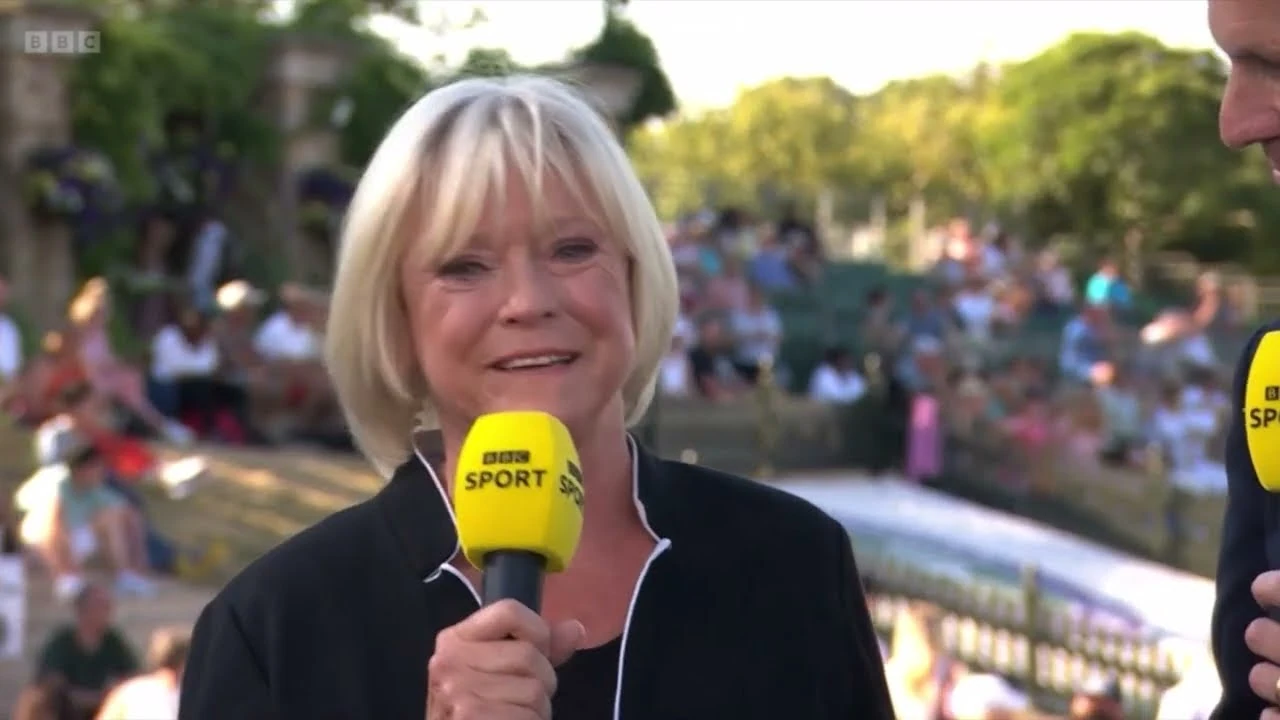
After retiring, Barker worked as a commentator and sports reporter for Australia’s Channel 7 in 1985, then presented tennis coverage for British Sky Broadcasting from 1990 to 1993. She joined the BBC in 1993 and began presenting Wimbledon coverage the following year. From 2000 until 2022, she anchored the broadcaster’s coverage of the championship. Her role placed a former competitor at the centre of one of British television’s most established sporting events, drawing on her knowledge of the game and her experience of its pressures.
Her BBC work extended well beyond tennis. Barker presented Grandstand and hosted A Question of Sport from 1997. She also presented BBC coverage of the Olympic and Commonwealth Games, athletics and horse racing, among other events. She hosted the BBC Sports Personality of the Year ceremony from 1994 to 2012. These programmes required her to move between sports with different audiences and rhythms, making her a prominent general sports presenter as well as a familiar face at Wimbledon.
In September 2020, the BBC announced that Barker would leave A Question of Sport after 24 years. Her final episode had been recorded that month. Barker later said she had been dismissed rather than choosing to leave, and criticised how the decision was handled. She accepted the BBC’s choice to refresh the programme while describing the experience as insulting and saying she felt damaged by it. In June 2022, she announced that she would step down from Wimbledon coverage after that year’s finals, concluding a role she had held since 1993 as a presenter and anchor.
Recognition and a long public presence
Barker received three appointments in the Order of the British Empire. She was made an MBE in 2000 for services to sport and broadcasting, an OBE in 2016 for services to broadcasting and charity, and a CBE in 2021 for services to broadcasting and charity. The honours mark different stages in a career that crossed professional sport, live-event presentation and long-running television programmes.
Her autobiography, Calling the Shots, was published in September 2022. It followed decades in which Barker’s work took her from international tennis tournaments to the BBC’s coverage of Wimbledon and major sporting events. That breadth matters: her broadcasting career was not confined to commenting on the sport in which she had competed. It made her a regular guide to a wide range of events for viewers at home.
Why Sue Barker deserves a place in British Legacy
Barker’s place in British sporting history begins with an achievement earned on court. Her 1976 French Open victory made her a major singles champion at 20, and her wider record included 15 singles titles, 12 doubles titles and wins over some of the leading players of her era. Her career also included a testing recovery after injury and the disappointment of the 1977 Wimbledon semi-final. Together, those results give a fuller account than a single triumph: they show a player who competed at the highest level over a sustained period and returned to form after a serious setback.
Her second career extended that contribution to audiences who encountered sport through television. At the BBC, Barker presented Wimbledon for nearly three decades and fronted coverage of Olympic and Commonwealth Games, athletics, racing and other events. On A Question of Sport, she spent 24 years connecting a quiz format with the people and stories of sport. The transition from player to presenter gave her work an unusual continuity: she could bring the perspective of a competitor to the broadcast without limiting herself to tennis. That combination of achievement on court and service to British sports broadcasting is the specific legacy her career leaves behind.
Sources
Adapted in part from Sue Barker by Wikipedia contributors, under CC BY-SA 4.0. Text has been edited and combined with the existing article; this adapted text is shared under the same licence. Contributor history.