
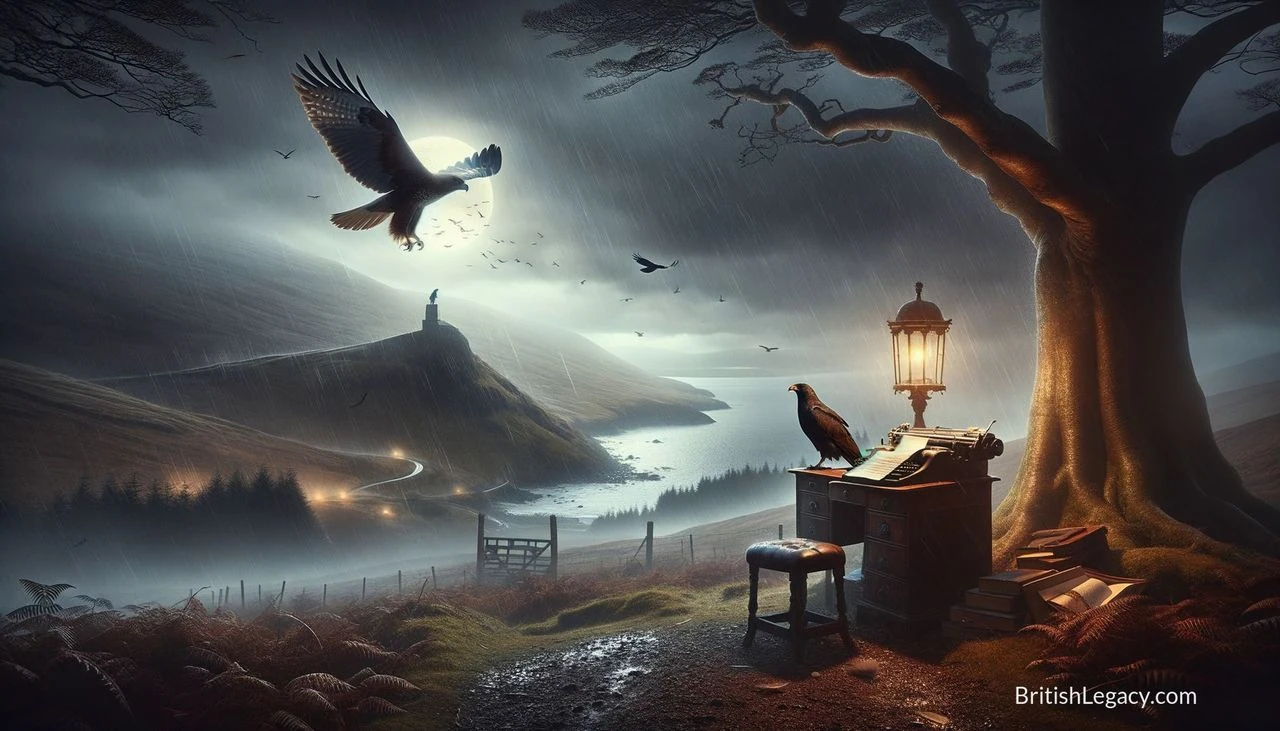
Ted Hughes’s poems made the natural world more than scenery. Animals, weather and landscape became powers in their own right: beautiful, violent and resistant to human control. From the acclaimed first collection The Hawk in the Rain to the strange mythology of Crow, Hughes forged a poetry whose force came partly from its attention to the places and speech of his Yorkshire childhood. He served as Poet Laureate from 1984 until his death in 1998, while also writing for children, translating poetry and supporting opportunities for writers.
Yorkshire beginnings and a poet’s education
Edward James Hughes was born on 17 August 1930 in Mytholmroyd, Yorkshire. He grew up among the farms of the Calder Valley and the Pennine moors, first attending Burnley Road School and later schools in Mexborough after his family moved there. Animals and rural work were not distant subjects: Hughes remembered observing wildlife and the hard conditions of farming. His knowledge of local places and the West Riding dialect would remain audible in his poetry.
At Mexborough Secondary School, teachers encouraged his writing and introduced him to poets including Gerard Manley Hopkins and T. S. Eliot. Hughes had begun publishing poems in the school magazine by 1946. He won an exhibition to study English at Pembroke College, Cambridge, but completed national service first, serving as a ground wireless mechanic in the RAF from 1949 to 1951. At Cambridge he initially read English, then transferred to anthropology and archaeology. After graduating, he held a succession of jobs, including work as a nightwatchman, rose gardener and reader for the film company J. Arthur Rank.
His first collection, The Hawk in the Rain, appeared in 1957 and brought him wide critical attention. It won the Somerset Maugham Award. The poems’ compressed, forceful language and close attention to animal life established a distinctive direction, though Hughes resisted being confined to the label of nature poet. Lupercal, published in 1960, won the Hawthornden Prize; later collections would range from the animal poems of Wodwo to the mythic and unsettling world of Crow.
From Crow to the Poet Laureate’s work
Crow: From the Life and the Songs of the Crow appeared in 1970. Its central figure moves through a bleak, surreal creation-story, bringing together myth, violence and dark humour. The book became one of Hughes’s best-known works, but its abrasive view of the universe divided readers as well as attracting admiration. Hughes returned to the sequence over several years, and collaborated with the artist Leonard Baskin, who illustrated many of his books.
Hughes’s interests extended well beyond animal poetry. He wrote plays, essays, translations and books for children. The Iron Man, published in 1968, became one of his most successful children’s books and was later adapted for stage and screen. In 1965 he co-founded the journal Modern Poetry in Translation with Daniel Weissbort, helping bring poets from countries including Poland and Hungary to English-language readers. He also worked with the National Theatre Company and director Peter Brook.
Appointed Poet Laureate in December 1984, Hughes held the office until his death. His Laureate poems were gathered in Rain-charm for the Duchy (1992), which included writing for royal occasions. His later books included Tales from Ovid (1997), a collection of free-verse translations, and Birthday Letters (1998). In the latter, he addressed his life with the poet Sylvia Plath, whom he had married in 1956. Their marriage ended in separation in 1962; Plath died the following year. Hughes’s handling of her literary estate, including his editorial choices for the posthumous collection Ariel, became a source of sustained public criticism. The history around their work is part of Hughes’s literary reception, but it does not erase the reach or variety of his own writing.
Writing, teaching and care for rivers
Hughes’s work for young readers was matched by practical support for writing education. He dedicated himself to the Arvon Foundation, which runs residential writing courses, including at Lumb Bank in West Yorkshire. He also helped establish the Rainbow Press with his sister Olwyn; between 1971 and 1981 it published sixteen titles, including work by Hughes, Plath, Ruth Fainlight, Thom Gunn and Seamus Heaney.
His concern for the living landscape also found a direct outlet in conservation. In 1994, worried by declining fish numbers in rivers near his Devon home, he became involved with the Westcountry Rivers Trust and was one of its founding trustees. The trust sought to restore rivers through catchment-scale management and work with local landowners. The commitment connects closely with the attention to place in his writing, while remaining a distinct part of his public life.
Hughes continued to live in Devon. He died in London on 28 October 1998, aged 68, while receiving treatment for colon cancer. Queen Elizabeth II had appointed him to the Order of Merit shortly before his death. His posthumous reputation has been sustained through the study of his writing and through memorials and literary activity in places associated with his life, including the Ted Hughes Festival in Mytholmroyd and the poetry trail at Stover Country Park in Devon.
Why Ted Hughes deserves a place in British Legacy
Hughes belongs in British Legacy not simply because he held the national office of Poet Laureate, but because his writing made regional experience central to a major poetic career. The farms, moors and dialect of Yorkshire were not decorative background: they helped shape the language and the subjects of his poems. In The Hawk in the Rain, the animal world is vivid and unsentimental; in Crow, Hughes reworks myth into a troubling account of creation and survival. The contrast between those books shows the breadth of a writer who could draw on close observation and imaginative invention without making nature merely comforting or picturesque.
His contribution also travelled through institutions and practical work. Through Modern Poetry in Translation, Hughes helped widen English-language access to poetry from elsewhere in Europe. His writing for children reached readers beyond the audience for his adult collections, while his commitment to the Arvon Foundation supported residential opportunities for writers. As a founding trustee of the Westcountry Rivers Trust, he applied his concern for the natural world to the restoration of rivers. Taken together, these achievements give his legacy several distinct dimensions: an influential body of poetry, work that opened doors for other writers and a documented contribution to conservation. His British connection rests in the particular landscapes, institutions and literary traditions with which he engaged, not in a general claim about national character.
Sources
Ted Hughes — Wikipedia, revision 1378907745
Adapted in part from Ted Hughes by Wikipedia contributors, under CC BY-SA 4.0. Text has been edited and combined with the existing article; this adapted text is shared under the same licence. Contributor history.
.jpg)