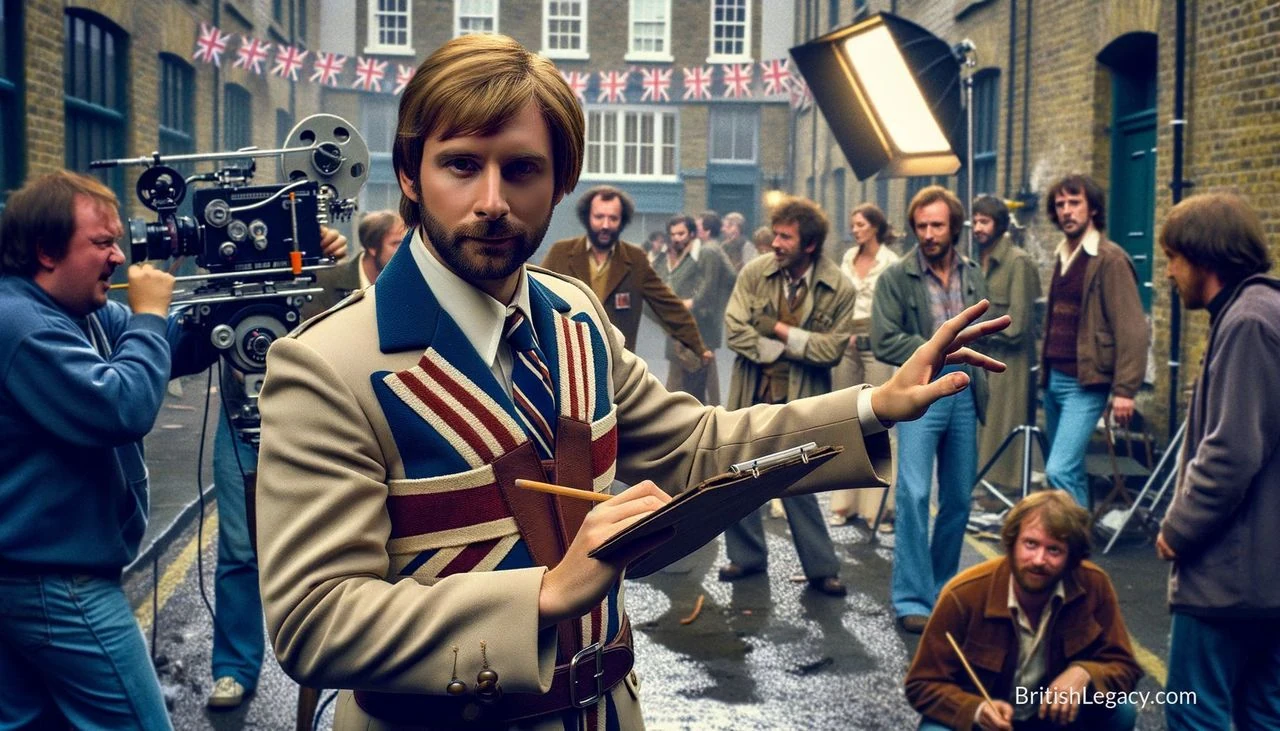
Terry Jones helped give Monty Python its distinctive shape. As a performer, he was memorable as a sharp-tongued older woman; as a writer and director, he helped make comedy that could abandon the punchline, break the expected flow and leave an absurd idea hanging in the air. His work ranged from the BBC’s Monty Python’s Flying Circus to films including Monty Python and the Holy Grail, Life of Brian and The Meaning of Life. Beyond the troupe, he wrote for children, made television programmes about history and pursued an independent career as a writer, director and presenter.
From Colwyn Bay to Oxford
Born Terence Graham Parry Jones in Colwyn Bay, Wales, on 1 February 1942, he moved with his family to Claygate in Surrey when he was four and a half. He attended Esher Church of England primary school and the Royal Grammar School in Guildford, where he became school captain in the 1960–61 academic year. At St Edmund Hall, Oxford, he read English, graduated with a 2:1 and developed an interest in medieval history through studying Chaucer.
Oxford also brought him into comedy. Jones performed in the Oxford Revue with Michael Palin, a year behind him at the university. Their shared interest in character-based humour became an important creative partnership. After graduating, the pair worked on British television programmes including The Frost Report, Do Not Adjust Your Set and Twice a Fortnight. Jones also wrote for other David Frost programmes and appeared in The Complete and Utter History of Britain.
Making Monty Python flow differently
In 1969, Jones joined Palin, Graham Chapman, John Cleese, Eric Idle and Terry Gilliam to create Monty Python’s Flying Circus. The six performers brought together different comic instincts, but Jones’s contribution went beyond playing characters. He was largely responsible for the show’s unusual structure: sketches could run into one another without a conventional punchline to announce their end. That looseness made room for surreal turns and unexpected shifts in tone.
On screen, his performances as middle-aged women became some of his best-known roles. The Python sketches used such characters for more than disguise: Jones’s forceful, often impatient presence could carry a scene as readily as its verbal absurdity. He and Palin continued their collaboration with Ripping Yarns, an anthology series they created and wrote together, and also wrote the play Underwood’s Finest Hour.
Jones’s work moved from television to film. He co-directed Monty Python and the Holy Grail with Gilliam, making his feature directorial debut. He then directed Monty Python’s Life of Brian and Monty Python’s The Meaning of Life. In the first, Brian Cohen is mistaken for the Messiah; in the second, a linked sequence of sketches examines stages of human life. The films carried Python’s comic invention into a larger cinematic form, with Jones’s direction using visual comedy and surreal detail alongside the writing.
The Meaning of Life received the Grand Jury Prize at the 1983 Cannes Film Festival. Jones’s directorial work was not confined to Python: his later films included Personal Services, Erik the Viking and The Wind in the Willows. He also wrote the screenplay for Labyrinth, although the draft went through several rewrites before the film was made.
History, books and other projects
Jones’s interest in the Middle Ages grew from his Oxford studies. His first book, Chaucer’s Knight: The Portrait of a Medieval Mercenary (1980), offered a deliberately revisionist reading of Chaucer’s knight, questioning the familiar image of a model of Christian virtue. In his account, the historical record of the knight’s campaigns suggested a more troubling figure. Jones returned to Chaucer in Who Murdered Chaucer?, co-written with others and published in 2003.
He carried his appetite for challenging received accounts into television. In Terry Jones’s Medieval Lives (2004), he argued against the assumption that the Middle Ages were simply backward; Terry Jones’s Barbarians (2006) presented the cultural achievements of peoples conquered by Rome and questioned Roman accounts of their history. His documentaries, alongside books on medieval and ancient history, made historical argument part of his public work as a comedian and broadcaster.
Jones was also a prolific writer for younger readers. His books included The Saga of Erik the Viking, which won the Children’s Book Award in 1984, and Nicobobinus. His comic writing extended to Blazing Dragons, an animated series he co-created with Gavin Scott that turned Arthurian convention on its head. The range was characteristic: he moved between historical interpretation, children’s fiction, screenwriting and comedy without treating any one of them as a side pursuit.
Other work included a 1977 microbrewery, Penrhos Brewery, which Jones co-founded in Herefordshire with Peter Austin and Richard Boston. He wrote newspaper columns, including criticism of the Iraq War, and later supported Unbound, the crowdfunding publisher, as it developed its approach to publishing books. He wrote and directed the musical play Evil Machines, which premiered in Lisbon in 2008, and in 2011 was commissioned to write and direct the libretto for The Doctor’s Tale.
Recognition, illness and final years
Jones received a Lifetime Achievement award at the BAFTA Cymru Awards in 2016 for his contribution to television and film. In 2014, he reunited with the other living Pythons for ten performances at London’s O2 Arena. The shows brought the group back together on stage, but would be his last performance with them.
Diagnosed with colon cancer in 2006, Jones underwent surgery and chemotherapy and was later declared free of the disease. In 2015, he was diagnosed with primary progressive aphasia, a form of frontotemporal dementia that affects speech and communication. As his ability to speak diminished, he became a campaigner for dementia awareness and a fundraiser for research; he also donated his brain for dementia research.
Jones died at home in Highgate, London, on 21 January 2020, aged 77, from complications of dementia. His life joined a Welsh upbringing and British television career to work that travelled across comedy, film, books and historical broadcasting. The breadth matters: he was not simply one of the faces in a famous troupe, but a writer and director whose ideas helped determine how that troupe’s comedy worked.
Why Terry Jones deserves a place in British Legacy
Terry Jones deserves a place in British Legacy because his contribution to British comedy was both visible and structural. Audiences remember the characters he played, but his influence also lies in the way Monty Python’s Flying Circus moved between sketches without relying on tidy punchlines. That approach widened the possibilities of television comedy. His work with Michael Palin before and after Python, and his direction of Holy Grail, Life of Brian and The Meaning of Life, show how he carried ideas across writing, performance and film-making rather than staying within a single role.
His historical work adds another dimension to that legacy. Through books and television programmes such as Medieval Lives and Barbarians, Jones questioned familiar stories about the past and brought those arguments to viewers beyond academic readership. His books for children, including the award-winning The Saga of Erik the Viking, extended that imaginative work to a younger audience. These achievements connect him to British cultural life not through a general claim of national character, but through specific institutions and forms: Oxford comedy, BBC television, British film and publishing, and BAFTA Cymru recognition. His career shows how comic invention can coexist with historical curiosity and serious public engagement.
Sources
Terry Jones — Wikipedia, revision 1377641005 · Terry Jones — Wikipedia
Adapted in part from Terry Jones by Wikipedia contributors, under CC BY-SA 4.0. Text has been edited and combined with the existing article; this adapted text is shared under the same licence. Contributor history.