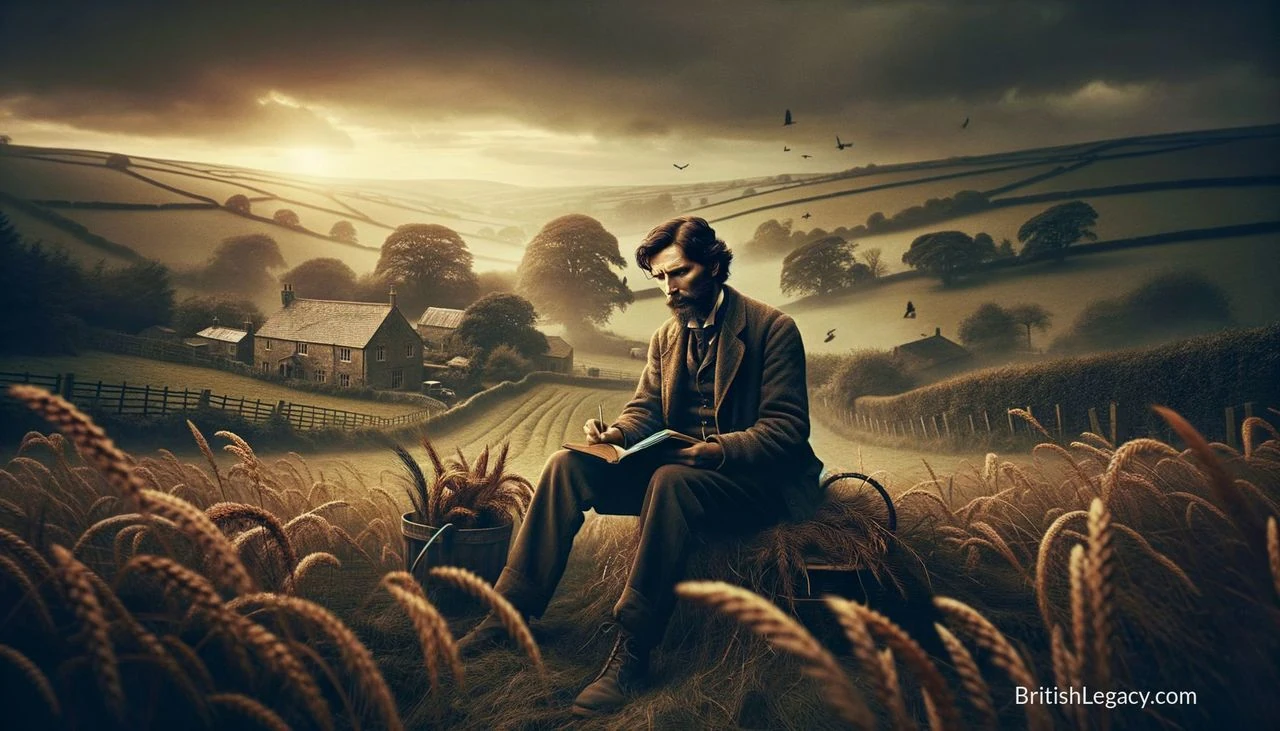
Thomas Hardy’s Wessex is at once a recognisable landscape and an imaginative one: a region shaped from the south-west of England, where the weather, work and social rules of rural life press upon people’s choices. Hardy knew the countryside he wrote about from childhood, but his work is no simple celebration of country life. In novels such as Far from the Madding Crowd, Tess of the d’Urbervilles and Jude the Obscure, private hopes meet class divisions, moral convention and chance. He built his reputation as a novelist, then spent the later part of his writing life publishing poetry.
A Dorset childhood, then an architectural apprenticeship
Hardy was born on 2 June 1840 in Higher Bockhampton, a hamlet in the parish of Stinsford, east of Dorchester. His father, Thomas, was a stonemason and local builder; his mother, Jemima, was well read and taught him before he went to school. Hardy attended a school at Bockhampton and later Mr Last’s Academy for Young Gentlemen in Dorchester, where he learnt Latin. His family could not afford a university education. At 16, he began an architectural apprenticeship with the local architect James Hicks.
In 1862 Hardy moved to London and studied at King’s College London. He won prizes from the Royal Institute of British Architects and the Architectural Association, and worked as an assistant architect in Arthur Blomfield’s practice. His work included churches in London and Windsor. The city also made him acutely aware of class divisions and his own sense of social inferiority. After five years, concerned about his health, he returned to Dorset and decided to devote himself to writing.
His early novels did not all find an easy route into print. Hardy completed The Poor Man and the Lady, but did not publish it; after advice from his friend and mentor George Meredith, he destroyed the manuscript. He subsequently wrote Desperate Remedies and Under the Greenwood Tree, both published anonymously. A Pair of Blue Eyes, published in 1873, appeared under his own name. Its serialised episodes include a character literally left hanging from a cliff, a scene associated with the origin of the term “cliffhanger”.
Making a fictional country out of the West
Far from the Madding Crowd, published in 1874, brought Hardy success and helped him leave architectural work for a literary career. It also introduced Wessex as the name for the region in which he set his fiction. The name recalled an early Saxon kingdom; Hardy’s imagined territory grew to encompass parts of Dorset, Wiltshire, Somerset, Devon, Hampshire and Berkshire. The places in the novels are fictionalised, but their geography draws on a particular part of England and its communities.
Hardy’s later novels extended that world and its concerns. The Return of the Native appeared in 1878, followed by The Mayor of Casterbridge in 1886 and The Woodlanders in 1887. In Tess of the d’Urbervilles (1891), Tess’s life exposes the unequal moral expectations imposed on women. Hardy’s subtitle, A Pure Woman Faithfully Presented, challenged the conventions of the time; the novel’s sympathetic treatment of its heroine attracted criticism, and publication was initially refused. Jude the Obscure (1895), his last novel, provoked a stronger hostile response for its treatment of sex, religion and marriage.
These books are not merely records of rural custom. Hardy places characters under pressure from social rules, economic circumstance and events they cannot control. In Far from the Madding Crowd, Bathsheba Everdene’s decisions and the accidents around her shape the course of the story; in Two on a Tower, a relationship crosses class boundaries. Chance repeatedly turns a journey, an encounter or a choice into a turning point. The countryside is not a reliably comforting backdrop: its seasons and physical beauty exist alongside human suffering and the indifferent workings of nature.
From novels to poems
Hardy wrote poetry throughout his life, although his first collection, Wessex Poems, did not appear until 1898. Poems of the Past and the Present followed in 1901. After his last novel, he published poetry rather than another novel. His verse moves through different forms, including lyrics, ballads, dramatic monologues and dialogue; it also includes The Dynasts, an ambitious verse drama about the Napoleonic Wars.
Time, memory, disappointment and mortality recur in the poems, as do irony and the caprice of fate. Hardy wrote about war from the perspective of ordinary soldiers in poems including “Drummer Hodge” and “The Man He Killed”. After his first wife, Emma, died in 1912, he wrote the poems later collected in Satires of Circumstance (1914), including the group known as Poems 1912–13. The work looks back on their courtship and his remorse. His writing also reflects an enduring attachment to rural church ritual, alongside questioning of conventional Christian belief.
Life, conservation and remembrance
Hardy met Emma Gifford in 1870 while working on the restoration of St Juliot’s church in Cornwall. They married in 1874. In 1885 they moved to Max Gate, a house outside Dorchester that Hardy designed and his brother built. Emma died in 1912; in 1914 Hardy married his secretary, Florence Emily Dugdale.
His interests extended beyond literature and architecture. From the 1880s, he campaigned against the destruction or insensitive modernisation of historic buildings and became an early member of the Society for the Protection of Ancient Buildings. His letters record unsuccessful efforts to prevent major alterations to Puddletown parish church and advice on the sensitive restoration of Athelhampton House. In 1914, he was among 53 British authors who signed the “Authors’ Declaration”, supporting Britain’s entry into the First World War. His private reflections on the war also express horror at its destruction.
Hardy died at Max Gate on 11 January 1928, aged 87. He had wished to be buried at Stinsford with Emma, but his funeral took place at Westminster Abbey. A compromise placed his heart at Stinsford and his ashes in Poets’ Corner. His birthplace at Bockhampton and Max Gate are both owned by the National Trust. The landscape that informed his fiction remains closely associated with his name, while the fictional Wessex gives readers a way into the real places and social changes behind the stories.
Why Thomas Hardy deserves a place in British Legacy
Hardy deserves a place in British Legacy because his writing made the lives and pressures of rural south-west England central to a body of work read far beyond the region. Wessex was not a claim that countryside life was timeless or idyllic. It was a literary map through which he could examine the effects of class, gender expectations, religion and economic change on individual lives. His novels brought those conflicts into view through particular people: Tess, whose treatment exposes a double standard, and Bathsheba, whose independence is tested by love and social expectation. Their stories remain distinctive because Hardy connects personal decisions to the rules and circumstances that constrain them.
His legacy also crosses the boundary between novelist and poet. After establishing himself through fiction, Hardy continued to write in verse, exploring memory, war, mortality and the uncertainties that also shape his novels. His commitment to protecting historic buildings adds a practical dimension to that legacy: he worked to preserve the material traces of the past as well as describing a changing rural world. The continued association of his birthplace and home with the National Trust, and of Dorset with Wessex, gives readers a tangible route into the places that informed his imagination. Together, his books, poems and conservation work make Hardy’s contribution to British literature and the preservation of its historic landscape specific and enduring.
Sources
Thomas Hardy — Wikipedia revision
Adapted in part from Thomas Hardy by Wikipedia contributors, under CC BY-SA 4.0. Text has been edited and combined with the existing article; this adapted text is shared under the same licence. Contributor history.