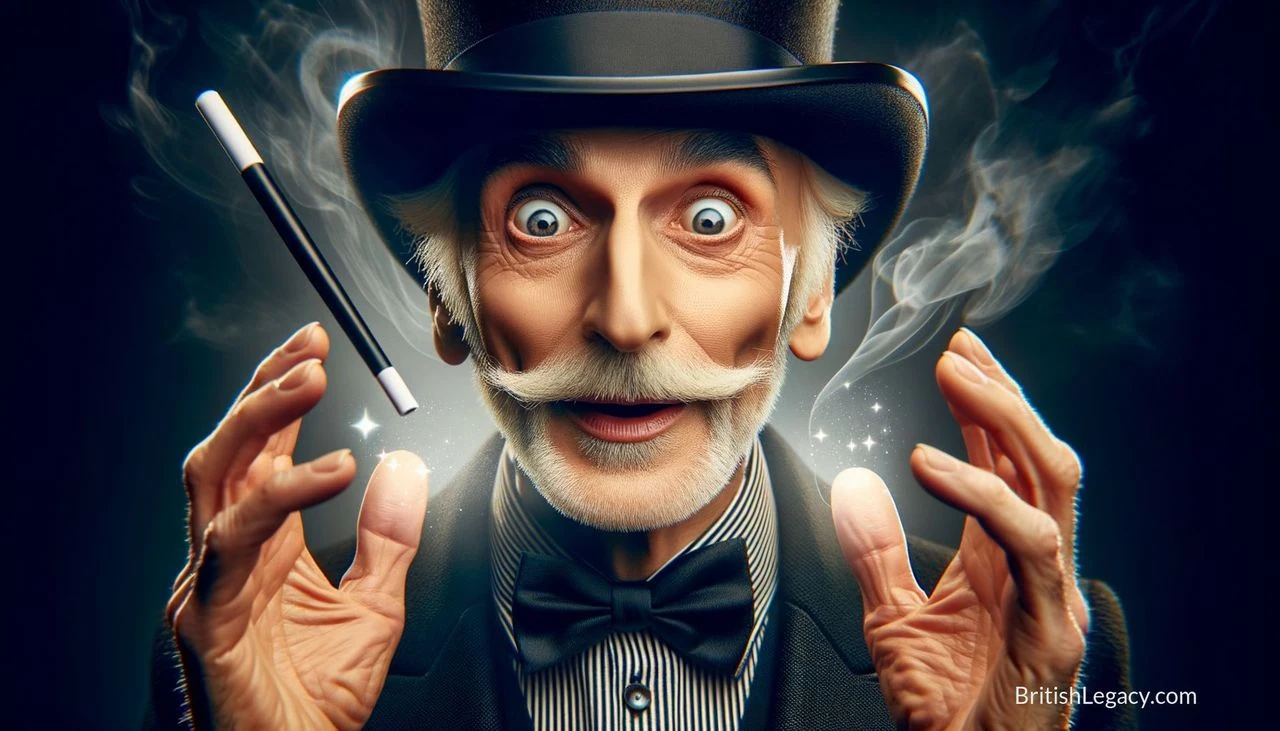
Tommy Cooper made the apparent failure of a magic trick part of the trick. Tall, broad and wearing a red fez, he stood before audiences as a conjurer whose props seemed to betray him. The laughs came from the collapse of magical expectation; an occasional successful illusion kept the audience guessing. His catchphrase, “Just like that!”, became inseparable from an act that joined physical comedy to carefully developed performance.
From Caerphilly to the Army
Thomas Frederick Cooper was born in Caerphilly, Glamorgan, on 19 March 1921. His father, Thomas, was Welsh; his mother, Catherine Gertrude Wright, came from Devon. When Cooper was three, the family moved to Exeter, where his father had found a new job after working as a miner. Cooper later described himself as Welsh, while acknowledging his mother’s Devon origins and his early departure from Caerphilly.
An aunt gave him a magic set when he was eight, and he spent hours practising the tricks. After leaving school, he became a shipwright in Southampton. In 1940 he was called up to serve in the Royal Horse Guards. His seven years in the Army included service in Egypt with Montgomery’s Desert Rats. He joined an entertainment party run by the Navy, Army and Air Force Institutes, developing a routine that combined conjuring with comedy.
The fez arrived during a sketch in Cairo. Cooper was meant to wear a pith helmet but had forgotten the prop; he borrowed a fez from a passing waiter instead. The audience’s response persuaded him to keep wearing one on stage. This origin is more particular than the familiar shorthand that the fez simply appeared during his wartime service: it was a comic accident within an organised entertainment performance.
Building an act from apparent mishaps
Cooper was demobilised after seven years and entered show business on Christmas Eve 1947. He later drew on his military service for a popular monologue as “Cooper the Trooper”. Variety theatres around the country and London night spots became his working circuit. At times, he performed as many as 52 shows in a week.
He continued to develop his conjuring and became a member of The Magic Circle. Accounts of how he began presenting tricks as failures differ: one places the discovery among his shipbuilding colleagues, another during his Army service, and another at a post-war audition. What matters to the shape of the act is that the apparent mishap became a comic device. Cooper could wrong-foot an audience by allowing a trick to fail, then occasionally letting one work when it was least expected.
His height—6 feet 4 inches—gave the performance a physical scale, but the comedy depended on more than his imposing appearance or fez. A prop’s failure, a pause and the certainty with which he announced “Just like that!” turned conjuring into a sequence of surprises. The audience was invited to recognise the failure and enjoy the mismatch between the magician’s confidence and the result.
Variety performer and television star
Cooper’s television debut came on the BBC talent programme New to You in March 1948. He went on to appear in his own programmes and remained popular for nearly four decades. His work with London Weekend Television from 1968 to 1972 and Thames Television from 1973 to 1980 helped carry his act from the variety circuit to a national audience. By the mid-1970s, television had made him one of the world’s most recognisable comedians.
His career also had difficult stretches. By the mid-1970s, heavy drinking was affecting his work; club owners complained that he arrived late or rushed through performances. He experienced a range of health problems, including chronic indigestion, back pain, sciatica, bronchitis and circulation problems in his legs. After recognising the extent of his ill health, he cut down on drinking and his act regained energy, although he did not stop drinking altogether.
Cooper suffered a heart attack while performing in Rome on 22 April 1977 and returned to television three months later. By 1980, Thames Television would not commission another starring series, and Cooper’s Half Hour was his last. He continued to appear as a guest on entertainment programmes, including two Thames productions with Eric Sykes in 1982. The change from leading his own series to guest appearances marks a less triumphant but important part of his working life.
A final live performance and a continuing presence
On 15 April 1984, Cooper collapsed during Live from Her Majesty’s, a London Weekend Television variety programme transmitted live from Her Majesty’s Theatre in Westminster. Twelve million viewers were watching. His fall was initially taken by the audience as part of the act, but those backstage realised he had suffered a heart attack. He was taken to Westminster Hospital and pronounced dead, aged 63.
His death was reported the following morning. His funeral took place at Mortlake Crematorium in London; his son scattered his ashes in the garden over Cooper’s favourite daffodils. The end of a live performance became part of the public story of his career, but it should not obscure the decades of work that preceded it: the Army entertainment party, the variety circuit and the television programmes that made his comic method familiar.
Cooper’s afterlife has included performances, broadcasts and public memorials. A statue was unveiled in Caerphilly in 2008 by Anthony Hopkins, patron of the Tommy Cooper Society. In 2016, a blue plaque was unveiled at Cooper’s former home in Chiswick, and the Victoria and Albert Museum acquired 116 boxes of his papers and props, including his joke file. The file’s alphabetical organisation offered a glimpse of the practical work behind an act that could look effortlessly chaotic.
His work has also been revisited through stage tributes and television. A drama about Cooper’s life, Tommy Cooper: Not Like That, Like This, starring David Threlfall, was broadcast by ITV in 2014. In 2021, BBC One marked the centenary of his birth with Tommy Cooper at the BBC, presented by Lenny Henry. These memorials take different forms, from an archive of working papers to a statue and renewed performances, but all keep attention on the comic craft itself.
Why Tommy Cooper deserves a place in British Legacy
Cooper’s place in British Legacy rests on a distinctive contribution to popular entertainment: he made the mechanics of conjuring, and the possibility of its failure, the material of comedy. His act was not simply a collection of bungled tricks. He trained as a magician, belonged to The Magic Circle and could use a successful illusion to make the apparent disasters less predictable. That mixture of skill and feigned ineptitude gave audiences a recognisable comic language, anchored by the fez and “Just like that!”
His career also records the reach of British performance across changing venues and media. Cooper moved from Army entertainment and a demanding variety circuit to BBC television, then to prominent work with London Weekend Television and Thames Television. His performances reached millions at his peak; his final collapse, witnessed by a live audience, remains a stark part of television history. In Caerphilly, the statue connects his fame to his birthplace; in Chiswick, the blue plaque marks a later home; and the V&A’s collection preserves papers and props that illuminate the labour behind the act. Together, these details show why his legacy is more than a catchphrase: it is a sustained, particular achievement in British comedy, remembered through both performance and material record.
Sources
Tommy Cooper — Wikipedia revision 1379639230 · Tommy Cooper — Wikipedia
Adapted in part from Tommy Cooper by Wikipedia contributors, under CC BY-SA 4.0. Text has been edited and combined with the existing article; this adapted text is shared under the same licence. Contributor history.