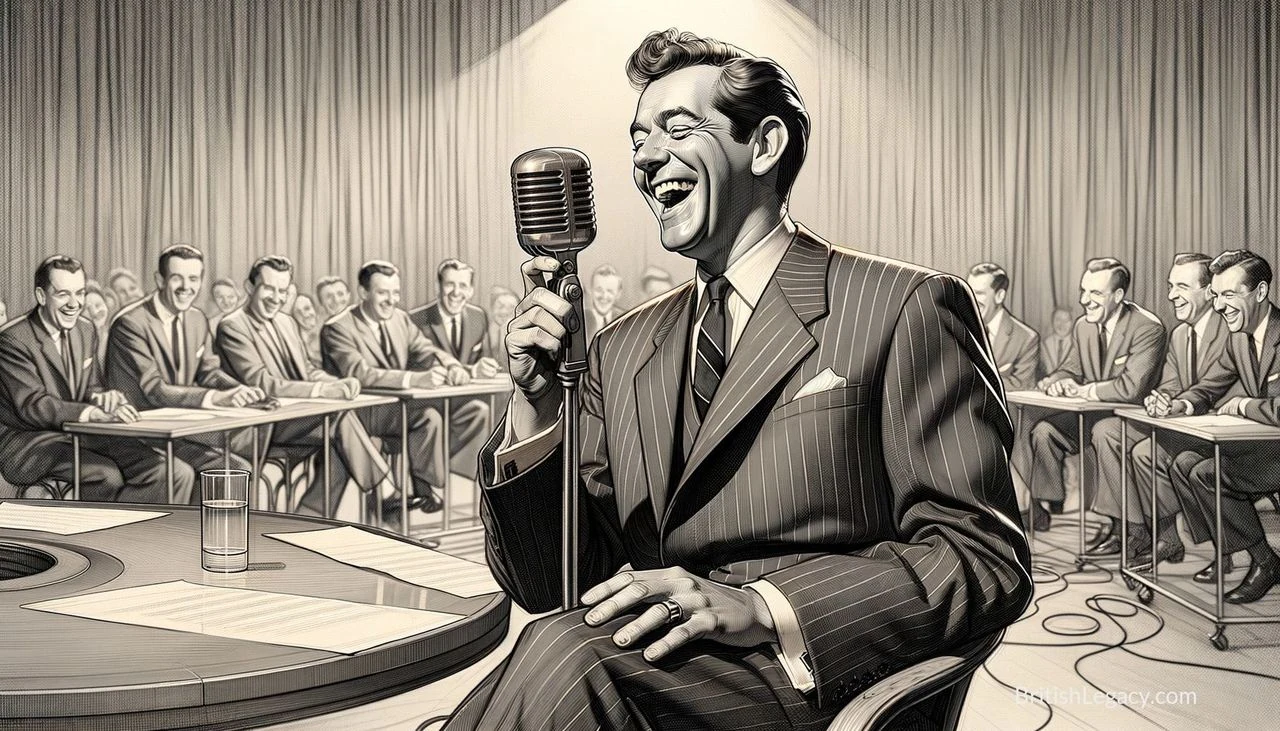
Tony Hancock made comedy out of a man who was sure he deserved better. As Anthony Aloysius St John Hancock, he played a struggling performer in a shabby East Cheam home, nursing ambitions that his circumstances and shortcomings repeatedly undid. The character’s grandiosity was never quite separable from his vulnerability: the joke depended on both. In Hancock’s Half Hour, that everyday predicament displaced the variety-show conventions that had dominated radio comedy and helped establish situation comedy as a form built around character, place and recurring relationships.
From Hall Green to the music hall
Hancock was born on 12 May 1924 in Hall Green, Birmingham, the second of three sons of Jack and Lily Hancock. In 1927, his father moved the family to Bournemouth in an effort to improve his health. The family ran businesses there, including a laundry and, later, the Durlston Court Hotel. After his father died in 1934, Hancock lived with his brothers, mother and stepfather. He boarded at Durlston Court School and attended several schools before leaving Bradfield College at 15.
His first stage appearances came in Bournemouth. In 1940, he performed at the Church of the Sacred Heart and made a professional appearance at the Labour Halls, now the Avon Social Club. During the war he was attached to a Royal Canadian Air Force photographic interpretation unit, then joined the RAF Regiment in 1942. After unsuccessful auditions for the Entertainments National Service Association, he entertained troops with the Gang Shows. He continued in Ralph Reader’s touring production of Wings after the war.
Hancock worked in a double act with musician Derek Scott at London’s Windmill Theatre and began appearing on radio, including Workers’ Playtime and Variety Bandbox. His regular role as the tutor in the radio series Educating Archie in 1951–52 brought him national recognition. In 1954, the BBC gave him his own radio series, Hancock’s Half Hour.
The making of Hancock’s Half Hour
Written by Ray Galton and Alan Simpson, Hancock’s Half Hour ran on radio for seven years and more than a hundred episodes. A television version began in 1956, running alongside the radio programme. Its central character lived at “23 Railway Cuttings”, East Cheam, and was usually an unsuccessful comedian with aspirations to be taken seriously as an actor. The plots could also place him in other situations, including as an incompetent barrister.
The series found comedy in recognisable domestic and social circumstances rather than a parade of unrelated turns. In the television version, Sid James became Hancock’s principal foil: more grounded, and often well placed to expose the gap between Hancock’s claims and his actual prospects. The radio cast also included Bill Kerr and Kenneth Williams, with Moira Lister, Andrée Melly and Hattie Jacques appearing in turn. An ITV series, The Tony Hancock Show, ran in 1956–57 during a contractual dispute involving producer Jack Hylton.
Hancock’s popularity grew with the programmes. From autumn 1959, episodes were recorded before transmission rather than performed live, a change attributed to the strain live broadcasts placed on him. In 1961, he made his final BBC series without James, simply titled Hancock. Its best-known episodes include The Blood Donor, with the line, “A pint! That’s very nearly an armful!”, and The Radio Ham, in which his character’s incompetence prevents him from locating a distressed yachtsman.
Ambition, separation and a changing career
Hancock was uneasy that his partnership with James might make them seem like a double act. He chose to end their professional association after the 1961 series. Later that year he also broke with Galton and Simpson. The split followed disagreements about scripts and Hancock’s desire to move away from catchphrases and towards what he considered more realistic comedy. The writers went on to develop Steptoe and Son for the BBC.
In The Rebel (1961), Hancock played an office worker who becomes a successful artist in Paris through mistaken identity. His next notable film, The Punch and Judy Man (1963), cast him as a struggling seaside entertainer who dreams of a better life. The film’s setting drew on memories of his childhood in Bournemouth. He moved to ATV in 1962 and worked with different writers, but the television series that followed received unfavourable comparisons with Steptoe and Son.
His later British television work included the variety programmes The Blackpool Show (1966) and Hancock’s (1967), as well as a 50-minute BBC2 show from the Royal Festival Hall. The last years of his career were increasingly difficult. Alcoholism affected his performances, and after collapsing with acute liver failure in January 1967, he was warned that continued drinking could prove fatal. In 1968 he went to Australia under contract to make a series for the Seven Network. He completed three programmes before his death; they were broadcast later.
Death and remembrance
Hancock died in Sydney on 25 June 1968, aged 44. His death was ruled a suicide. His ashes were brought to England by satirist Willie Rushton and buried at St Dunstan’s Church, Cranford, London. His career included two BAFTA awards for Light Entertainment Artist, in 1958 and 1960. He was also nominated for the BAFTA Award for Most Promising Newcomer to Leading Film Roles for The Rebel.
His life and work have continued to prompt performances, broadcasts and commemorations. A sculpture was erected in Birmingham’s Old Square in 1996, and plaques mark places associated with him in Birmingham, Bournemouth and London, including an English Heritage blue plaque at his former South Kensington home. A 2002 BBC radio-listener poll named him the nation’s favourite comedian. Galton and Simpson linked the appeal of later characters such as Alan Partridge and David Brent to Hancock’s comic self-delusion.
His work has also been revisited directly. BBC productions have dramatised aspects of his life, while The Missing Hancocks brought radio scripts back to listeners with Kevin McNally in the title role. The Tony Hancock Appreciation Society, formed in 1976, continues to bring together admirers and preserve material relating to his career. These acts of remembrance reflect a body of work that remains available not only as biography but as performance: a voice, a character and a comic world that can still be encountered on air and on stage.
Why Tony Hancock deserves a place in British Legacy
Hancock’s place in British Legacy rests first on a specific achievement in broadcasting. With Galton and Simpson, he helped move radio and television comedy away from variety-show structure towards the situation comedy: stories organised around a recurring character, his habits and the people who challenge him. The East Cheam setting and Hancock’s self-important, frequently defeated performer gave the series a distinctive comic engine. Its best-remembered episodes still show how a modest everyday situation can expose a character’s grand ambitions and blind spots.
That approach travelled beyond Hancock’s own performances. His influence is associated with later British comic characters whose confidence exceeds their competence, while the return of his scripts in productions such as The Missing Hancocks keeps the original work in circulation. His story also connects several important strands of British entertainment: post-war variety, BBC radio and television, the development of the sitcom and the continuing work of writers, performers and fan groups in preserving comedy history. The Birmingham sculpture, commemorative plaques and the Appreciation Society give that history public and practical form. Hancock’s legacy is not simply that he made audiences laugh; it is that his sharply observed, flawed character helped provide British comedy with a durable way to make ordinary failure compelling.
Sources
Tony Hancock — revision 1378643610 · Tony Hancock
Adapted in part from Tony Hancock by Wikipedia contributors, under CC BY-SA 4.0. Text has been edited and combined with the existing article; this adapted text is shared under the same licence. Contributor history.