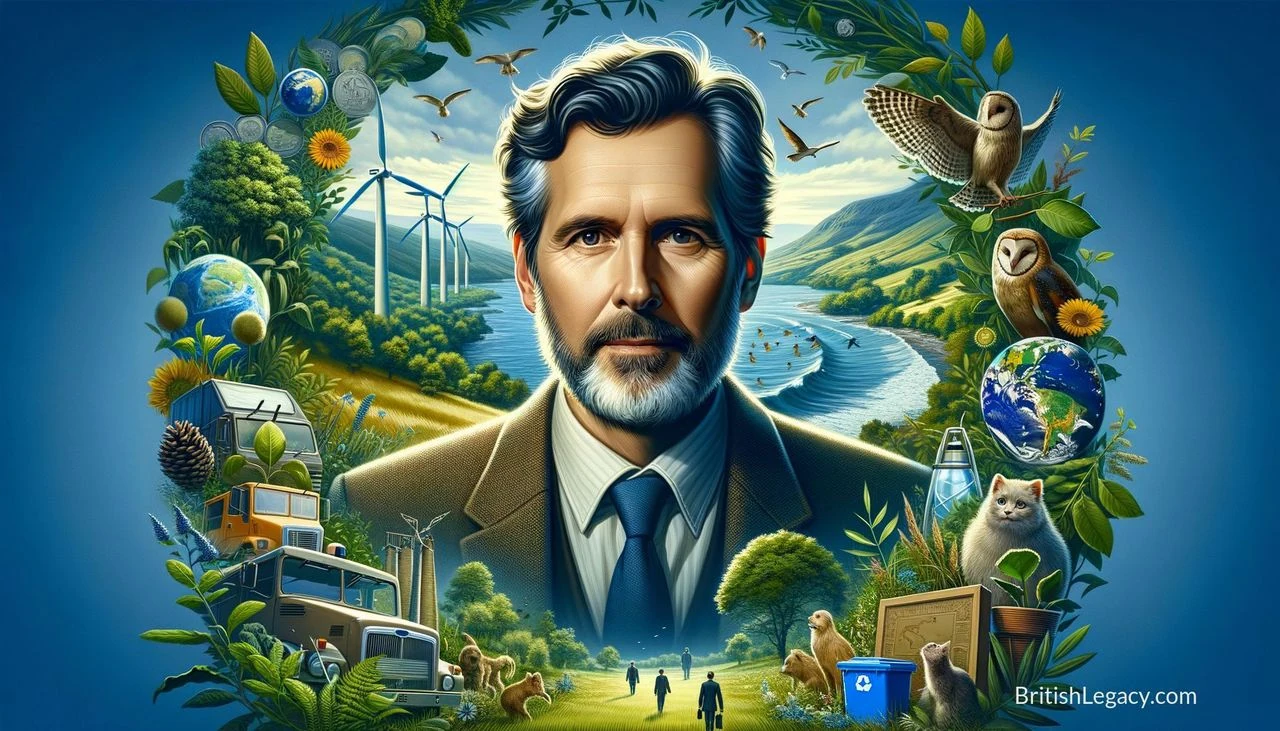
Tony Juniper’s career has connected field conservation, public campaigning, writing and environmental policy. A conservationist with a particular interest in parrots, he joined Friends of the Earth in 1990 and later became its executive director for England, Wales and Northern Ireland. He went on to lead WWF-UK and, from 2019, chair Natural England. Across those roles, his work has ranged from campaigns on forests and climate change to the practical question of how nature can be restored alongside economic and social needs.
From natural history to conservation work
Born in Oxford in 1960, Juniper developed an early interest in natural history. He studied psychology and zoology at the University of Bristol, graduating in 1983, then gained a master’s degree and diploma in nature conservation from University College London in 1988. His early conservation work included a project with the South Oxfordshire Countryside Education Trust and research for Saudi Arabia’s National Commission for Wildlife Conservation and Development.
In 1989 he joined the International Council for Bird Preservation, now BirdLife International, as a parrot conservation officer. He helped launch the Protect the Parrots campaign, which advocated a ban on trade in the birds. In 1990, working with Brazilian ornithologist Carlos Yamashita, he located the last known Spix’s macaw in the wild. Juniper’s work on rare parrots continued in later years: he co-authored a reference book on the world’s parrots and wrote about the effort to save the Spix’s macaw.
Campaigning at Friends of the Earth
Juniper joined Friends of the Earth in 1990 as a senior campaigner, working on tropical rainforests in the UK and internationally. He subsequently took on responsibility for work on biodiversity and forests, then campaigns on transport, genetically modified crops, world trade and industrial pollution. He was campaigns director from 1995 and policy and campaigns director from 1998. He also chaired the LINK legislation group, whose work contributed to the Countryside and Rights of Way Act 2000. The Act established a public right to roam on open country and common land, reformed rights of way and strengthened nature-conservation protections.
From 2003 to 2008, Juniper was executive director of Friends of the Earth in England, Wales and Northern Ireland. During this period, the organisation’s Big Ask campaign pressed for legislation to tackle climate change. Juniper worked on the campaign with Radiohead’s Thom Yorke, and its efforts helped secure the inclusion of a Climate Change Bill in the Queen’s Speech in 2006. The Climate Change Act became law in 2008, establishing carbon budgets and an independent committee to advise on emissions targets. The Act’s original target was later strengthened to net zero by 2050.
His work also extended beyond Friends of the Earth. Juniper advised the Prince of Wales’s International Sustainability Unit and the Prince’s Rainforests Project. He contributed to the 2008 Green New Deal Group report, which proposed tackling financial crisis, climate change and energy insecurity together. He later worked with organisations and businesses on sustainability, and took part in public discussions about the relationship between economic activity and the natural systems on which it depends.
Writing, WWF and public debate
Juniper’s books have brought conservation arguments to readers outside specialist circles. What Has Nature Ever Done for Us? examines the benefits people receive from ecosystems, while Harmony: A New Way of Looking at Our World, written with the then Prince of Wales and Ian Skelly, considers the relationship between human society and the natural world. His other work includes books on rainforests, climate change, biodiversity and the Spix’s macaw. He has also written regularly for newspapers and edited Green magazine.
From 2017 to 2019, Juniper was executive director of WWF-UK, leading its advocacy, policy engagement and campaigning. This included overseeing WWF-UK’s participation in Greener UK during discussions about environmental governance after Brexit. In his public writing and campaigning, he has argued that ecological recovery should be treated as an investment, not simply a cost. He has also drawn attention to the environmental effects of food production, including the pressures that high consumption of animal protein and food waste can place on land.
His interest in conservation has included work with charities and public bodies. He chaired the rainforest charity Cool Earth and served as president of the Royal Society of Wildlife Trusts from 2015 to 2019. In 2009 he became an ambassador for the National Trust’s Wicken Fen Vision, a landscape-scale conservation project in Cambridgeshire. These roles reflect an approach that considers habitats and ecological recovery across landscapes, as well as through individual campaigns or species.
Natural England and the challenge of recovery
Juniper took up the chairmanship of Natural England in April 2019, after being proposed for the role by the Environment Secretary. Natural England is the government’s statutory adviser on the natural environment in England. The appointment required him to give up political activity and his interests in the Robertsbridge Group; he also left the Green Party and stepped down from WWF-UK. He was reappointed in 2021 and again in 2025, with his third term scheduled to run to April 2027.
During his chairmanship, Natural England has overseen the introduction of biodiversity net gain, landscape-scale nature-recovery projects and the King’s Series of national nature reserves. Juniper has supported the ecological case for restoring predators such as the lynx and has argued that nature recovery and development need not be opposing goals. He has also publicly challenged claims that nature is simply an obstacle to development, while scrutiny has focused on the tensions involved when a conservation agency administers developer-funded restoration. The role brings such competing demands into view: the work of protecting wildlife takes place amid decisions about land, infrastructure, public resources and economic growth.
Why Tony Juniper deserves a place in British Legacy
Tony Juniper’s British legacy rests on the range of routes through which he has pursued conservation. At Friends of the Earth, he helped lead campaigns that connected public pressure with legislation, including the work that contributed to the Climate Change Act 2008. His earlier work on the Countryside and Rights of Way Act linked environmental protection with public access to the countryside. These are concrete examples of campaigning and policy-making meeting in the institutions that shape how people live and how land is used.
His contribution also reaches beyond domestic policy. Juniper’s work on parrots, including the Spix’s macaw, brought attention to the conservation of threatened species; his writing has explained why ecosystems matter to human life as well as to wildlife. As chair of Natural England, he has worked within a public body responsible for advising on England’s natural environment at a time when nature recovery must be weighed against development and other demands. That work does not resolve every conflict, but it gives conservation a continuing place in national decision-making. Juniper’s career shows how British environmental influence can be built through research, campaigning, public communication and service in institutions, with benefits measured in stronger protections, broader understanding and sustained attention to biodiversity.
Sources
Tony Juniper — Wikipedia revision 1375855307
Adapted in part from Tony Juniper by Wikipedia contributors, under CC BY-SA 4.0. Text has been edited and combined with the existing article; this adapted text is shared under the same licence. Contributor history.