
Mick Jagger’s place in rock history rests on more than the movement and theatre he brought to the stage. As the Rolling Stones’ lead singer and a principal songwriter with Keith Richards, he helped turn a London rhythm-and-blues group into one of the world’s most enduring bands. The partnership produced songs including “(I Can’t Get No) Satisfaction” and “Paint It Black”; Jagger’s forceful, distinctive vocals and restless stage presence gave the music a recognisable human focus.
Dartford, records and a musical partnership
Born Michael Philip Jagger in Dartford, Kent, on 26 July 1943, he grew up in a family whose everyday life did not point inevitably towards a career in music. His father, Basil “Joe” Jagger, was a physical-education teacher; his mother, Eva, was a hairdresser. Jagger attended Dartford Grammar School after passing the eleven-plus examination. He sang as a child and, in the mid-1950s, formed a band with school friend Dick Taylor, playing songs by American blues and rhythm-and-blues musicians.
Jagger and Keith Richards had first met as classmates at Wentworth Primary School. They lost touch when they went to different schools, then met again on Dartford railway station in October 1961. Jagger was carrying Chuck Berry and Muddy Waters records; the music gave the two young men an immediate point of connection. They began playing together, at first with Taylor, and the circle of musicians around them gradually developed into the group that became the Rolling Stones.
Jagger studied at the London School of Economics on a government grant, but left in 1963 to concentrate on music. The band’s first performance under the name the Rollin’ Stones was at London’s Marquee Club on 12 July 1962. Its early members included Jagger, Richards, Brian Jones, Ian Stewart, Dick Taylor and drummer Tony Chapman; the line-up changed as the group took shape. The Stones initially played songs by American rhythm-and-blues artists, building a sound and repertoire from the music that had brought Jagger and Richards together.
Writing the Stones’ sound
The group’s early recordings established it as a formidable interpreter of other writers’ songs. Its first two UK number-one singles were covers: Bobby Womack’s “It’s All Over Now” and Willie Dixon’s “Little Red Rooster”. Encouraged by manager Andrew Loog Oldham, Jagger and Richards began writing for the band themselves. Their partnership took time to mature, but it became central to the Stones’ identity and to Jagger’s work as a musician.
“(I Can’t Get No) Satisfaction” was their first international hit and helped cement the band’s reputation for defiance. It was followed by a catalogue that included “Paint It Black” and “Sympathy for the Devil”, songs whose different moods showed the range of their collaboration. Jagger’s contribution was not confined to lyrics or voice: he played guitar on some recordings, and his role in the band’s business grew as he took greater responsibility for its affairs.
The Stones’ reputation was also shaped by their live performances. In June 1963 they began a five-month residency at the Eel Pie Island Hotel in Twickenham, an early engagement later credited with helping shape the band’s career. After Brian Jones left the group in 1969 and died that July, the Stones played a free concert at Hyde Park in his memory. Jagger read from Percy Bysshe Shelley’s elegy “Adonaïs”; the concert marked the group’s first appearance with guitarist Mick Taylor. The moment linked a major change in the band’s history with one of its most visible public performances.
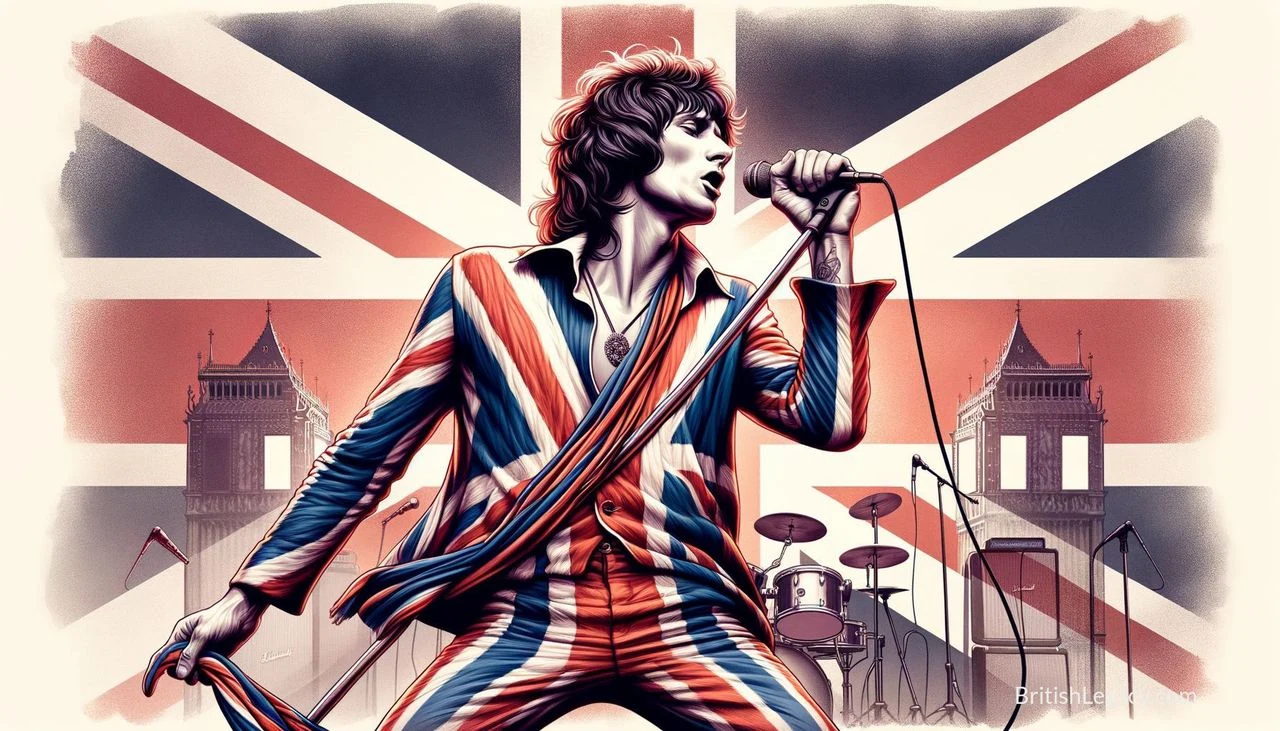
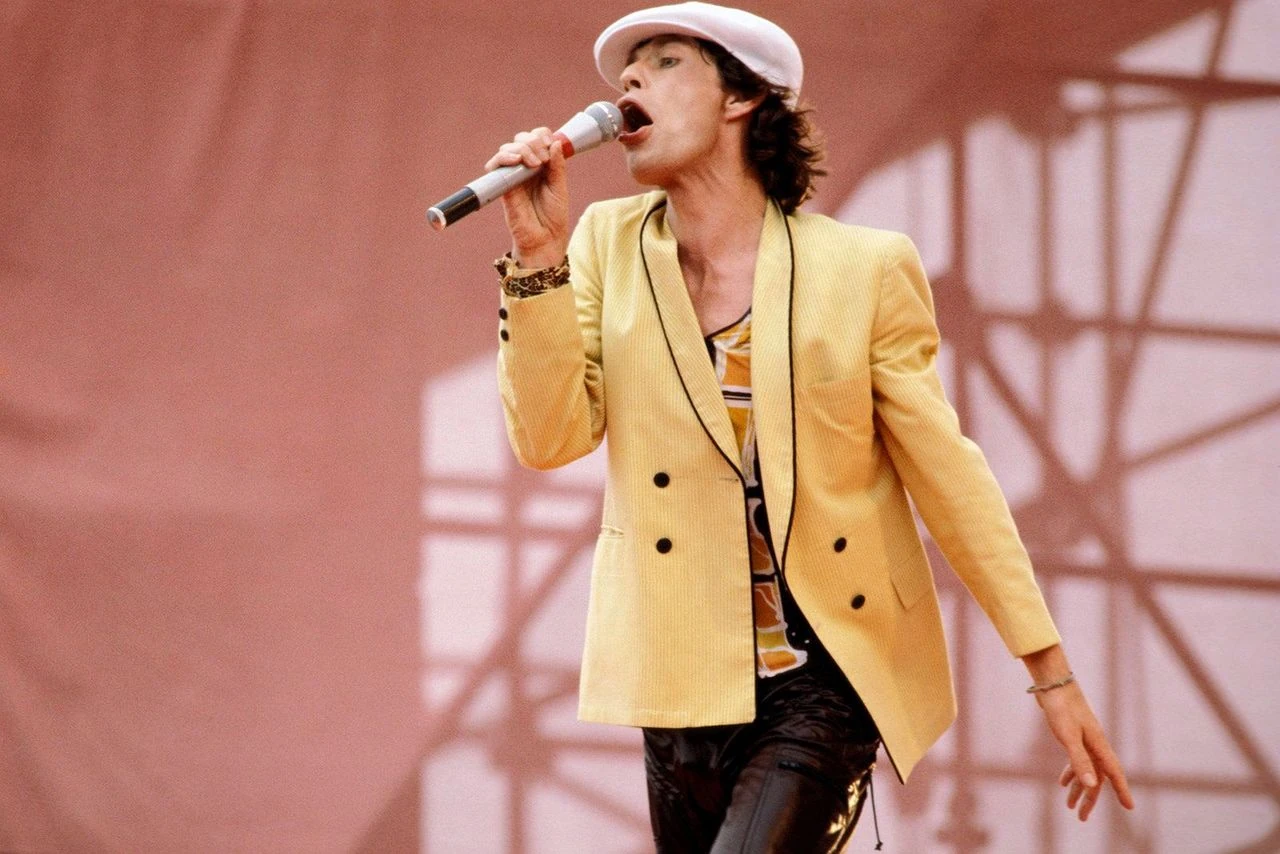
Jagger’s stage manner became one of rock’s most imitated features. His movement, dress and vocal delivery gave the songs an element of performance that extended beyond simply standing at a microphone. The group’s image shifted over the decades: during its 1972 American tour, for example, Jagger wore glitter make-up and flamboyant clothes associated with glam rock. Such reinvention did not replace the band’s musical roots; it gave them new theatrical settings.
Beyond the band: records and screen work
Jagger’s career has included solo work as well as the Stones. His first solo album, She’s the Boss, appeared in 1985, followed by Primitive Cool in 1987, Wandering Spirit in 1993 and Goddess in the Doorway in 2001. His duet with David Bowie on “Dancing in the Street” reached number one in the UK in 1985. That year he also performed at Live Aid in Philadelphia, including a duet with Tina Turner.
Solo work unfolded alongside periods of strain within the Stones, particularly in Jagger’s relationship with Richards. Their different views about touring and the band’s direction became especially pronounced in the 1980s. The group’s 1986 album Dirty Work arrived amid poor relations, and Jagger did not tour with the band to promote it. He and Richards later resumed writing together, and the Stones returned to the road with the 1989–90 Steel Wheels/Urban Jungle tour. The partnership survived disagreement as well as success, and their shared work remained the band’s creative core.
Acting and film production gave Jagger other ways to work with performance and music. His best-known early screen roles included Turner in Performance, released in 1970, and Ned Kelly in the film of the same year. In 1991 he co-founded Jagged Films; its first release was the Second World War drama Enigma in 2001. He later co-produced the James Brown biopic Get on Up and co-created and executive-produced the television drama Vinyl. These projects extended his activity beyond the stage, though his career with the Rolling Stones remained its defining thread.
A long-running band and a changing public image
The Stones continued recording and touring through successive decades. Their 1994 album Voodoo Lounge reached number one in the UK and won the Grammy Award for Best Rock Album. The 2000s brought further touring, alongside Jagger’s soundtrack work on the film Alfie; “Old Habits Die Hard”, which he wrote and performed with David A. Stewart, won a Golden Globe for Best Original Song. In 2007, the band’s A Bigger Bang tour was recorded in Guinness World Records as the most lucrative music tour at that time.
Later work included the supergroup SuperHeavy, formed with Dave Stewart, Joss Stone, Damian Marley and A. R. Rahman, and new recordings with the Stones. In 2020, the band released “Living in a Ghost Town”, recorded before the COVID-19 lockdown and finished in isolation. Its 1973 album Goats Head Soup was reissued that year and returned to the top of the UK Albums Chart, making the Stones the first band to top the chart in six different decades.
Jagger’s honours include induction into the Rock and Roll Hall of Fame as a member of the Stones in 1989 and the UK Music Hall of Fame in 2004. He was named for a knighthood in the Queen’s 2002 Birthday Honours; he received the accolade from the Prince of Wales on 12 December 2003. In Dartford, the Mick Jagger Centre provides a local performing-arts venue, and Jagger has supported music in schools through the Red Rooster Programme. Those links give his career a continuing connection to the town where it began.
Why Mick Jagger deserves a place in British Legacy
Jagger’s British legacy is grounded in a specific musical history: a boy from Dartford who was drawn to American blues and rhythm and blues, reunited with Keith Richards over records at a Kent railway station, and helped build a band that carried those influences into popular music around the world. With Richards, he co-wrote much of the Stones’ catalogue, including “(I Can’t Get No) Satisfaction”. His expressive voice and physical stage performance helped establish a model for the rock frontman, while the band’s changing sound and presentation made its work relevant to audiences across several generations. This is more than a story of celebrity: it is a record of British musicians making their own work from transatlantic influences and taking it onto the international stage.
His career also shows how a musical legacy can extend into other forms of work and into a home community. Jagger acted in films, co-founded Jagged Films and contributed to soundtracks, while returning repeatedly to the Stones’ shared creative work after periods of tension. The Mick Jagger Centre in Dartford and his support for school music through the Red Rooster Programme connect his public profile with opportunities for performance and music education in the town where he grew up. These achievements give British Legacy concrete reasons to remember him: a substantial body of songwriting and performance, a lasting influence on the presentation of rock music, and a continuing association with music-making in his local community.
Sources
Adapted in part from Mick Jagger by Wikipedia contributors, under CC BY-SA 4.0. Text has been edited and combined with the existing article; this adapted text is shared under the same licence. Contributor history.
_(52193656268)_(cropped).jpg)