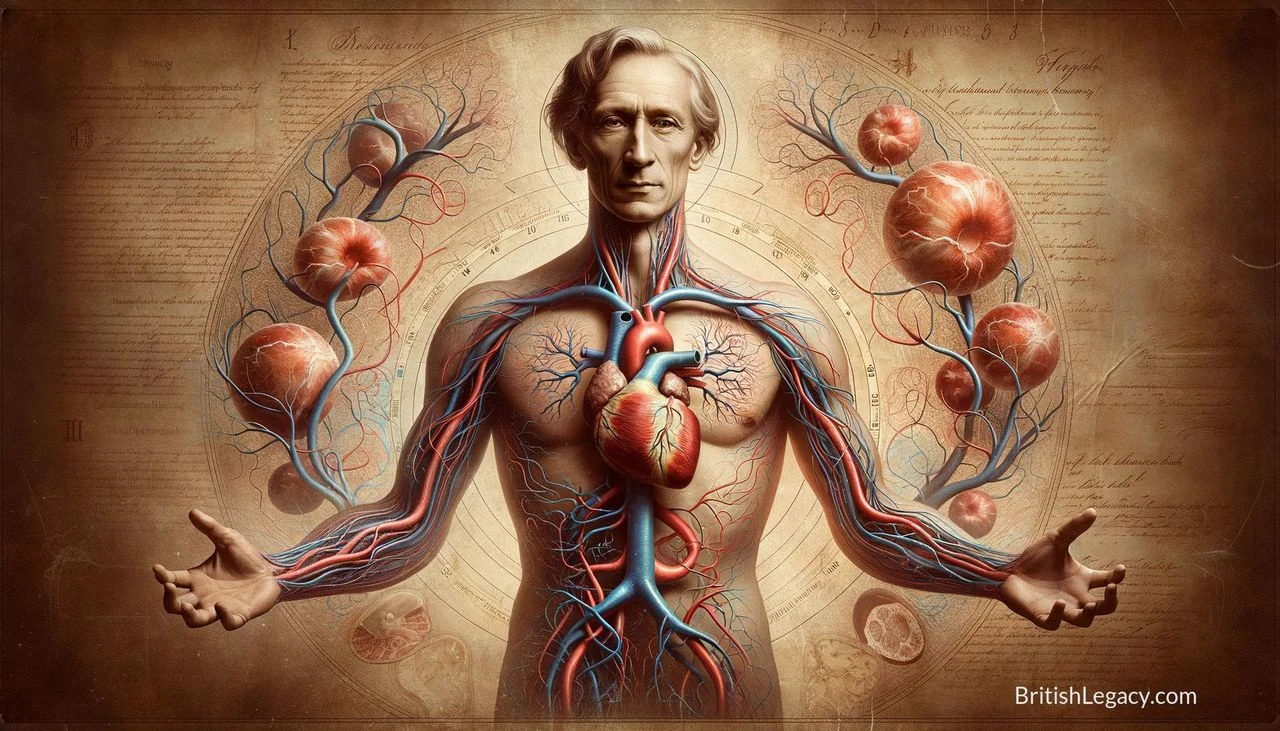
In 1628, William Harvey published an argument that blood moved around the body in a circuit, propelled by the heart. The idea challenged established medical teaching. Harvey did not rely on authority alone: he compared hearts and blood vessels in animals, observed the effects of ligatures and used estimates of the heart’s output to test whether prevailing explanations could add up. His account of circulation helped make careful observation and experiment central to the study of the body.
From Folkestone to Padua
Harvey was born in Folkestone, Kent, on 1 April 1578. He learnt Latin locally before attending the King’s School in Canterbury. In 1593 he entered Gonville and Caius College, Cambridge, graduating with a Bachelor of Arts degree in 1597. He then travelled through France and Germany to Italy and enrolled at the University of Padua in 1599.
At Padua, Harvey studied with the anatomist Hieronymus Fabricius and read his work on the valves in veins. Those valves would become important to Harvey’s later explanation of how blood moves. He graduated in medicine on 25 April 1602, aged 24, and returned to England. In the same year he also obtained a medical degree from Cambridge.
In 1604 Harvey joined the Royal College of Physicians. He married Elizabeth Browne that year; they had no children. He became a Fellow of the College in 1607 and, in 1609, took up a post as physician at St Bartholomew’s Hospital in London, where he served for almost the rest of his working life. His hospital duties included examining patients and prescribing for them. In 1615 he was appointed Lumleian lecturer, a role established to teach anatomy. He began lecturing the following year.
Testing what the heart does
Harvey’s investigation was not simply a new description of the heart. It asked how blood moved, in what quantity and in which direction. The Galenic account, influential for centuries, treated the venous and arterial systems as distinct and proposed that the liver produced blood that the body consumed. Harvey argued instead that the heart sent blood into the arteries and that it returned through the veins.
He studied the beating heart in animals, including fish and other cold-blooded creatures, whose slower movements could be easier to observe. He examined how the ventricles contracted and how blood entered the pulmonary artery. He also used arithmetic to estimate how much blood the heart moved over time. Even using deliberately low figures, he reasoned, the quantity was too great for the liver to produce continually as the accepted account required.
Experiments with ligatures offered another test. When Harvey tied veins or arteries, he observed different effects on the heart and limb. A tight band around a human upper arm could make the lower arm pale and cool. Loosening it allowed arterial blood to enter, while veins became more visible and swollen. Harvey examined the valves in those veins, first described by Fabricius, and found that blood moved readily towards the heart but could not be pushed back down the arm. From such observations he argued for one-way movement through the veins and a circuit linking arteries and veins.
His case was not built on direct observation of every part of that circuit. Harvey could not see blood passing through capillaries, and he did not claim to have observed that passage. Instead, he inferred circulation from the heart’s action, the quantity of blood it moved and the behaviour of vessels under experiment. The distinction matters: his achievement lay in connecting observations and calculations into a coherent explanation, while recognising limits in what could be seen.
A disputed book and a wider career
Harvey published his account in Frankfurt in 1628 as Exercitatio Anatomica de Motu Cordis et Sanguinis in Animalibus, commonly called De Motu Cordis. The 72-page work presented a connected account of the heart’s action and the movement of blood. Its publication brought opposition from physicians attached to established ideas, and Harvey’s medical practice suffered. He continued in public and professional life, however: he served as physician to James I, held offices in the Royal College of Physicians and later became physician to Charles I.
Harvey’s work extended beyond circulation. His other major book, Exercitationes de generatione animalium, appeared in 1651 after years of work. It examined the development of animal embryos, including the hen’s egg and the development of deer. The book reflected his continuing interest in observation and generation, though its account was also shaped by the limits of the magnifying lens available to him.
During the English Civil War, soldiers opposing the King entered Harvey’s lodgings and scattered or took his papers. He remained associated with Charles I, helped wounded people on several occasions and protected the King’s children during the Battle of Edgehill. He later went to Oxford with the King and was made Warden of Merton College in 1645. After Oxford surrendered, Harvey gradually withdrew from public duties and returned to London, where he lived with his brothers.
Death, burial and commemoration
Harvey died at Roehampton on 3 June 1657, aged 79, at the home of his brother Eliab. He was buried at St Andrew’s Church in Hempstead, Essex. In 1882–83, the Royal College of Physicians arranged for his leaden burial case to be repaired and his remains to be reinterred in the Harvey vault. His will also left money to the College, which he had served and supported.
Harvey’s name has since been attached to institutions and commemorations in Britain and elsewhere. The Royal College of Physicians holds an annual Harveian Oration, established by Harvey in 1656. The main lecture theatre of the University of Cambridge’s School of Clinical Medicine bears his name, as does William Harvey Hospital in Ashford, Kent. Folkestone, where he was born, also has a statue of him. These commemorations mark different parts of his life: his connection to a Kent town, his Cambridge education and his place in the history of medicine.
Why William Harvey deserves a place in British Legacy
William Harvey deserves a place in British Legacy for a specific achievement: he made the movement of blood around the body an experimentally argued account, rather than an inherited assertion. His work at St Bartholomew’s Hospital and his teaching as a Lumleian lecturer placed him within England’s medical life, while his education at Cambridge and Padua connected that career to institutions on both sides of the Channel. In De Motu Cordis, he combined observation of living and dissected animals, experiments on veins and arteries, and numerical reasoning about the heart’s output. The result did not make every part of circulation directly visible, but it offered a powerful explanation that challenged a long-established medical model.
His British legacy is also tangible. The Royal College of Physicians continues to hold the Harveian Oration, a lecture Harvey established during his lifetime; a Cambridge medical lecture theatre and a hospital in Kent bear his name; and Folkestone commemorates its native son. Those memorials point back to a lasting benefit of his work: a way of studying the body that tests claims against what can be observed and reasoned through. Harvey’s story also resists the simple image of instant triumph. His book faced opposition, and his practice suffered after publication. Remembering both the method and the resistance gives a fuller account of how a British physician’s argument helped change medical understanding.
Sources
Adapted in part from William Harvey by Wikipedia contributors, under CC BY-SA 4.0. Text has been edited and combined with the existing article; this adapted text is shared under the same licence. Contributor history.