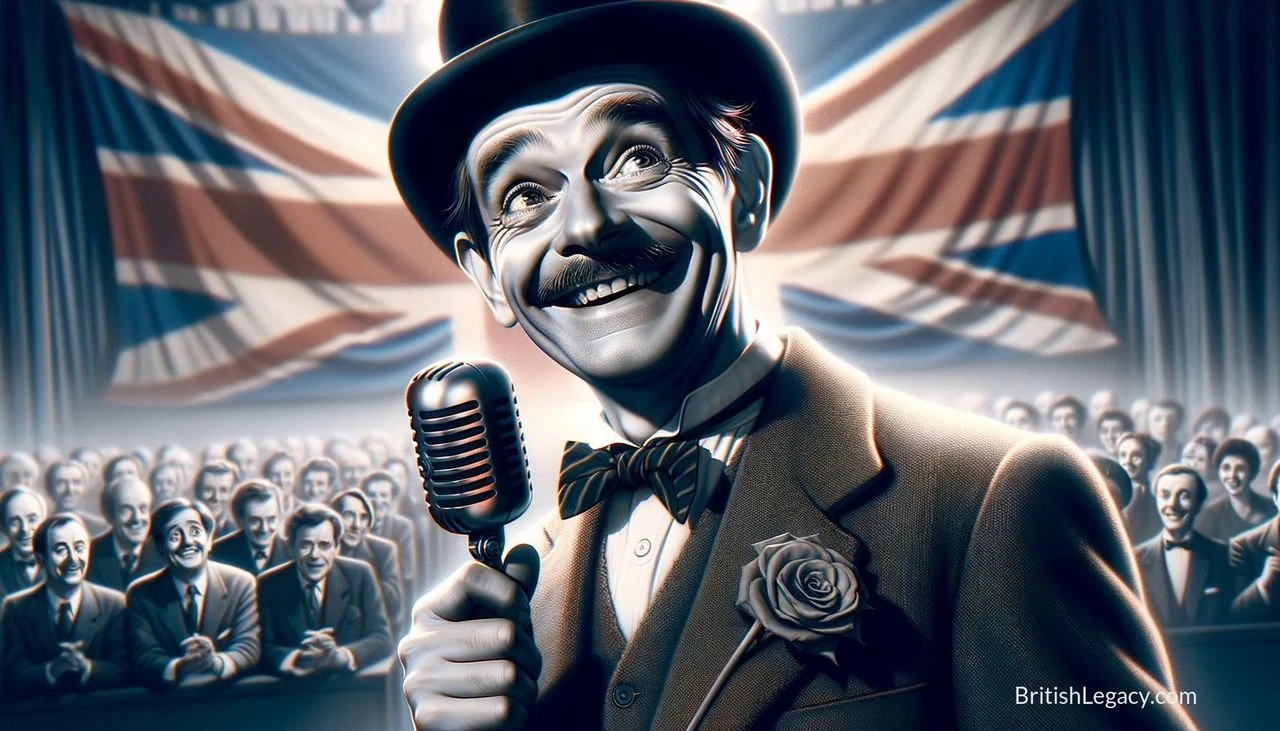
Frankie Howerd made a pause part of the punchline. His mock hesitation, verbal tics and apparent asides to the audience gave his innuendo the air of an improvised confidence, even when the lines had been carefully prepared. The result was a comic style that could move between radio, stage, film and television, and that made him one of Britain’s most recognisable performers.
From York to the Army concert party
Born Francis Alick Howard in York on 6 March 1917, he was the son of Francis Alfred William Howard, a soldier, and Edith Florence Howard, who worked at the Rowntree’s factory. The family later moved to Eltham, south-east London, when his father was posted to Woolwich. Howerd attended Shooter’s Hill Grammar School. He made his first stage appearance at 13 and hoped to become a serious actor, but an unsuccessful audition for the Royal Academy of Dramatic Art redirected that ambition.
During the Second World War, he served in the British Army and entertained fellow servicemen. He changed the spelling of his surname to Howerd because, he said, he wanted to be different. In 1944 he became a bombardier in Plymouth, was promoted to sergeant and took part in the D-Day effort, though he was stuck on a boat off Normandy. His experience performing for troops did not immediately remove his stage fright, but it gave him a route into professional entertainment.
Howerd began his professional career in 1946 with the touring show For the Fun of It. That December he made his radio debut on the BBC’s Variety Bandbox, alongside other former servicemen. His surname, his stage manner and his comic persona were now taking shape together.
Finding a voice on radio and stage
Howerd’s early radio success was helped by writers including Eric Sykes, Ray Galton, Alan Simpson and Johnny Speight. Sykes, who had led a rival wartime concert party, supplied material and marked it with spoken pauses. Howerd retained those pauses in performance, turning what might have been punctuation into a distinctive part of his delivery. On the music-hall circuit, phrases such as “titter ye not” became familiar, while his feigned innocence allowed an audience to recognise a double meaning before he appeared to acknowledge it.
His fame grew quickly after the war, but he did not follow one format. He performed in stage farces and Shakespearean comedy roles as well as on radio, and his film debut came in 1954 in The Runaway Bus, a part written for his comic talent. At the start of the 1960s, a season at Peter Cook’s Establishment Club in Soho helped restore his popularity. His success on the satirical television programme That Was the Week That Was in 1963 and in the stage production A Funny Thing Happened on the Way to the Forum, in which he performed from 1963 to 1965, brought further attention.
Howerd’s performance style depended on control beneath the appearance of disorder. His direct addresses to camera, verbal tics and pauses could suggest that a thought had just occurred to him. In reality, his scripts were meticulously prepared. Fellow comedian Barry Cryer praised his ability to transform written material through timing and delivery: the apparent waffle, he observed, could hold an audience in suspense before the laugh arrived.
Up Pompeii! and the comic’s second act
Howerd’s best-known television role was Lurcio, the slave at the centre of Up Pompeii!, which ran from 1969 to 1970. The show used a setting in ancient Rome for broad farce and verbal innuendo, while Howerd’s addresses to the audience made the viewers part of the joke. The apparent spontaneity of his asides was a performance in itself: their effect depended on the precision of the writing and his command of timing.
He also appeared as Francis Bigger in Carry On Doctor (1967) and as Professor Inigo Tinkle in Carry On Up the Jungle (1970). The success of the film version of Up Pompeii in 1971 brought a further measure of public recognition: British exhibitors voted Howerd the ninth most popular star at the British box office that year. He followed it with comic roles in Up the Chastity Belt (1971) and Up the Front (1972), playing variations on the Lurcio character.
His career continued well beyond that peak. He made television programmes for the BBC and Thames, appeared in the Hollywood musical Sgt. Pepper’s Lonely Hearts Club Band in 1978 and performed in televised Gilbert and Sullivan productions in 1982. After several years without a regular UK television series, he returned in 1987 with Channel 4’s Superfrank!. In his later years he found a following among students, taking a one-man show to universities and smaller theatres. His work across decades included radio, live performance and television, rather than relying on a single famous role.
A private life kept out of public view
Howerd’s public persona concealed parts of his private life. He kept his homosexuality secret from his audience and his mother, at a time when sexual acts between men were illegal in England and Wales until 1967. In 1958 he met Dennis Heymer, who became his partner and manager. They remained together for more than thirty years. Heymer also helped Howerd revive his career during the 1960s, while the need for discretion shaped their life together.
Howerd had suffered from a stutter early in his career and turned it into part of his comic delivery. He also experienced depression and sought psychiatric treatment. For the last twenty years of his life, he and Heymer lived at Wavering Down in Somerset. Howerd died of heart failure on 19 April 1992, aged 75, after suffering respiratory problems. He was buried at St Gregory’s Church in Weare; Heymer was buried near him after his own death in 2009.
Remembering the performer
Howerd was appointed an Officer of the Order of the British Empire in 1977. His life and work have been commemorated in different forms: a BBC Four drama, Rather You Than Me, told a fictionalised account of his life in 2008, with David Walliams playing Howerd. Plaques in London and York mark places associated with him, including his childhood home at 53 Hartoft Street and the Grand Opera House in York. St Barnabas Church in Eltham named its church hall the Frankie Howerd Centre in the 1980s, and Howerd himself opened it.
His career’s repeated recoveries were part of its character. He experimented with different formats, passed through periods when his public profile fell, and returned to television and live performance. The comic identity audiences knew—his pauses, verbal tics and mock rebukes to anyone who noticed an innuendo—was not a spontaneous accident but a crafted method, honed over years of work.
Why Frankie Howerd deserves a place in British Legacy
Frankie Howerd deserves a place in British Legacy for the way he made comic technique visible without making it feel mechanical. His pauses, stammering delivery and apparent diversions gave innuendo a distinctive shape: the joke could seem to emerge in the moment, while the performance rested on preparation and exact timing. From his first professional tour and BBC radio appearance in 1946 to Up Pompeii!, he worked across the forms through which British audiences encountered comedy. His career links wartime entertainment, post-war radio, music hall, satire, film and television, not as separate chapters but as stages in the development of a recognisable performer.
That achievement is more specific than a general claim that he made people laugh. Howerd could carry a carefully written script as though he were gossiping with the audience, then turn a hesitation or a mock protest into the set-up for a joke. His work in Carry On Doctor and Carry On Up the Jungle, his role as Lurcio and his later one-man performances show how he adapted that technique to different settings and generations of viewers. His long partnership with Dennis Heymer also belongs to the history of his career: Heymer was not only his partner but his manager, helping him through a revival in the 1960s. Howerd’s British legacy lies in this combination of craft, adaptability and enduring public presence.
Sources
Adapted in part from Frankie Howerd by Wikipedia contributors, under CC BY-SA 4.0. Text has been edited and combined with the existing article; this adapted text is shared under the same licence. Contributor history.