Edward Thomas had spent two decades writing about literature and the countryside before he began writing poems of his own. He was 36 when he turned to poetry, encouraged by his friend Robert Frost. In the few years that followed, Thomas made the English landscape the setting for poems attentive to ordinary moments, memory and loss. “Adlestrop”, prompted by a train stopping at a Gloucestershire station in June 1914, became his best-known work. His death at Arras in 1917 cut short a career that had only just begun to move from prose into poetry.
From Lambeth to a life of writing
Philip Edward Thomas was born in Lambeth on 3 March 1878. His family had strong Welsh connections: his father, Philip Henry Thomas, was born in Tredegar, and the family continued to visit relatives in Wales. Edward attended Belleville School, Battersea Grammar School and St Paul’s School in London. From 1898 to 1900 he studied history at Lincoln College, Oxford.
Thomas married Helen Berenice Noble in 1899, while still an undergraduate. He had chosen to make his living by writing, and began with book reviews, at one point reviewing as many as 15 books a week. He became a literary critic for the Daily Chronicle and wrote criticism, biographies, travel books and work about nature. His subjects included Oxford, Wales and the English countryside; The South Country appeared in 1909, followed by the travel book In Pursuit of Spring in 1914. He also wrote a novel, The Happy-Go-Lucky Morgans, published in 1913.
Landscape was not simply a subject for his books. From 1906 Thomas and his family lived in and around Steep, in Hampshire, drawn to the countryside and the area’s links with London. His encounters with the English landscape would become central to his poetry, but he did not begin writing poems until the end of 1914. At first he published them under the name Edward Eastaway.
Robert Frost and the start of a poetic career
Thomas had long admired poetry, though he had not considered himself a poet. His friendship with the American poet Robert Frost helped change that. Frost, who was living in England, encouraged Thomas to write verse. The friendship also involved long walks, and Frost’s “The Road Not Taken” was inspired by Thomas’s indecision about which route to take. Thomas took the poem seriously and personally; a biographer has suggested that it helped tip his decision to enlist, though the decision had more than one cause.
Thomas’s poems often use a colloquial voice and draw on the countryside without treating it as an escape from human experience. Nature, memory and war can sit together in a few lines. “In Memoriam”, written in 1915, begins with flowers in a wood at nightfall and turns towards men who are far from home and will never gather them with their sweethearts again. The poem shows how the landscape in his work could carry the weight of absence.
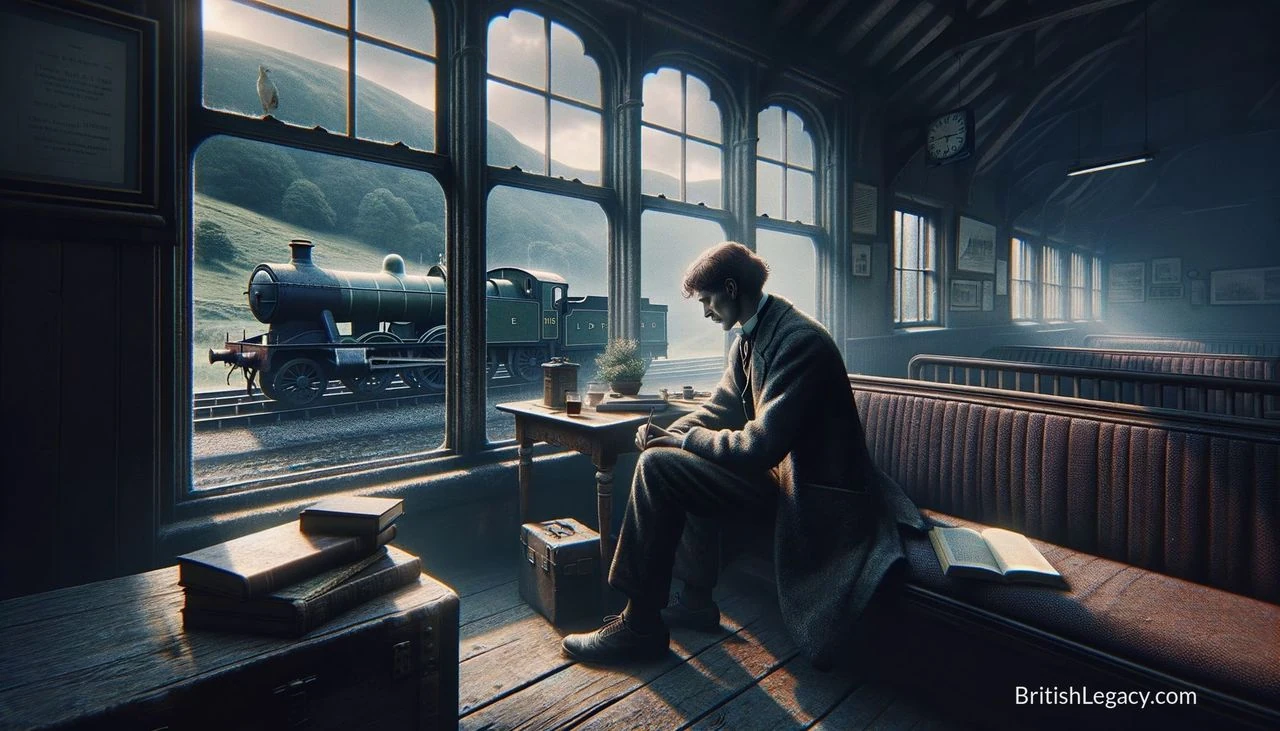
His best-known poem, “Adlestrop”, recalls a stop at the Gloucestershire station on 24 June 1914, shortly before the First World War began. The railway station has since closed, but Thomas’s subject is the moment of stopping: the name on the station sign, the heat of late June and the sounds of birds beyond the train. The poem’s attention to a brief pause gives it its particular force. Rather than presenting a grand scene, Thomas makes a commonplace interruption memorable, while the date places that recollection on the edge of a period of upheaval.
Enlistment and the war
Thomas enlisted in the Artists Rifles on 19 July 1915. He was a married man with children and could have avoided enlistment. After training at a temporary camp in High Beach, Epping Forest, he was promoted to corporal. In November 1916 he received a commission as a second lieutenant in the Royal Garrison Artillery. The forest remained part of his experience of the war: he moved with his family to a cottage nearby, and wrote “Out in the dark” there at Christmas 1916.
Thomas was killed in action at Arras on Easter Monday, 9 April 1917, soon after arriving in France. He was 39. His poems do not often describe combat directly, and his reputation as a war poet rests in part on the way war and its consequences enter work rooted in familiar places and natural details. His death left a small body of poetry beside a much larger career in prose, criticism and biography.
Poems, remembrance and influence
Thomas’s work continued to find readers after his death. His poems were collected in Last Poems in 1918 and in a collected edition in 1920. The Gloucester composer Ivor Gurney set at least 19 of his poems to music. In 1985 Thomas was among 16 First World War poets commemorated on a slate stone in Poets’ Corner at Westminster Abbey. The inscription, written by Wilfred Owen, reads: “My subject is War, and the pity of War. The Poetry is in the pity.”
Thomas is also remembered in places tied to his life and writing. A blue plaque marks his birthplace at Lansdowne Gardens in Stockwell; there are memorials at Steep and at Eastbury in Berkshire, and a plaque at Lincoln College, Oxford. In Steep, a literary walk includes a memorial stone erected in 1937. The Edward Thomas Fellowship, founded in 1980, works to keep his life and writing in view. His memory has also prompted responses from other writers: W. H. Davies, his close friend and a poet whose career Thomas had supported, published “Killed in Action (Edward Thomas)” in 1918.
Why Edward Thomas deserves a place in British Legacy
Thomas’s place in British literary history rests not on a long poetic career but on the way his writing joined close observation to an awareness of change. Before he became a poet, he had already spent years writing criticism, biographies and books about the countryside. That experience gave him a broad knowledge of literature and a working writer’s discipline. When Frost encouraged him to write verse, Thomas brought those qualities to poems shaped by speech, place and recollection. “Adlestrop” is a clear example: it makes a particular English station and a passing summer moment memorable without turning them into grand spectacle.
His British connection is also grounded in the places and histories his work records. He was born in Lambeth, lived and wrote in Hampshire, and drew on the countryside in prose and poetry. His Welsh family connections remained part of his life, while his enlistment and death at Arras placed him among the generation marked by the First World War. The memorials at Westminster Abbey, Steep and elsewhere, along with the work of the Edward Thomas Fellowship, show how his writing continues to be read and remembered. His legacy offers readers a way to attend to the ordinary details of a landscape while recognising the losses that history can bring to it.
Sources
Edward Thomas (poet), revision 1379016394
Adapted in part from Edward Thomas (poet) by Wikipedia contributors, under CC BY-SA 4.0. Text has been edited and combined with the existing article; this adapted text is shared under the same licence. Contributor history.