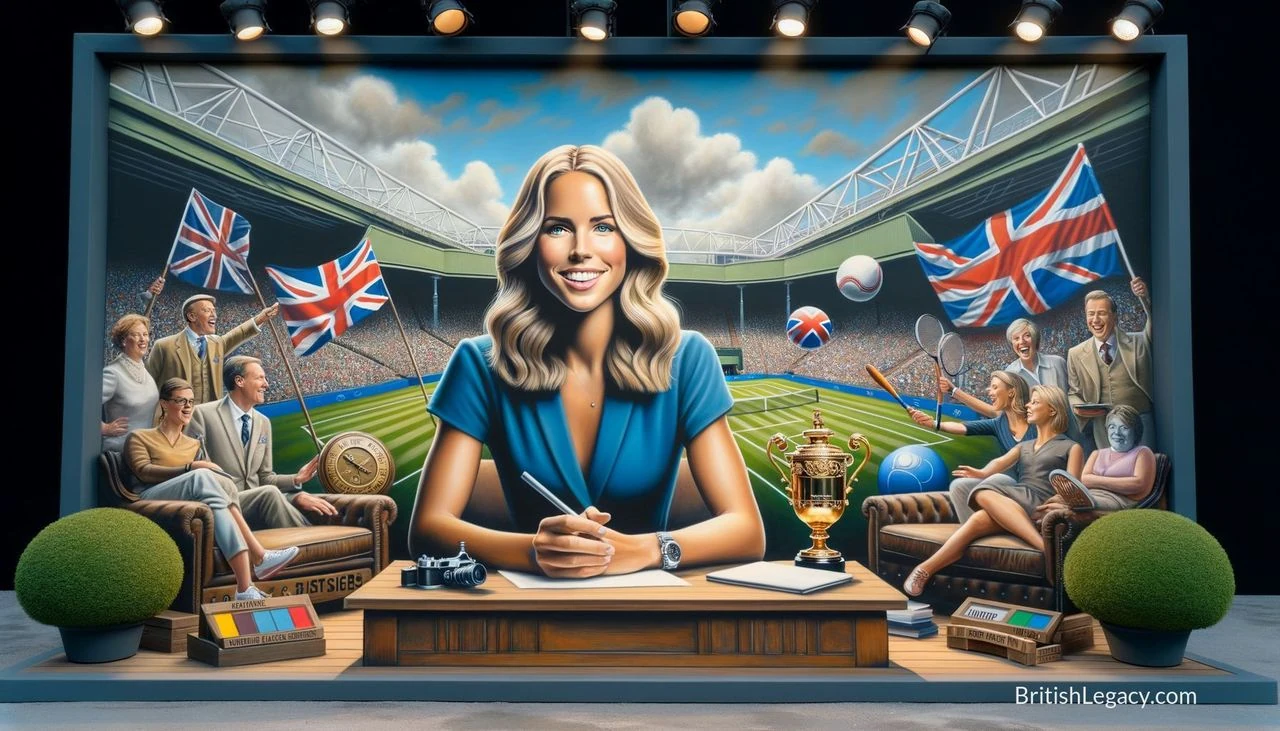
Clare Balding’s broadcasting career began in radio, but its subject matter was close to home: she grew up in a family of racehorse trainers and rode as an amateur jockey before joining the BBC as a trainee in 1994. Since then, she has presented from Olympic Games, major British sporting events and the racecourse, building a career that connects sporting expertise with the stories around competition.
Racing first
Balding was born in Kingsclere, Hampshire, on 29 January 1971. Her father, Ian Balding, was a racehorse trainer, as was her uncle Toby; her mother was Emma Hastings-Bass, daughter of trainer Peter Hastings-Bass. Horse racing was therefore both family life and a working environment. From 1988 to 1993, Balding was a leading amateur flat jockey. She became Champion Lady Rider in 1990, an experience that gave her direct knowledge of the demands and conventions of the sport she would later cover.
She attended Downe House School before studying English at Newnham College, Cambridge. At university she was president of the Cambridge Union Society in Easter 1992, and graduated in 1993 with a 2:1 honours degree. Her first book, My Animals and Other Family, would later return to the world of the racing yard in which she grew up.
From trainee to a familiar sports presenter
Balding joined BBC National Radio as a trainee in 1994, working across BBC Radio 5 Live, Radio 1, Radio 2 and Radio 4. Her first television presenting role came in June 1995, introducing highlights of Royal Ascot. The following year she began presenting live coverage; in December 1997, she became the BBC’s lead horse-racing presenter after Julian Wilson’s retirement. She went on to front coverage of the Grand National as well as other major meetings.
Her work soon extended well beyond racing. Balding has reported from eight Summer Olympic Games, beginning with radio coverage from Atlanta in 1996 and television from Sydney in 2000. At Athens in 2004 she presented nightly highlights; at Beijing in 2008 she fronted coverage of the early events. For London 2012, she anchored afternoon coverage and reported from diving, equestrian and swimming. Later roles included presenting the evening action at Rio 2016 and hosting the opening and closing ceremonies at Tokyo 2020, alongside a nightly highlights programme with Alex Scott.
She has also presented from seven Winter Olympic Games and five Commonwealth Games, and hosted five Paralympic Games. These assignments have required more than a single presenting style: studio coverage, live reporting from venues and daily highlights each place different demands on a broadcaster. Her Olympic work also included leading Channel 4’s television coverage of the London 2012 Paralympic Games.
Wimbledon and sport beyond the stadium
Wimbledon is one of the most prominent strands of Balding’s broadcasting, but the detail matters. She worked on BBC Radio 5 Live’s Wimbledon coverage from 1995 to 2014. Since 2015 she has presented the BBC’s Today at Wimbledon; in 2023 she became the BBC’s lead presenter for the championships, succeeding Sue Barker, who retired the previous year.
Her live-event work also encompasses The Boat Race, which she has presented for the BBC since 2010. In 2015 she was part of the first live BBC coverage of the women’s Boat Race on the Tideway. She has presented BBC Sports Personality of the Year and coverage of events including the Lord Mayor’s Show and Trooping the Colour. For BBC Radio 4, she has presented Ramblings since 2000, walking with people who share an interest in a particular route, place or activity. The programme takes her away from the stadium and uses walking as a way into conversations about landscape and local experience.
Other work has included BBC programmes such as Countryfile, Britain By Bike and Sport and the British, a 30-part Radio 4 series about sport’s impact on British life. She presented Channel 4’s racing coverage from 2013 to 2016, and hosted The Clare Balding Show on BT Sport and BBC Two. The range of these programmes—from racing and international competition to walking and the countryside—has made her career broader than the label of sports presenter might suggest.
Writing, advocacy and recognition
Balding’s writing has included columns for publications such as the Racing Post, The Sunday Telegraph, The Evening Standard and Stylist. Her memoir, My Animals and Other Family, was published in 2012, reached number one in The Sunday Times bestseller list and won the National Book Award for Biography/Autobiography of the Year. Walking Home: My Family and Other Ramblings followed in 2014.
Her broadcasting has also given her a platform to discuss the place of women in sport. In 2012 she appeared before an All Party Parliamentary Group on women’s sport and argued that women’s freedom to play sport was connected to political freedom. She became president of the Rugby Football League in July 2020, serving until December 2022. The role brought her long-running work covering rugby league into a formal position within the sport’s governing body; she said she wanted to see the women’s game become professional.
Balding was appointed OBE in the 2013 Birthday Honours for services to broadcasting and journalism. That year she received a special BAFTA for her work on the 2012 Olympics and Paralympics. Other recognition has included Royal Television Society awards for Sports Presenter in 2003 and Presenter in 2012, and the Sports Broadcaster of the Year award from the Sports Journalists’ Association in 2012. In 2022 she was appointed CBE for services to sport and charity.
Her public life has included her relationship with fellow broadcaster Alice Arnold. The couple entered a civil partnership in 2006 and married in 2015. Balding has also spoken publicly about having thyroid cancer: she announced the diagnosis in May 2009 and later said radioactive iodine treatment had been successful, with no sign that the cancer had spread.
Why Clare Balding deserves a place in British Legacy
Clare Balding’s place in British Legacy rests on the substance and range of her contribution to British sporting culture. She has brought audiences into events that form part of the country’s shared calendar, from Royal Ascot and the Grand National to Wimbledon, The Boat Race and the London Olympics. Her career has not been confined to the commentary box: early experience as a jockey gave her a participant’s understanding of racing, while years of live reporting and presenting have made her a recognisable guide to sports with very different audiences and demands.
Her work has also helped widen the view of what sports broadcasting can cover. Reporting from Olympic and Paralympic events, taking part in discussion about women’s access to sport, and serving as president of the Rugby Football League are distinct contributions, linked by a sustained engagement with sport and its institutions. Her programmes on walking, British landscapes and the role of sport in British life extend that engagement beyond results and competition. Through broadcasting and writing, Balding has made sporting achievement intelligible as both an individual effort and a public experience. That combination—professional knowledge, a long record of live coverage and attention to the people and communities around sport—gives her work a clear British connection and lasting relevance.
Sources
Adapted in part from Clare Balding by Wikipedia contributors, under CC BY-SA 4.0. Text has been edited and combined with the existing article; this adapted text is shared under the same licence. Contributor history.