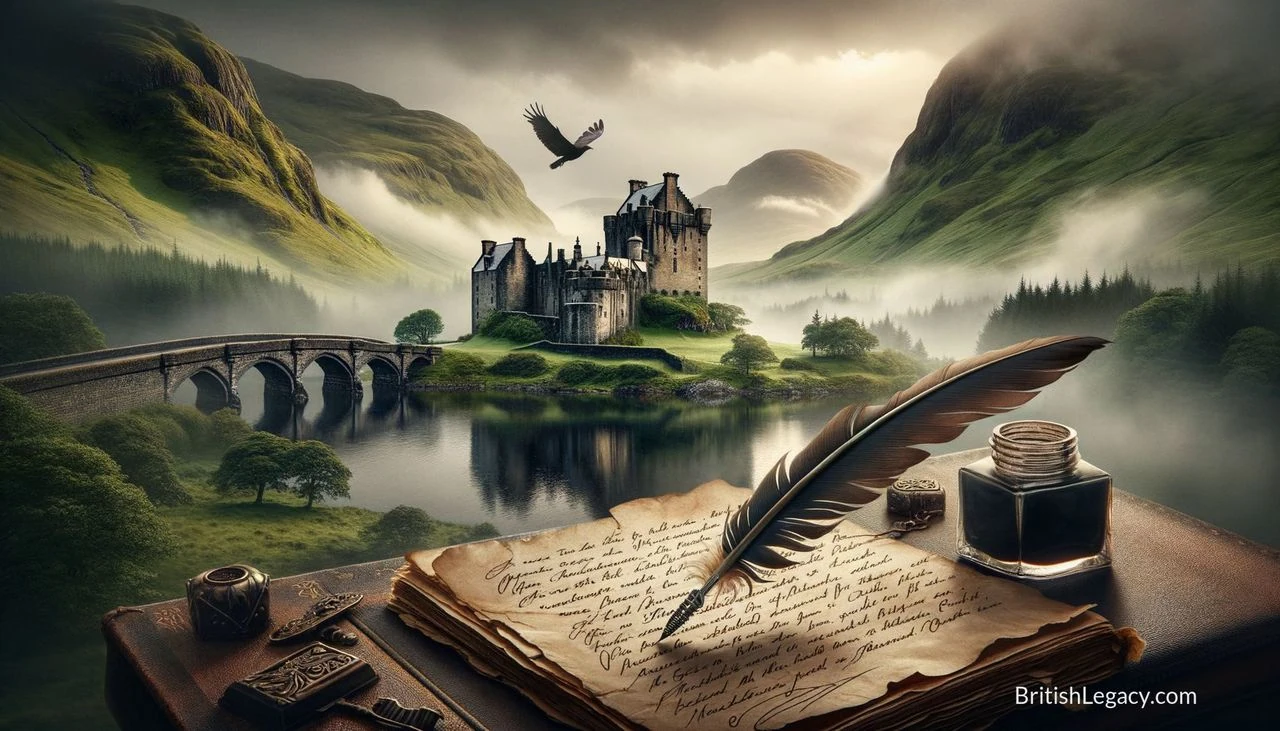
Walter Scott made the past a place readers could enter. In poems such as The Lady of the Lake and novels beginning with Waverley, he set invented characters among historical conflicts and customs, giving distant periods the texture of lived experience. His writing carried Scottish landscapes and traditions to a wide readership; his work in law, literary editing and public life was equally substantial.
Edinburgh, the Borders and a life in law
Scott was born in Edinburgh on 15 August 1771. A bout of polio in childhood left him lame. Sent to the Borders to improve his health, he learned from his aunt Jenny Scott and from local stories and legends. That early familiarity with spoken tradition and the landscape of the Borders later fed his poetry and fiction.
He returned to Edinburgh for schooling at the Royal High School and studied at the University of Edinburgh. His professional life began in the law: after training in his father’s office, he was admitted to the Faculty of Advocates in 1792. He became Sheriff of Selkirk in 1799 and, from 1806, Clerk of Session, combining legal work with writing for much of his career. In 1797 he married Charlotte Charpentier, known in English as Carpenter; they had five children.
Scott’s literary work began with German translations and an intensive interest in traditional ballads. With the help of John Leyden, he published Minstrelsy of the Scottish Border in 1802. The collection presented traditional material to new readers, though Scott sometimes combined different versions of ballads into more coherent texts, a practice he later repudiated. It was one of several editorial projects alongside his own creative work.
The poet of the Borders and the Highlands
The Lay of the Last Minstrel (1805) brought Scott a major success as a poet. Its Border setting and mixture of legend, history and romance drew on the knowledge he had gathered since childhood. He followed it with Marmion (1808), whose story leads towards the Battle of Flodden, and The Lady of the Lake (1810), set in the Perthshire Highlands.
The Lady of the Lake became a remarkable publishing success, selling 20,000 copies in its first year, according to the biographical account. Its setting also helped increase tourism in the area around Loch Katrine. The poem’s songs travelled beyond the page: several were translated into German and set to music by Franz Schubert, including “Ellens dritter Gesang”, widely known as “Ave Maria”. Scott’s writing could make a landscape both a setting for a story and a destination readers wanted to see.
He continued to publish long poems, including Rokeby and The Lord of the Isles, while his popularity as a poet eventually faced competition from Lord Byron. Scott did not abandon verse when he turned to novels: songs and poems also appear within the Waverley books.
The Waverley novels and historical fiction
Scott returned to a novel he had begun years earlier and published Waverley in 1814, at first anonymously. It begins a sequence now known as the Waverley novels. Guy Mannering, The Antiquary and Rob Roy followed; later works included The Heart of Mid-Lothian and Ivanhoe. For years, the books appeared as works “by the author of Waverley” or under similar descriptions.
Many of the novels are set in Scotland, where Scott placed characters within periods of political and social change. His fiction brings historical events into contact with the habits, loyalties and arguments of ordinary life. Waverley, set around the Jacobite rising of 1745, shows its hero drawn first to the romance of the Jacobite cause and then to a changing political reality. The novels do not simply reproduce history: they use invented lives to explore how people experience the clash between older customs and new forms of society.
With Ivanhoe (1820), Scott shifted the setting to medieval England. Across his fiction he ranged widely through Scottish, British and European history. His achievement helped establish the historical novel as a major form, although claims that he alone invented the genre overlook earlier writers. His influence reached well beyond Britain: the biographical account identifies writers including Alexandre Dumas and Leo Tolstoy among those affected by his work.
Abbotsford, public life and financial ruin
Scott’s literary interests were closely tied to a life of public and practical activity. In 1818, after a search prompted by his suggestion, he and a small team opened the locked box in Edinburgh Castle containing the Scottish regalia, or Honours of Scotland. In 1822 he helped organise George IV’s visit to Scotland. The King wore tartan for the occasion, and the pageantry helped make tartan dress a prominent symbol of Scottish identity.
Scott made his home at Abbotsford, on the River Tweed, developing the former farm into a house shaped by his interests in history and architecture. Its collections and design made it an expression of the same historical imagination found in his books. Today, the house is closely associated with his life and work.
His business involvement brought severe financial consequences. Scott had a financial interest in the Ballantyne printing business, which collapsed during the banking crisis of 1825, leaving debts of £130,000. Rather than declare himself bankrupt, he put his house and income into a trust for his creditors and continued writing to repay them. Charlotte died in 1826, the year after the crisis. Scott produced further novels, histories and other books in his final years, but died at Abbotsford on 21 September 1832, aged 61. He was buried at Dryburgh Abbey; his works continued to sell, and his estate’s debts were discharged shortly after his death.
Why Walter Scott deserves a place in British Legacy
Scott’s place in British literary history rests on more than the number of books he published. His fiction gave readers a way to imagine societies unlike their own: the loyalties and political divisions of the 1745 Jacobite rising, the older customs of the Borders and Highlands, and the medieval world of Ivanhoe. By joining invented characters to researched settings and historical change, he helped make the historical novel a durable form. His poems performed a related task through landscape and legend, bringing places such as Loch Katrine into a shared literary imagination and, in the case of The Lady of the Lake, helping stimulate visitors to the region.
His British legacy is specifically Scottish as well as broader. Scott collected and reworked Border ballads, wrote about Scotland’s contested past, and took part in public events that changed how Scotland was presented to a British audience. His role in recovering the Honours of Scotland and in staging George IV’s 1822 visit joined historical storytelling to public ceremony. The tartan pageantry of that visit became influential in shaping a visible symbol of Scottish identity. These achievements were not without complexity: Scott’s recreations could be romanticised, and his business ventures left him with devastating debts. Yet his books, public work and lasting association with Abbotsford show how literary imagination can influence the way a nation understands its history and presents itself to others.
Sources
Walter Scott — Wikipedia revision 1379806517
Adapted in part from Walter Scott by Wikipedia contributors, under CC BY-SA 4.0. Text has been edited and combined with the existing article; this adapted text is shared under the same licence. Contributor history.