
Wilfred Owen’s war poems refuse the distance and grandeur of patriotic abstraction. In “Dulce et Decorum Est”, a gas attack is experienced through the exhausted bodies of soldiers; in “Anthem for Doomed Youth”, guns and shells take the place of church bells and funeral prayers. Owen’s writing drew on what he had witnessed as a British Army officer, but it also grew from years of reading, revision and exchange with other writers. He was killed in France a week before the Armistice. Most of the poems for which he is now known appeared after his death.
From Oswestry to Bordeaux
Wilfred Edward Salter Owen was born on 18 March 1893 at Plas Wilmot, near Oswestry in Shropshire. He was the eldest of four children of Thomas and Susan Owen. The family’s circumstances changed after Owen’s maternal grandfather died in 1897 and the house was sold. They lived in Birkenhead and Shrewsbury before returning to Birkenhead in 1898, where Thomas Owen became stationmaster at Woodside. The family moved back to Shrewsbury in 1907.
Owen attended the Birkenhead Institute and Shrewsbury Technical School. He later described discovering his poetic vocation during a holiday in Cheshire, around 1904. The Romantic poets, particularly Wordsworth and John Keats, were early influences, alongside the Bible and his Anglican upbringing. In his last two years of formal education he was a pupil-teacher at Wyle Cop school in Shrewsbury. He passed the University of London matriculation examination in 1911, but not with the first-class honours needed for the scholarship that would have made university possible for him.
From 1911 to 1913 Owen worked as a lay assistant to the vicar of Dunsden, near Reading, living in the vicarage in return for lodging and some tuition. He attended classes at University College, Reading, first in botany and later in Old English. His experience at Dunsden contributed to disillusionment with the Church, both its ceremonies and its failure, as he saw it, to help those in need. In 1913 he moved to France, teaching English and French at the Berlitz School of Languages in Bordeaux and later working with a family. He met the French poet Laurent Tailhade and corresponded with him in French.
War service and Craiglockhart
When war broke out, Owen did not immediately enlist; he even considered joining the French army. On 21 October 1915 he joined the Artists Rifles. After training at Hare Hall Camp in Essex, he was commissioned as a second lieutenant in the Manchester Regiment in June 1916. His early impressions of his troops were not generous, but the experiences that followed changed his understanding of the men and the war.
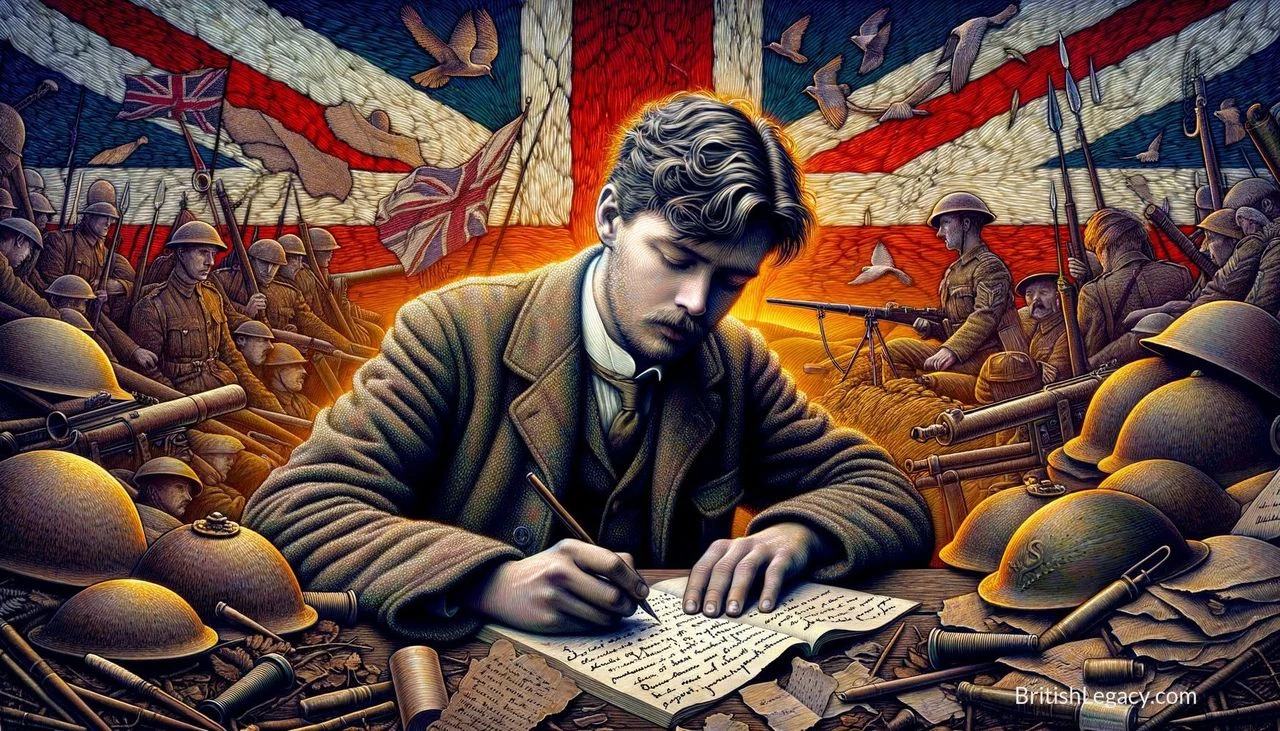
At the front, Owen suffered concussion after falling into a shell hole and was caught in the blast of a trench mortar. He spent several days unconscious near the remains of a fellow officer. Diagnosed with neurasthenia, also known as shell shock, he was sent to Craiglockhart War Hospital in Edinburgh. There he met Siegfried Sassoon, whose poetry, criticism and friendship helped shape Owen’s developing voice. Owen also made connections in Edinburgh’s artistic and literary circles and taught for a time at Tynecastle High School.
Craiglockhart was not simply a meeting-place for two poets. Owen’s doctor, Arthur Brock, encouraged him to work his experiences and recurring dreams into poetry. Sassoon offered a model of direct, unsentimental writing and helped Owen revise his work. Owen brought that realism together with the Romantic inheritance of his earlier writing. The result was neither an impersonal record nor a simple rejection of feeling: his poems make room for pity while exposing the physical realities that public accounts of war could obscure.
After leaving Craiglockhart, Owen spent time on light regimental duties, including a winter in Scarborough and a posting to Ripon. He composed or revised poems there, among them “Futility” and “Strange Meeting”. In July 1918 he returned to active service in France. Sassoon, recovering in Britain after being wounded, opposed the decision, but Owen regarded it as his duty to continue bearing witness to the realities of the fighting.
Poems shaped by experience
“Dulce et Decorum Est” takes its title from the Latin saying that it is sweet and fitting to die for one’s country. Owen turns the phrase against itself. A gas attack and the suffering that follows replace any polished account of honour in battle. The poem’s force comes from its concrete witness to violence, not from a general claim that every experience of war is the same.
“Anthem for Doomed Youth” also makes its argument through detail. Its opening asks what funeral bells will sound for soldiers who die like cattle, then answers with the “monstrous anger” of guns. Church ritual gives way to the sounds and gestures of a battlefield and to the grief of those left at home. In “Strange Meeting”, Owen imagines an encounter with a dead enemy soldier. Together with poems such as “Futility” and “The Parable of the Old Men and the Young”, these works show different aspects of his response to violence, loss and the language used to justify sacrifice.
Owen’s poems were not widely published during his lifetime. Only five appeared before his death, including a fragmentary work; one was “Miners”, published in The Nation. He had planned a volume and written a preface, but did not see the collection in print. After his death, “Anthem for Doomed Youth”, “Dulce et Decorum Est” and other poems became central to his reputation. Sassoon helped promote and edit the work; later, a fuller edition prepared by Edmund Blunden in 1931 and renewed attention in the 1960s brought Owen to a wider readership.
Death, recognition and remembrance
On 1 October 1918, Owen led men of the Second Manchesters in an attack near Joncourt. He was awarded the Military Cross for his courage and leadership, although the award was not gazetted until February 1919. On 4 November he was killed during the crossing of the Sambre–Oise Canal in France. The Armistice came a week later. Owen was promoted to lieutenant the day after his death and was buried at Ors Communal Cemetery. His mother received the telegram informing her of his death on Armistice Day, as bells rang in Shrewsbury.
His words became part of public remembrance as well as literary history. In 1985, Owen was among sixteen First World War poets commemorated on a slate stone in Westminster Abbey’s Poets’ Corner. Its inscription comes from his preface: “My subject is War, and the pity of War. The Poetry is in the pity.” Memorials also stand in places associated with his life and death, including Oswestry, Shrewsbury, Birkenhead and Ors. Craiglockhart, the hospital where he met Sassoon, houses a collection devoted to the war poets.
Owen’s influence has also travelled through performance and the arts. Benjamin Britten’s War Requiem, first performed in 1962, uses his poetry extensively. The friendship between Owen and Sassoon has been dramatised, including in Stephen MacDonald’s play Not About Heroes, first performed in 1982, and their story forms part of Pat Barker’s Regeneration novels. The Wilfred Owen Association, formed in 1989, promotes readings, talks, visits and performances, and has established public memorials in Shrewsbury and Oswestry.
Why Wilfred Owen deserves a place in British Legacy
Owen’s place in British literary history rests on more than the fame of a handful of poems. He joined the experience of a serving officer to a careful poetic practice: revising lines, drawing on earlier writers and responding to Sassoon’s criticism. In “Dulce et Decorum Est” and “Anthem for Doomed Youth”, the reader encounters the machinery, bodily cost and bereavement of war rather than an abstract celebration of sacrifice. His writing gives historical memory a human scale, helping later readers consider what military language can leave out.
That legacy has been carried forward through institutions and creative work as well as print. The memorial in Poets’ Corner places Owen among the writers commemorated nationally for the First World War; memorials and the Craiglockhart collection connect his work to particular British places and to the people who encounter it there. Britten’s War Requiem, the Wilfred Owen Association and later plays and novels have brought the poems to audiences beyond readers of poetry. Owen did not live to see the reputation that developed after his death. His enduring contribution is the precision with which he made suffering and pity part of Britain’s continuing public understanding of war.
Sources
Adapted in part from Wilfred Owen by Wikipedia contributors, under CC BY-SA 4.0. Text has been edited and combined with the existing article; this adapted text is shared under the same licence. Contributor history.
.jpg)