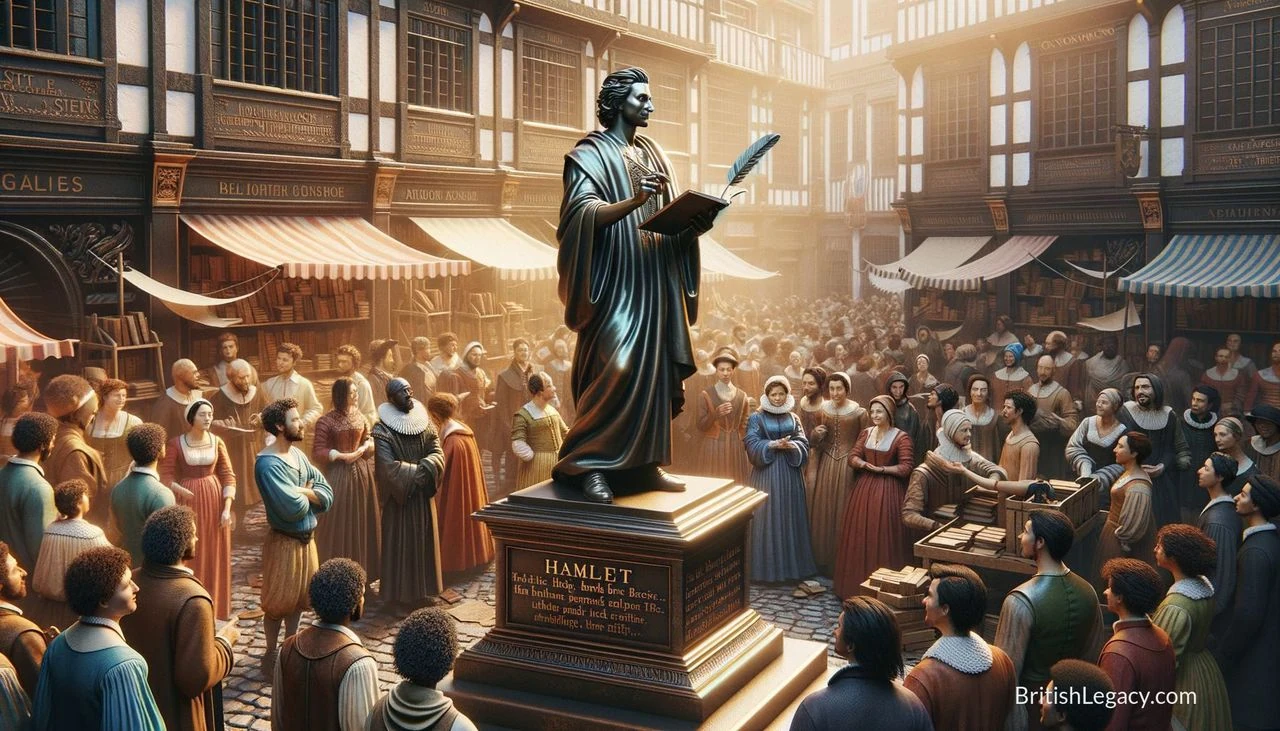
William Shakespeare’s plays move between private feeling and public consequence: love and jealousy, ambition and power, mistaken identity and political conflict. Born in Stratford-upon-Avon in 1564, he became a playwright and actor in London, where his work ranged across tragedy, comedy and English history. His plays and sonnets remain part of the repertoire performed, studied and reinterpreted in Britain and around the world.
From Stratford to the London stage
Shakespeare was born in Stratford-upon-Avon to John Shakespeare and Mary Arden. The existing account describes his father as a local businessman and his mother as the daughter of a landowner. Shakespeare later travelled to London, then a centre of theatrical life. By 1592 he was established as a playwright and actor. He became a member of the Lord Chamberlain’s Men, the company later known as the King’s Men, which performed many of his plays.
The company’s association with the Globe Theatre connects Shakespeare’s writing to the practical life of the stage. His work was made for performance, and its varied plots and characters offered actors sharply different demands: from the inward arguments of Hamlet to the political and military action of Henry V. Stratford remained an important part of his story, while London provided the professional setting in which his plays reached audiences. The contrast between his birthplace and the capital’s theatrical world gives his career a clear geographical shape, from a market town in England to the city’s stages.
Tragedy, comedy and English history
Shakespeare’s tragedies include Hamlet, Macbeth, Othello and King Lear. Their subjects include revenge, ambition, jealousy, authority and the consequences of flawed judgement. In Hamlet, a prince wrestles with revenge and uncertainty; in Macbeth, the pursuit of power carries a steep moral cost. These plays give private choices public consequences, and their conflicts have kept them central to stage and study. Across the tragedies, characters face pressures that can expose the limits of their judgement and bring personal decisions into collision with wider political or family obligations.
His comedies use mistaken identities, romantic entanglements and reversals to bring characters towards resolution. A Midsummer Night’s Dream joins romance with magical mischief, while As You Like It moves its characters into a pastoral setting. The comic plots depend on confusion and change, but also on the wit of the characters caught up in them. Their movement towards happy resolutions sets them apart from the tragic falls and losses of the darker plays, while the recurring complications give Shakespeare room to play with expectation and character.
In the history plays, Shakespeare dramatised England’s past through kingship, conflict and political calculation. Richard III and Henry V bring questions of leadership and power into the theatre. Taken together, the plays do not settle on one mode: they shift from court to battlefield, from domestic confusion to national crisis, and from comedy to tragedy. That breadth allowed Shakespeare to write both intimate encounters and dramas in which the fate of a kingdom is at stake.
Sonnets, language and performance
Shakespeare also wrote 154 sonnets. Their subjects include love, beauty and mortality, expressed in compact poems shaped by argument and imagery. The sonnets complement the plays: where drama gives ideas to characters in conflict, the poems concentrate attention on a single speaker’s changing thoughts. They form a distinct part of his literary work alongside the plays, showing his attention to both the demands of performance and the concentrated form of lyric poetry.
His writing has left a substantial mark on English-language literature and performance. Phrases including “a foregone conclusion”, “break the ice” and “in a pickle” are often associated with his works, though their origins are not established here. The plays themselves continue to be adapted and staged in different forms. In Britain, that life can be seen in London theatres and in Stratford-upon-Avon, where the Royal Shakespeare Company and Shakespeare Birthplace Trust are among the institutions commemorating his life and work. His writing is encountered in professional productions, community theatre and education, as well as through adaptations for other media. This continuing movement between the page, the stage and new interpretations helps keep the works in public view.
Why William Shakespeare deserves a place in British Legacy
Shakespeare’s place in British cultural history rests on the breadth of his work and its continuing presence in performance. He wrote across tragedy, comedy and history, creating plays that put questions of ambition, love, leadership and responsibility into dramatic action. Hamlet, Macbeth, A Midsummer Night’s Dream, Richard III and Henry V show the range of that achievement. His 154 sonnets add a distinct body of poetry, exploring intimate subjects through concentrated language. The lasting value of this work is not just that it records particular stories: it gives performers and readers different forms through which to consider conflict, desire, authority and consequence.
The connection to Britain is specific: Shakespeare was born in Stratford-upon-Avon, developed his theatrical career in London and wrote history plays about England. His work remains part of British performance, education and the cultural life of Stratford, while productions and adaptations also reach audiences internationally. The Royal Shakespeare Company and Shakespeare Birthplace Trust commemorate his life and work in his birthplace, and theatres, community groups and students continue to encounter his writing. That continuing use gives his legacy more than commemorative value. Actors can shape the roles for new audiences; readers and students can interpret the plays in changing contexts. Shakespeare belongs in British Legacy not simply as a famous name, but as a writer whose work connects the country’s literary history with its living stages and continuing cultural practice.