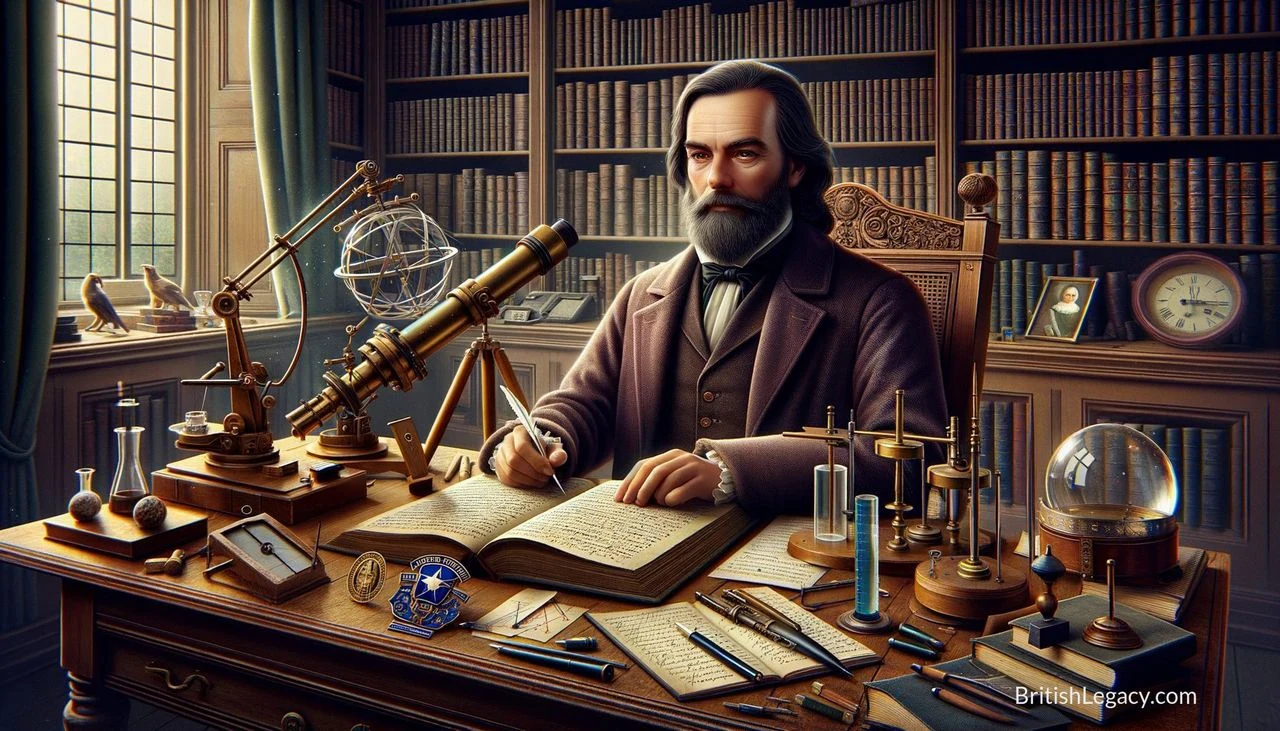
Isaac Newton’s work connected phenomena that had seemed separate. In the Principia, published in 1687, he showed how mathematical principles could describe the motion of objects on Earth and bodies in the heavens. His investigations of light, his development of calculus and his later work at the Royal Mint reveal a career that extended well beyond the laws of motion for which he is best known.
A Lincolnshire childhood and Cambridge education
Newton was born at Woolsthorpe Manor in Lincolnshire on 25 December 1642 under the Julian calendar then used in England; the corresponding Gregorian date is 4 January 1643. His father, also called Isaac, had died before his birth. When Newton was three, his mother, Hannah Ayscough, remarried and left him in the care of his maternal grandmother, Margery Ayscough. He attended the King’s School in Grantham, where he distinguished himself by making sundials and models, before entering Trinity College, Cambridge, in 1661.
At Cambridge, Newton encountered the established curriculum while also pursuing mathematics and natural philosophy on his own. The university closed temporarily during the plague in 1665, and he returned to Lincolnshire. In the following period he developed ideas in mathematics, optics and gravitation that would shape much of his later work. He returned to Cambridge in 1667 and was elected a fellow of Trinity. In 1669, aged 26, he succeeded Isaac Barrow as Lucasian Professor of Mathematics, a post he held until 1702. He was elected a Fellow of the Royal Society in 1672.
His professorship did not make him a celebrated classroom teacher: accounts in the biographical record describe poorly attended lectures. Its significance lay instead in Newton’s position within Cambridge’s mathematical life and in the research he pursued there. His university years also brought questions of religious conformity. He secured an exemption from the requirement that he take holy orders, allowing him to retain the Lucasian chair.
Calculus and the mathematics of change
During the 1660s Newton developed what he called the method of fluxions, a form of calculus that brought together methods for describing changing quantities and finding areas. He made major progress before his work was published. The German mathematician Gottfried Wilhelm Leibniz independently developed calculus later, and both men are credited with its creation. Their dispute over priority became bitter, but it should not obscure the distinction between independent development and Newton’s earlier work.
Newton’s mathematical achievements went beyond calculus. He generalised the binomial theorem to non-integer powers, devised a method for approximating the roots of equations and contributed to the study of infinite series. He also developed mathematical tools that he applied to questions of motion and planetary orbits. His notation was not the one that eventually became standard across mathematics, but his work helped establish techniques that remain central to mathematical analysis.
Newton was slow to publish some of these investigations. The Principia eventually provided a striking demonstration of how mathematical reasoning could be used to treat physical problems. Rather than presenting science as a collection of disconnected observations, it set out principles that could account for a wide range of motions.
The Principia: motion and universal gravitation
Published in 1687 with encouragement and financial help from the astronomer Edmond Halley, Philosophiæ Naturalis Principia Mathematica—usually called the Principia—set out Newton’s three laws of motion and his law of universal gravitation. The laws describe how forces affect motion; gravitation supplied a single mathematical account of attraction between bodies. Together, these ideas made it possible to treat the motions of terrestrial objects and celestial bodies within the same framework.
Newton used his theory to explain planetary motion and to investigate comets, tides and other astronomical phenomena. He showed how Kepler’s laws of planetary motion could be derived from gravitational principles. His work established classical mechanics as a powerful account of the physical world. It was eventually superseded as a more complete theory by relativity, but Newtonian mechanics remains a useful approximation for ordinary speeds and comparatively weak gravitational fields.
The book also displayed Newton’s command of mathematical argument, including methods that anticipated or used calculus in a geometrical form. Its importance lay not simply in presenting three memorable laws but in bringing mathematical explanation to bear on the motion of bodies across the Solar System. The resulting unification became one of the defining achievements of the Scientific Revolution.
Prisms, colour and the reflecting telescope
Newton’s investigations of light began with experiments using prisms. He concluded that a prism separated white light into colours already present in it, rather than creating those colours. He tested the idea by isolating a coloured beam and examining how it behaved, then showed that the colours could be recombined as white light. His work challenged existing explanations of colour and formed the basis of his later book, Opticks, published in 1704.
He also recognised that the lenses used in refracting telescopes produce coloured fringes, or chromatic aberration. To avoid this problem, he built a reflecting telescope using a mirror rather than a lens as its main objective. The instrument demonstrated a practical alternative to refracting designs and brought his optical work to the attention of the Royal Society. His studies connected experiment with theory: observation helped him identify the properties of light, while instruments put those ideas into practice.
Public office in London
Newton’s career changed direction in 1696, when he became Warden of the Royal Mint and moved to London. He became Master of the Mint in 1699 and held the post until his death. These appointments could have been treated as comfortable sinecures; Newton instead took an active role in the institution. He worked on the Great Recoinage and pursued counterfeiters, including William Chaloner, who was convicted and executed.
His Mint work was a substantial part of his public life, not an incidental footnote to his science. It brought him into close contact with the practical questions of coinage, the law and the security of currency. Newton also served twice as a Member of Parliament for the University of Cambridge, in 1689–90 and 1701–02, and was elected president of the Royal Society in 1703, remaining in the post until his death.
Queen Anne knighted him in 1705 during a royal visit to Trinity College. Newton died in London on 31 March 1727 in the Gregorian calendar, aged 84. He was buried in Westminster Abbey, the first scientist to be buried there.
Why Isaac Newton deserves a place in British Legacy
Newton deserves a place in British Legacy because work carried out in England became part of an international account of how the physical world behaves. Educated and employed at Cambridge, he developed mathematics and mechanics that connected the motion of objects on Earth with the movement of planets and comets. The Principia made that connection precise: its laws supplied a framework for explaining phenomena through mathematical relationships rather than treating each as an isolated puzzle. Newton’s work on light added another strand, showing how experiment with prisms could challenge established assumptions and lead to a new account of colour. These achievements made a lasting contribution to the practice of science as well as to particular scientific theories.
His British legacy also includes work outside the university. As Warden and then Master of the Royal Mint, Newton applied close attention and authority to the security of the currency and the prosecution of counterfeiters. His career therefore joins intellectual innovation to the institutions in which knowledge and public service took practical form: Trinity College, the Royal Society and the Mint. Newton’s later theories have limits, and scientific understanding has moved on, but his methods and results remain consequential. The unit of force named after him is one visible reminder; more fundamentally, his work helped establish mathematical physics as a way to explain nature, test ideas and make predictions.
Sources
Isaac Newton — Wikipedia revision 1379624142
Adapted in part from Isaac Newton by Wikipedia contributors, under CC BY-SA 4.0. Text has been edited and combined with the existing article; this adapted text is shared under the same licence. Contributor history.