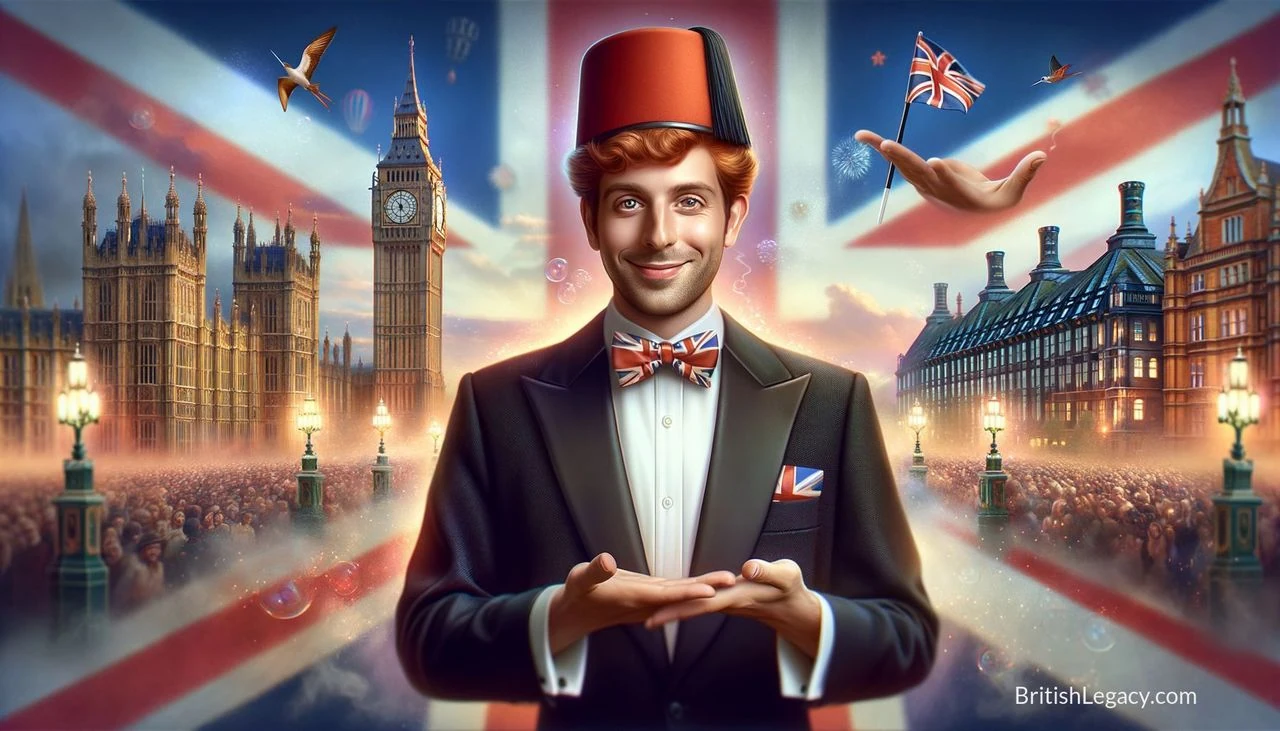
Tommy Cooper made magic look as though it had gone wrong. Towering at 6ft 4in and wearing a red fez, he fumbled with props, misjudged his tricks and delivered jokes with the air of a man surprised by his own act. The apparent bungling was his craft: he kept audiences guessing by mixing convincing failures with the occasional trick that worked. His catchphrase, “Just like that!”, became part of a comic persona that moved from variety theatres to television screens across Britain.
From Caerphilly to the Army
Thomas Frederick Cooper was born in Caerphilly, Glamorgan, on 19 March 1921. His father, Thomas H. Cooper, was Welsh and served as a recruiting sergeant in the British Army before becoming a coal miner. His mother, Catherine Gertrude Wright, was English and came from Crediton, Devon. When Cooper was three, the family moved to Exeter. At eight, he received a magic set from an aunt and spent hours practising its tricks. Before entering show business, he worked as a shipwright in Southampton.
Called up in 1940, Cooper served for seven years in the Royal Horse Guards, including time in Egypt with the Desert Rats. He joined an entertainment party organised through the Navy, Army and Air Forces Institutes (NAAFI), developing a performance that combined conjuring and comedy. The fez entered his act during a sketch in Cairo. He had forgotten the pith helmet required by his costume, so borrowed a fez from a passing waiter. The audience laughed, and the unexpected prop became his signature.
Making the trick go wrong
After demobilisation, Cooper entered show business on Christmas Eve 1947. He worked in variety theatres around the country and at London night spots, sometimes performing as many as 52 shows in a week. His “Cooper the Trooper” monologue drew on his military experience. He also continued to develop his conjuring skills and became a member of The Magic Circle.
Accounts of how he first shaped his comic style differ. One story has tricks going wrong in front of his shipbuilding colleagues; another places the discovery in the Army, while a third recalls a post-war audition. The finished act, however, depended on deliberate control. Cooper presented himself as a magician whose tricks persistently failed, then occasionally let one succeed when the audience least expected it. The contrast gave the performance its rhythm: apparent incompetence became a form of misdirection, and the audience could never be certain when the routine would turn.
“Just like that!” fitted the act’s sudden changes of direction. Cooper used the phrase as a punchline and as a verbal flourish around his tricks. The persona seemed spontaneous, but its effect rested on timing and the careful management of expectation. His red fez, large frame and catchphrase made the act instantly recognisable; the comic method beneath them was what held it together.
Variety stages and television fame
Cooper’s professional career gathered pace in variety. In 1947, agent Miff Ferrie booked him for a show, followed by a European tour, pantomime work and a season at the Windmill Theatre. Ferrie remained his agent until Cooper’s death. Cooper became a leading variety performer, building a reputation as the conjurer whose tricks never seemed to work.
Television brought him national prominence. He made his debut on the BBC talent programme New to You in March 1948 and went on to star in his own shows. His work with London Weekend Television from 1968 to 1972 and Thames Television from 1973 to 1980 reached large audiences. Programmes included Life with Cooper, The Tommy Cooper Hour and, later, Cooper's Half Hour. He also appeared in the Royal Variety Performance on several occasions. At his peak in the mid-1970s, he was one of the most recognisable comedians in the world.
His health and drinking began to affect his work. By 1980, Thames Television would not offer him another starring series, and Cooper's Half Hour was his last. He continued to appear as a guest, including in two Thames productions with Eric Sykes in 1982. A heart attack while performing in Rome in 1977 had not ended his career; after returning to television later that year, he continued working, though opportunities for another starring series eventually receded.
A final live appearance
On 15 April 1984, Cooper collapsed from a heart attack during a live broadcast of Live from Her Majesty's, transmitted from Her Majesty's Theatre in Westminster. The audience initially laughed, taking his fall for part of the act. As it became clear that he was seriously ill, the programme moved on. Cooper was taken to Westminster Hospital, where he was pronounced dead. He was 63.
The circumstances became inseparable from the public memory of his final performance. His act had trained audiences to read apparent mishaps as jokes, and this time the fall was not part of the routine. His funeral was held at Mortlake Crematorium in London; his son scattered his ashes in the back garden over Cooper’s favourite daffodils. His wife, Gwen Henty, whom he had married in Cyprus in 1947, died in 2002. They had two children.
Memorials, tributes and an enduring comic method
Cooper’s legacy has been marked in his birthplace and elsewhere. A statue was unveiled in Caerphilly in 2008 by actor Anthony Hopkins, patron of the Tommy Cooper Society. A blue plaque followed in 2016 at Cooper’s former home in Barrowgate Road, Chiswick. That year, the Victoria and Albert Museum acquired 116 boxes of his papers and props, including his “gag file”, which organised jokes alphabetically.
His work has continued to prompt tributes and new versions of his story. In a 2005 poll of comedians and comedy insiders, Cooper was ranked the sixth greatest comedy act. Jason Manford and John Lydon have cited him as an influence. Stage productions have included Jus’ Like That! A Night Out with Tommy Cooper, performed by Clive Mantle at the Edinburgh Festival in 2010, and Just Like That! The Tommy Cooper Show, first produced in 2014 and subsequently toured. David Threlfall played Cooper in the 2014 ITV drama Tommy Cooper: Not Like That, Like This. In 2021, Sir Lenny Henry presented a BBC documentary marking the centenary of Cooper’s birth.
Why Tommy Cooper deserves a place in British Legacy
Tommy Cooper deserves a place in British Legacy because he made a distinctive performance style part of the country’s shared entertainment culture. His comedy depended on the gap between what a magician was expected to do and what Cooper appeared to do instead. He turned the failed trick into the joke, then used an occasional success to wrong-foot an audience that thought it had understood the routine. The fez and “Just like that!” gave the act an unmistakable shape, but its lasting achievement lay in the control beneath the apparent disorder.
His career also traces a route through British popular entertainment, from military service and variety theatres to BBC television, London Weekend Television and Thames. Cooper adapted his stage persona to the screen without losing its central tension, reaching audiences through his own programmes and repeated appearances in the Royal Variety Performance. His influence is represented not only by later performers who have cited him, but by the continued staging of tribute shows and the preservation of his papers and props at the Victoria and Albert Museum. The statue in Caerphilly and plaque in Chiswick give that legacy a visible place in public life. Cooper’s achievement was not simply to make audiences laugh: he created a comic language of misdirection, apparent failure and sudden precision that remains recognisable decades later.
Sources
Tommy Cooper — Wikipedia, revision 1379639230
Adapted in part from Tommy Cooper by Wikipedia contributors, under CC BY-SA 4.0. Text has been edited and combined with the existing article; this adapted text is shared under the same licence. Contributor history.