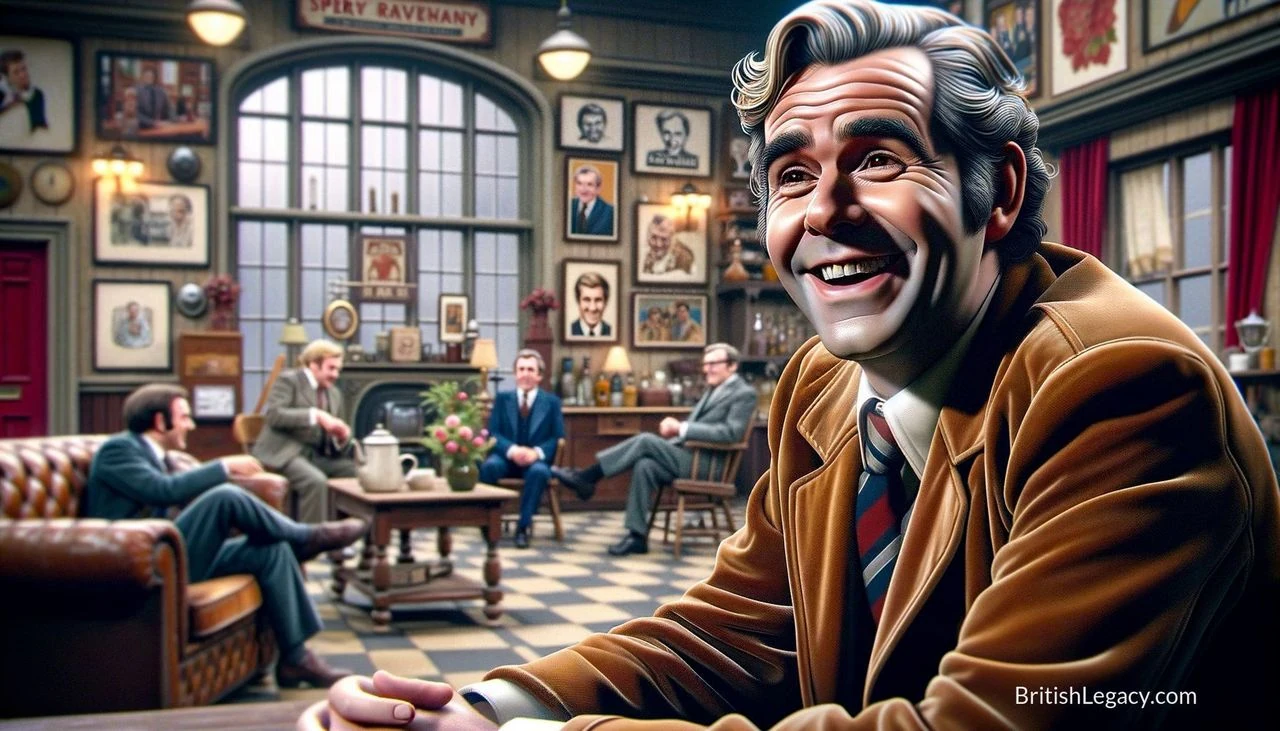
Stephen Fry’s career has crossed sketch comedy, television drama, theatre, books, radio and audiobook narration. He became widely known through his partnership with Hugh Laurie and his roles in Blackadder, but the work that followed ranged from hosting the quiz show QI to adapting a West End musical and presenting a documentary about bipolar disorder. Across those different forms, Fry has made language itself part of the performance: in a sketch, an essay, a documentary or an audiobook, the voice is often as recognisable as the words.
A circuitous route to Cambridge
Fry was born in Hampstead, London, on 24 August 1957, the son of Marianne Fry, a historian, and Alan Fry, a physicist and inventor. He grew up in Norfolk after the family moved from Chesham, Buckinghamshire. His education took him from preparatory schools to Uppingham, which he left before completing his sixth-form studies, and then to Paston School and Norfolk College of Arts and Technology. He did not pass his A-level examinations at the first attempt.
He resumed his studies at City College Norwich. In 1977, he passed A-levels in English and French and gained a scholarship to Queens’ College, Cambridge, where he read English literature. He joined the Cambridge Footlights, the student comedy society, and graduated in 1981. It was through their mutual friend Emma Thompson that he met Hugh Laurie. The two would become long-standing collaborators, but their professional partnership grew out of a wider group of performers and writers around the Footlights.
Sketch comedy and Blackadder
Fry’s early stage writing had already brought recognition: his play Latin! or Tobacco and Boys won a Fringe First at the 1980 Edinburgh Festival. The following year, the Footlights revue The Cellar Tapes, written by Fry, Laurie, Thompson and Tony Slattery, won the Perrier Comedy Award. Its television broadcast helped open the way to further work for Fry and Laurie, including There’s Nothing to Worry About! and, later, Alfresco.
The BBC commissioned A Bit of Fry & Laurie after a pilot in 1987. The series ran for four series, from 1989 to 1995, giving the pair space for finely constructed sketches, character work and verbal play. Their collaboration also included the television adaptation of Jeeves and Wooster (1990–93), with Fry as Jeeves and Laurie as Bertie Wooster.
Fry’s work in Blackadder showed another side of his comic acting. He played Lord Melchett in Blackadder II, the Duke of Wellington in Blackadder the Third, and General Melchett in Blackadder Goes Forth. His television career was not confined to comedy: among later parts were the title role in ITV drama Kingdom, and a recurring appearance as Dr Gordon Wyatt in the American series Bones.
Writer, actor and presenter
Writing and performance developed alongside one another. Fry adapted the musical Me and My Girl for the West End in 1984; it ran there for eight years before transferring to Broadway, where his adaptation received a Tony Award nomination. He later wrote four novels and three autobiographies, including Moab Is My Washpot and The Fry Chronicles. His books move between fiction, memoir and essays on subjects such as poetry and classical music.
On screen, Fry played Oscar Wilde in the 1997 film Wilde, earning a Golden Globe nomination for the role. His film work also included Gosford Park, V for Vendetta and the voice of the Cheshire Cat in Alice in Wonderland. He presented the BBC travel series Stephen Fry in America and made documentaries including Stephen Fry: The Secret Life of the Manic Depressive (2006). The documentary brought his experience of cyclothymia, a form of bipolar disorder, into public discussion and included conversations with other people living with mental-health conditions.
Fry hosted QI from its launch in 2003 until 2016. The comedy panel show made curiosity and unexpected facts the material of a quiz, with Fry guiding its conversations for 13 years. His presenting work also included the BAFTA Film Awards, which he hosted 12 times between 2001 and 2017, and the BBC Radio 4 series Fry’s English Delight, devoted to the English language.
A voice heard across books and broadcasting
Fry has narrated a wide range of work, but his readings of all seven Harry Potter novels for the British audiobooks are among his most familiar. He has also recorded books by authors including Douglas Adams and Roald Dahl, narrated Paddington stories, and read his own writing. The audiobook work draws on a skill evident throughout his career: the ability to give spoken language pace, texture and a distinct sense of character.
His broadcasting has reached beyond entertainment. In Last Chance to See (2009), he travelled with zoologist Mark Carwardine in search of endangered species, revisiting the subject of a book and radio series by Douglas Adams and Carwardine. He has also presented programmes about language and explored international attitudes to homosexuality in Stephen Fry: Out There. In 2011 he became president of the mental-health charity Mind, a role that sits alongside his public work discussing mental health.
Recognition has followed in several fields. Fry was elected a Fellow of the Royal Society of Literature in 2019 and, in the 2025 New Year Honours, was knighted for services to mental-health awareness, the environment and charity. These distinctions sit within a career whose public reach has come not from one defining role, but from sustained work across different kinds of British cultural life.
Why Stephen Fry deserves a place in British Legacy
Stephen Fry deserves a place in British Legacy because his career connects several influential strands of British entertainment without being confined to any one of them. His work with Hugh Laurie helped make sketch comedy and character-led television central to his public identity; his roles across Blackadder and Jeeves and Wooster brought literary and historical comedy to a wide audience. As a writer, he moved between novels, memoir and stage adaptation, with Me and My Girl demonstrating that his contribution extended from performance to the shaping of a successful musical for the West End and Broadway.
His broadcasting and narration have also created durable points of access to knowledge and stories. On QI, curiosity became popular entertainment; in his documentaries, subjects such as mental health, language and endangered wildlife received sustained attention. His readings of the Harry Potter audiobooks and other works have brought books to listeners through an expressive, carefully controlled performance. Just as importantly, Fry has spoken publicly about his own mental-health experience and presented a documentary that included other people’s accounts. His presidency of Mind gives that public discussion an institutional connection. Together, these achievements make his legacy not simply one of wit or celebrity, but of a British performer and communicator who has used comedy, writing and broadcasting to make ideas audible to large audiences.
Sources
Stephen Fry — Wikipedia revision 1376823197
Adapted in part from Stephen Fry by Wikipedia contributors, under CC BY-SA 4.0. Text has been edited and combined with the existing article; this adapted text is shared under the same licence. Contributor history.