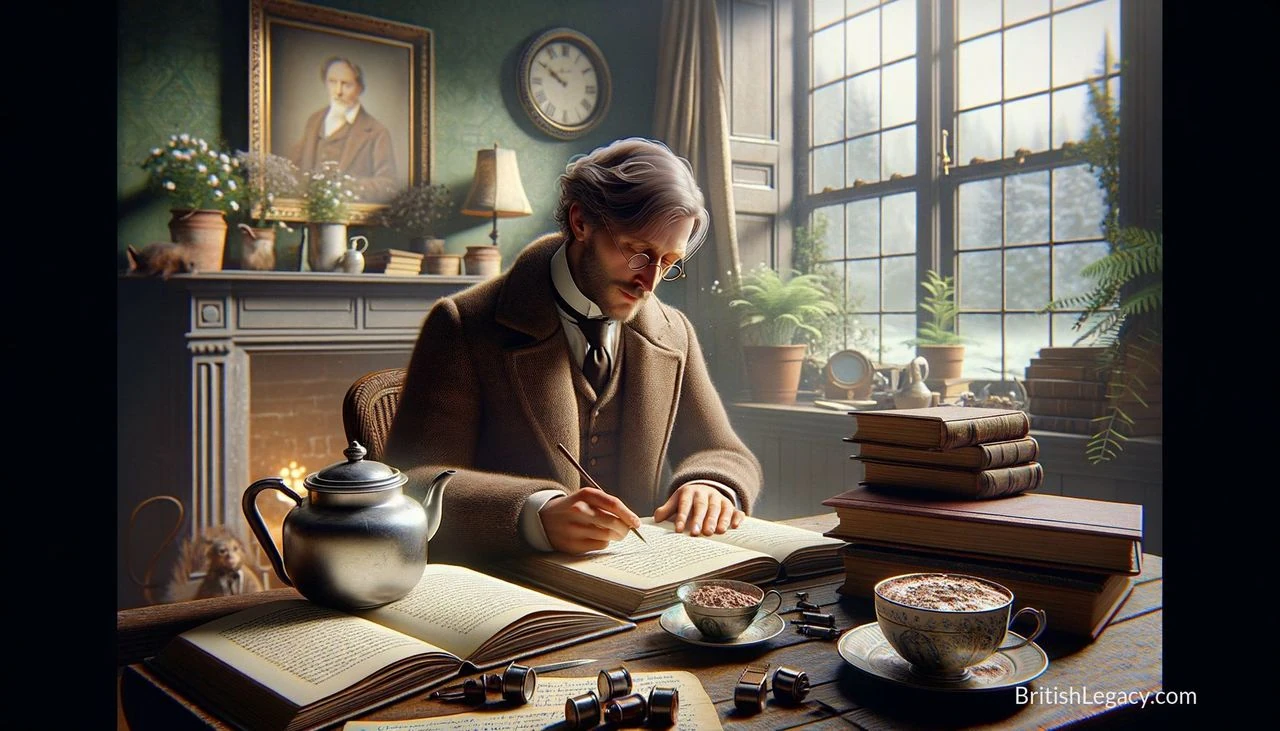
Wendy Cope’s poems can turn an ordinary frustration or a moment of affection into something sharply memorable. Their wit is often compact, but it rests on deliberate craft: rhyme, metre and the timing of a final turn. Since her debut collection, Making Cocoa for Kingsley Amis, appeared in 1986, Cope has built a body of work that moves between comic verse, intimate relationships and darker reflections.
From Kent to the classroom
Cope was born in Erith, Kent, on 21 July 1945. She attended West Lodge Preparatory School in Sidcup and Farrington’s School in Chislehurst, then read history at St Hilda’s College, Oxford. After graduating, she also attended Westminster College, Oxford. Her early working life was not that of a full-time poet: she spent fourteen years teaching at primary-school level.
In 1981, Cope became arts and reviews editor of Contact, a magazine published by the Inner London Education Authority. Five years later, she left teaching for freelance writing. She worked as a television critic for The Spectator until 1990. These changes brought literary work into the centre of her working life, but her career developed through distinct roles rather than a single leap from classroom to book publication.
A debut and a recognisable voice
Making Cocoa for Kingsley Amis, published in 1986, established the compressed, nimble verse for which Cope became widely known. The book’s poems often take everyday experience as their subject, giving frustrations, hopes and confusions a clear shape through rhyme and a dry, sometimes surprising punchline. Some are presented as the work of the fictional poet Jason Strugnell, a device that lets Cope play with poetic voice as well as with comic form.
The collection’s reception helped make Cope a popular poet, but her work is not simply a sequence of jokes. Its neat structures can carry pointed observations about relationships and social expectations. The lightness of a poem’s manner need not make its subject trivial; a change of tone or a well-placed ending can expose tensions that a more solemn treatment might leave untouched.
Cope’s second adult collection, Serious Concerns, followed in 1992. The title signals a seriousness alongside the comic reputation, while the book retained the concise formal qualities associated with her writing. Her next collections appeared at intervals: If I Don’t Know in 2001, Family Values in 2011 and Anecdotal Evidence in 2018. Cope has described the first two collections as different from the later three, linking changes in her writing to changes in her happiness and circumstances. Across the books, her work makes room for both lightness and more difficult feeling.
More than a comic poet
Cope’s style is often recognised through its formal control: short lines, rhyme and a conversational surface that can deliver a turn with little fuss. That combination makes poems approachable without making them effortless. The everyday details are selected and arranged; the apparent ease depends on decisions about sound, pace and what to leave unsaid.
Her output also reaches beyond adult poetry collections. She published the children’s collections Twiddling Your Thumbs in 1988 and The River Girl in 1991, and edited several anthologies of comic and other verse. Her editorial work includes The Orchard Book of Funny Poems and The Funny Side: 101 Humorous Poems. In 2007 she served as a judge for the Man Booker Prize, taking part in the assessment of fiction as well as building her own career as a poet.
Individual poems have travelled into other forms. In 1990, composer Colin Matthews set three haikus from the first collection, attributed there to Jason Strugnell, as Strugnell’s Haiku. In 2008, Cope’s poem “After The Lunch” became the lyric for “Waterloo Bridge”, a song by Jools Holland and singer Louise Marshall. These adaptations show how a poem’s rhythm and voice can be heard as well as read.
Recognition, readers and a literary archive
Cope’s standing has been marked by literary honours and public recognition. She was elected a Fellow of the Royal Society of Literature in 1992. In a 1998 BBC Radio 4 poll, listeners chose her as their preferred successor to Ted Hughes as Poet Laureate. She was again widely considered a popular candidate when Andrew Motion’s term ended in 2009, although Cope has said she believes the post should be discontinued; Carol Ann Duffy was appointed instead.
In 2010, Cope was appointed an Officer of the Order of the British Empire. The following year, the British Library purchased her archive: manuscripts, school reports, poetry notebooks, unpublished poems and 40,000 emails. The collection gives researchers material not only from the finished books but from the records of a writer’s working and everyday life. Cope said she wanted the archive to have a good home; the sale also helped meet the practical costs of moving house.
Her later publications include Life, Love and The Archers (2014), a collection of recollections, reviews and other prose, and Collected Poems (2024). In 2019, she appeared on BBC Radio 4’s Desert Island Discs, where her chosen book was The Compleet Molesworth by Geoffrey Willans. Such details sit alongside, rather than above, the poems: they sketch a working literary life shaped by reading, writing, editing and public engagement.
Why Wendy Cope deserves a place in British Legacy
Wendy Cope’s place in British literary life rests on more than a familiar comic manner. Her poetry takes the ordinary seriously enough to shape it: a conversation, a relationship or a private disappointment can become a tightly made poem whose rhythm helps carry its meaning. The popularity of her work and its literary recognition have developed together, showing that formal precision need not distance readers. Cope’s poems can be direct without being careless, funny without being slight, and emotionally alert without announcing every feeling.
Her contribution also extends through the different settings in which poetry reaches readers. She has written for adults and children, edited anthologies, served as a major literary prize judge and seen poems adapted for music. Her election to the Royal Society of Literature, OBE and place in the public conversation about the Poet Laureate reflect that wider standing. The British Library’s acquisition of her papers preserves drafts, notebooks and correspondence for future study, making the work’s creation as well as its published result available to researchers. Together, these achievements connect a distinct poetic voice with the institutions, readers and forms through which British literature is made and remembered.
Sources
Wendy Cope — Wikipedia revision 1377930219 · Wendy Cope — Wikipedia
Adapted in part from Wendy Cope by Wikipedia contributors, under CC BY-SA 4.0. Text has been edited and combined with the existing article; this adapted text is shared under the same licence. Contributor history.