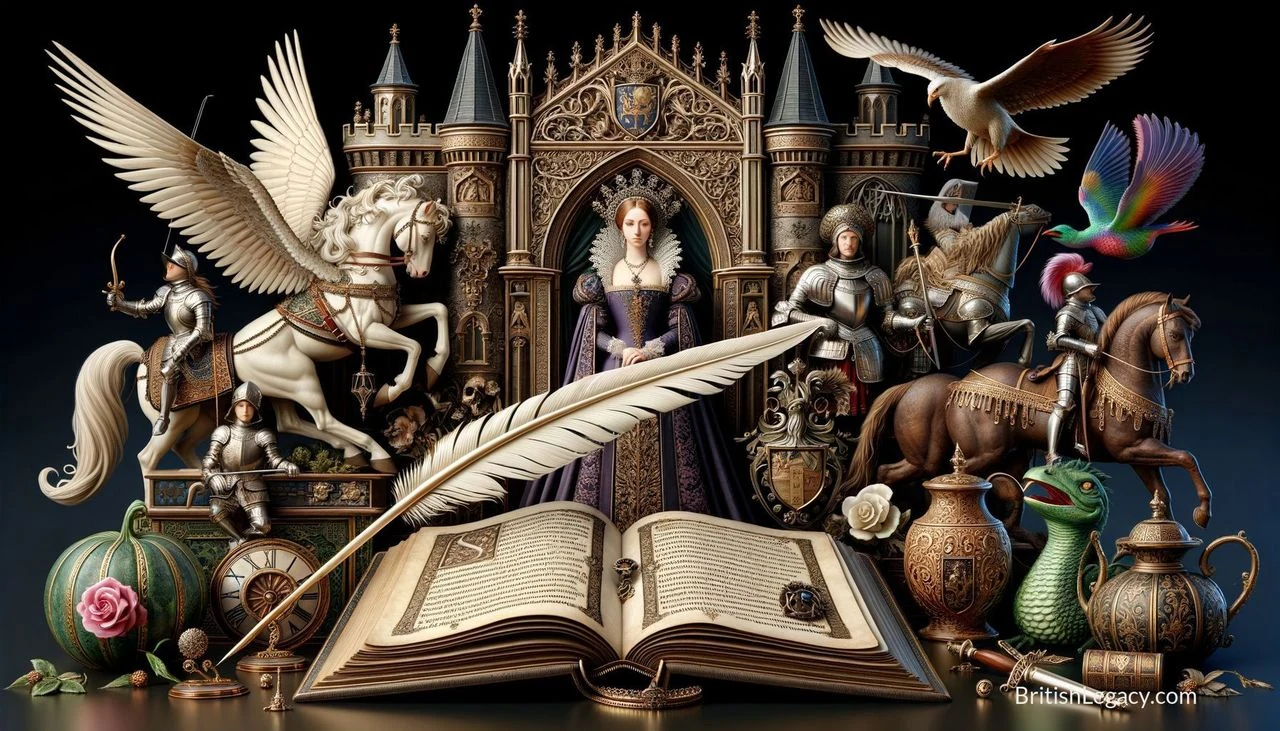
Edmund Spenser’s The Faerie Queene offers knights, quests and a fantastical world, but its ambitions were also political and moral. Published in two groups of books in 1590 and 1596, the epic celebrated Elizabeth I and the Tudor dynasty while presenting a series of encounters with virtue. Spenser’s influence reached beyond that poem: he shaped a distinctive stanza form, wrote pastoral and love poetry, and produced a fiercely prescriptive account of Ireland that exposes the politics behind his literary world.
Education and an early literary circle
Spenser was born in London around 1552; the precise date is uncertain. He attended Merchant Taylors’ School and entered Pembroke College, Cambridge, as a sizar, later taking an MA. At Cambridge he became friends with Gabriel Harvey, a fellow poet and intellectual with whom he would continue to exchange ideas, despite differences in their views on poetry. Spenser’s verse drew on classical writers such as Virgil and Ovid, as well as earlier traditions including Chaucer and Petrarch, but his work developed its own deliberately archaic language and forms.
In 1578 he briefly served as secretary to John Young, Bishop of Rochester. The following year he published The Shepheardes Calender, a set of pastoral poems organised around the months of the year. It appeared under the name Immerito and established a literary voice that could draw on pastoral convention while addressing questions of poetry and public life. Around this time he married Machabyas Childe; they had two children.
In 1580 Spenser travelled to Ireland in the service of Arthur Grey, the newly appointed Lord Deputy. He served under Grey during the siege of Smerwick and remained in Ireland after Grey’s recall to England, holding other official posts. In the late 1580s he acquired Kilcolman, an estate in North Cork. Ireland became more than the setting of his administrative career: it was the subject of a political treatise whose arguments reveal a starkly colonial outlook.
An epic for Elizabeth’s reign
Spenser travelled to London to publish and promote the first three books of The Faerie Queene, which appeared in 1590. The work is an unfinished epic: Spenser indicated that he intended twelve books, but only six were published in his lifetime, with the second group appearing in 1596. Its knights encounter challenges framed around particular virtues, and the poem’s allegory can be read on several levels, including as praise of Elizabeth I. In his account of his aims, Spenser described the poem as a way to form a person in virtuous and gentle discipline.
The poem’s figures connect moral instruction with the politics of the court. The Redcrosse Knight is associated with Holiness, while Gloriana, the Faerie Queene, is commonly read in relation to Elizabeth. This is not simply a sequence of adventures: allegory allows Spenser to bring together religious belief, ideas of good government and the projection of royal authority. The epic’s scale and fantastical invention made room for praise, but Spenser’s writing could also unsettle the people around the monarch. His later satire Mother Hubberd’s Tale antagonised Elizabeth’s principal secretary, William Cecil, Lord Burghley.
The work also made a lasting formal contribution. Spenser used a nine-line stanza, mostly in iambic pentameter, with a final longer line and the rhyme scheme ababbcbcc. Now known as the Spenserian stanza, it gave The Faerie Queene a distinctive structure for sustaining its extended narrative. Spenser also linked the rhymes of successive quatrains in his sonnets. His choices of form became part of his literary inheritance: later poets, including John Milton and Romantic writers, admired or drew on his work.
Love poetry and the politics of Ireland
Spenser’s writing was not confined to epic. Complaints (1591) gathered poems in mournful and satirical registers. In 1595, Amoretti and Epithalamion brought together sonnets about his courtship of Elizabeth Boyle and a wedding poem written for their marriage. His first wife had died by 1594, the year he married Boyle. He also wrote Prothalamion, a wedding song for two daughters of a duke, and hymns, elegies and pastoral works. Across these forms, he could move between intimate celebration, literary play and public ambition.
His 1596 prose work A View of the Present State of Ireland demands a different kind of attention. Written as a dialogue and circulated in manuscript, it argued that English control required the destruction of Irish language and customs, by violence if necessary. Spenser criticised Irish laws, customs and religion, and endorsed coercive measures, including the use of famine to break resistance. These are not incidental views that can be separated from his career in Ireland: they are an explicit part of his political writing and of the colonial project in which he served.
In 1598, during the Nine Years’ War, Irish forces under Hugh O’Neill drove Spenser from Kilcolman and burned the castle. The following year he travelled to London, where he died on 13 January 1599. He was buried in Westminster Abbey, near Geoffrey Chaucer, in the area later known as Poets’ Corner. The first three books of The Faerie Queene had brought him a royal pension; his literary success did not remove him from the upheavals of the political world in which he worked.
Conclusion
Spenser’s writing joins formal invention and moral purpose to the political circumstances in which he lived. His poetry can be read for its allegory, its experiments with verse and its representations of royal authority; his prose on Ireland makes the coercive assumptions behind some of that political world unmistakable.
Why Edmund Spenser deserves a place in British Legacy
Spenser merits a place in British literary history because he helped enlarge what English poetry could do. In The Faerie Queene, a carefully patterned stanza supports an expansive story in which quests can carry moral and political meaning. The poem’s incomplete design does not diminish its scale or its afterlife: its first six books gave later writers a demanding model for sustained allegory, while the Spenserian stanza offered a form that poets after him could adapt. His pastoral, sonnet and wedding poetry show that his achievement was not confined to one epic or one register.
That legacy is more useful when remembered in full. Spenser’s praise of Elizabeth and his experiments in poetic form belong alongside his service in Ireland and his argument for violently imposing English rule there. A View of the Present State of Ireland makes clear that literary achievement and political power could be intertwined, and that the ideals of virtue and order in his poetry existed alongside a programme of colonial coercion. For British Legacy, this tension matters: it enables readers to understand both the influence of an English Renaissance poet and the costs and assumptions embedded in the history his work reflects. His place rests not on an uncomplicated celebration, but on the enduring significance of his writing and the need to read it with historical attention.
Sources
Edmund Spenser — Wikipedia revision 1374047222
Adapted in part from Edmund Spenser by Wikipedia contributors, under CC BY-SA 4.0. Text has been edited and combined with the existing article; this adapted text is shared under the same licence. Contributor history.