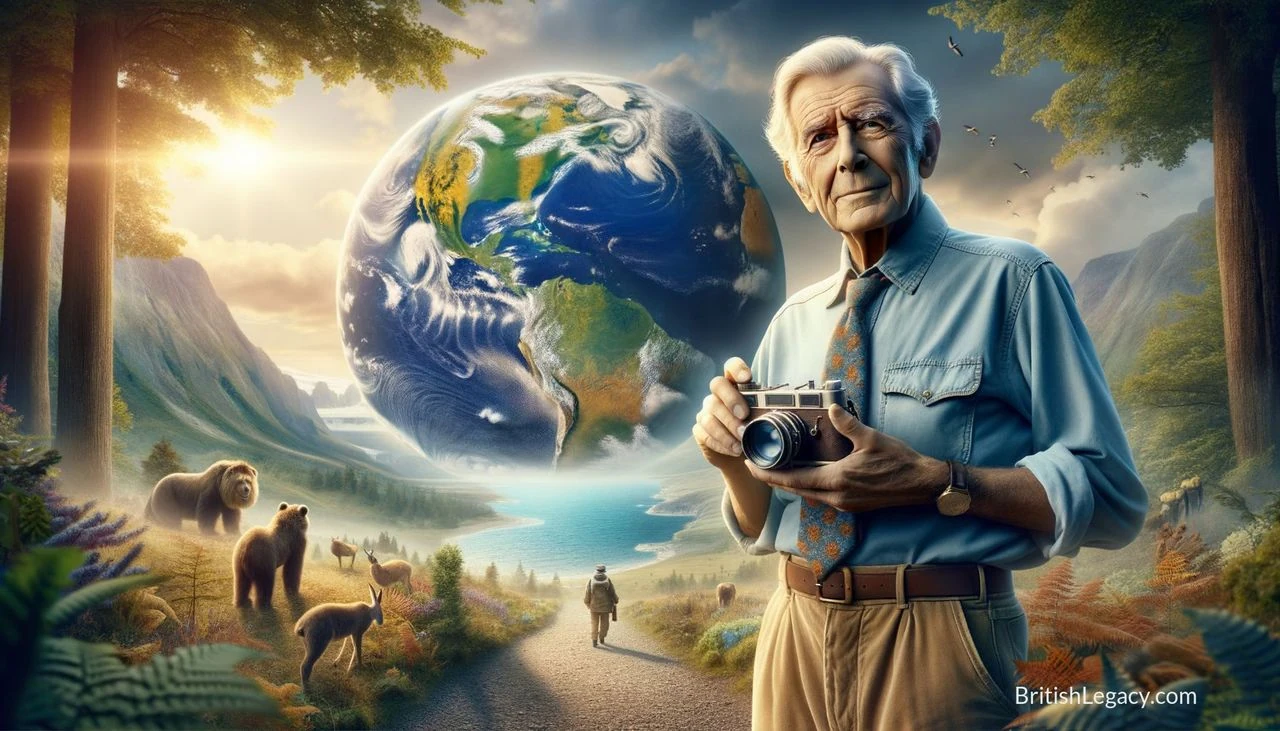
David Attenborough’s career has joined natural history to the changing possibilities of British television. He began presenting wildlife programmes with Zoo Quest in 1954, helped shape BBC Two as its controller, then returned to programme-making for a series of ambitious films that took viewers from animal behaviour to the history of life. Across more than seven decades, his work has made unfamiliar species and habitats part of popular conversation—and, increasingly, made the pressures on them impossible to ignore.
From collecting fossils to the BBC
David Frederick Attenborough was born in Isleworth, Middlesex, on 8 May 1926, and grew up in Leicester, where his father, Frederick, was principal of University College Leicester. As a child, he collected fossils, stones and other natural specimens. A lecture by the conservationist Grey Owl, which Attenborough attended with his brother Richard in 1936, helped foster an interest in the risks posed to nature by human activity.
He studied geology and zoology at Clare College, Cambridge, after winning a scholarship, and graduated in natural sciences. Following two years of national service in the Royal Navy, he worked on children’s science textbooks. In 1950 he applied unsuccessfully for a BBC radio job; his application nevertheless drew the attention of Mary Adams, head of the BBC’s factual broadcasting department. He joined the corporation full-time in 1952, first as a producer in its Talks department.
His early television work included producing Animal Patterns, a studio series about animal behaviour, camouflage and courtship. It brought him together with Jack Lester of London Zoo. Their plans for an expedition series became Zoo Quest, first broadcast in 1954. When Lester fell ill, Attenborough stepped in as presenter. The programme launched a distinctive combination: natural history filmed on location, with a presenter guiding viewers through what they were seeing.
A producer, a controller and a return to filming
When the BBC’s Natural History Unit was established in Bristol in 1957, Attenborough declined an invitation to join it, preferring not to move his young family from London. Instead he formed the Travel and Exploration Unit, which enabled him to continue making Zoo Quest and other factual programmes. He briefly left the BBC’s permanent staff to study social anthropology at the London School of Economics, but returned in 1965 as controller of BBC Two.
Attenborough’s work in management extended beyond natural history. He aimed to give the new channel a varied identity, commissioning programmes in areas including the arts, science, sport, comedy and current affairs. His commissions included Monty Python’s Flying Circus, The Old Grey Whistle Test, Chronicle and The Money Programme. He also backed Civilisation, Kenneth Clark’s landmark series about Western art, and Jacob Bronowski’s The Ascent of Man. These choices helped establish BBC Two as a home for substantial, authored factual television.
Promoted to director of programmes in 1969, Attenborough became responsible for the output of both BBC television channels. The management role took him further from filming, and in 1973 he left it to return to making programmes. He travelled to Indonesia for Eastwards with Attenborough, then began work on the series that would define a new phase of his career. The BBC’s eventual partnership with an American network helped fund Life on Earth, which was broadcast in 1979.
Building a landmark body of natural history
Life on Earth began a set of major series that included The Living Planet (1984) and The Trials of Life (1990). Rather than treating wildlife as a succession of isolated curiosities, the programmes connected organisms to their environments and explored adaptation, ecology and behaviour. International travel and new filming techniques helped crews capture events that had rarely been shown on television. Attenborough presented on screen, but made room for the animals and their habitats to carry the story.
He continued the work with programmes on Antarctica, plants, birds, mammals, invertebrates and reptiles. The Private Life of Plants (1995), for example, used time-lapse photography to show growth and movement that would otherwise be difficult to see. With Life in Cold Blood in 2008, the series had covered the major groups of terrestrial animals and plants. Attenborough later included First Life, about evolutionary history before Life on Earth, in the wider collection.
He was also a familiar voice across other BBC natural history programmes. He narrated Wildlife on One, which ran for 253 episodes between 1977 and 2005, and presented or narrated series including Natural World and the BBC Wildlife Specials. In 2001, he narrated The Blue Planet, the Natural History Unit’s first comprehensive series on marine life. The team reunited for Planet Earth (2006), the BBC’s first wildlife series filmed in high definition. Attenborough returned for Planet Earth II in 2016 and presented Blue Planet II in 2017.
His work has continued across formats and subjects: he narrated the radio monologues David Attenborough’s Life Stories, appeared in the polar series Frozen Planet, and presented Life in Colour in 2021. Later projects included Dinosaurs: The Final Day, Prehistoric Planet and, in 2025, Wild London. The changing technology behind these programmes—from colour television to high definition and 3D—has been part of their history, not simply a backdrop to it.
Conservation moves into the foreground
Environmental concerns were present in Attenborough’s programmes well before they became more explicit in his later work. State of the Planet (2000) examined the effects of human activity on the natural world; subsequent films addressed climate change and population growth. From the turn of the millennium, his authored documentaries increasingly set the beauty of nature alongside evidence of its damage.
In 2019 he narrated Netflix’s Our Planet, which placed human impacts more centrally than many of his earlier series. That year he also presented the BBC films Climate Change – The Facts and Extinction: The Facts. In David Attenborough: A Life on Our Planet (2020), he looked back on changes witnessed during his career and set out concerns for the future. He spoke at the opening of the 2021 United Nations Climate Change Conference in Glasgow, urging leaders to act, and in 2022 the United Nations Environment Programme named him a Champion of the Earth for his work documenting and advocating for the protection and restoration of nature.
His conservation work has also included support for organisations and specific projects. He has backed campaigns to protect rainforest and reduce the killing of albatross by longline fishing, and helped launch ARKive, a digital library of natural history media. He has held roles with groups including Butterfly Conservation and the Leicestershire and Rutland Wildlife Trust. His environmental advocacy has not been without debate: the Wikipedia account records criticism that some programmes give too little prominence to threats, as well as his own concern that repeatedly stressing threats can turn viewers away. His later films have made those issues more direct.
Honours and a lasting public presence
Attenborough was appointed a Commander of the Order of the British Empire in 1974 for services to nature conservation and knighted in 1985. He later received the Order of Merit and was made a Knight Grand Cross of the Order of St Michael and St George in 2020. His awards include the BAFTA Fellowship, the Kalinga Prize for the popularisation of science, the Peabody Award and the 2024 Stephen Hawking Medal for Science Communication.
His influence is reflected not only in awards but in the institutions and programmes associated with his career. He served as controller of BBC Two and director of programmes, as well as a long-running presenter and narrator. A BBC Natural History Unit series could bring animal behaviour, ecology and conservation to a large audience, while his programmes also helped demonstrate how new filming technology could reveal previously unseen details. In 2009, the Natural History Museum in London opened the Attenborough Studio; a British polar research ship was later named in his honour.
Attenborough’s wife, Jane, whom he married in 1950, died in 1997. They had two children. He has continued working into later life, and his hundredth birthday in 2026 was marked by a BBC One programme, David Attenborough’s 100 Years on Planet Earth. The milestone also prompted the announcement that he would narrate Blue Planet III.
Why David Attenborough deserves a place in British Legacy
David Attenborough’s place in British Legacy rests on more than a celebrated voice or a catalogue of wildlife programmes. His career connects several important parts of British broadcasting: the BBC’s factual output, the development of BBC Two, the Natural History Unit’s international film-making and the movement from black-and-white television to high definition and newer formats. As controller, he commissioned a broad range of work; as a programme-maker, he helped make natural history a sustained, ambitious form of television rather than an occasional diversion.
The consequences reach beyond broadcasting. Series such as Life on Earth, The Blue Planet and Planet Earth have given viewers ways to understand animal behaviour, habitats and the interdependence of living things. His later documentaries have put that knowledge in conversation with conservation, presenting evidence of climate change, biodiversity loss and human pressure on nature to audiences at home and internationally. He has also supported conservation organisations and efforts to protect habitats and wildlife. This is a specific British legacy: a public-service broadcasting tradition used to explain the natural world, and a body of work that has helped bring both its wonders and its vulnerabilities into the national conversation.
Sources
David Attenborough — Wikipedia revision 1377734588 · David Attenborough — Wikipedia
Adapted in part from David Attenborough by Wikipedia contributors, under CC BY-SA 4.0. Text has been edited and combined with the existing article; this adapted text is shared under the same licence. Contributor history.