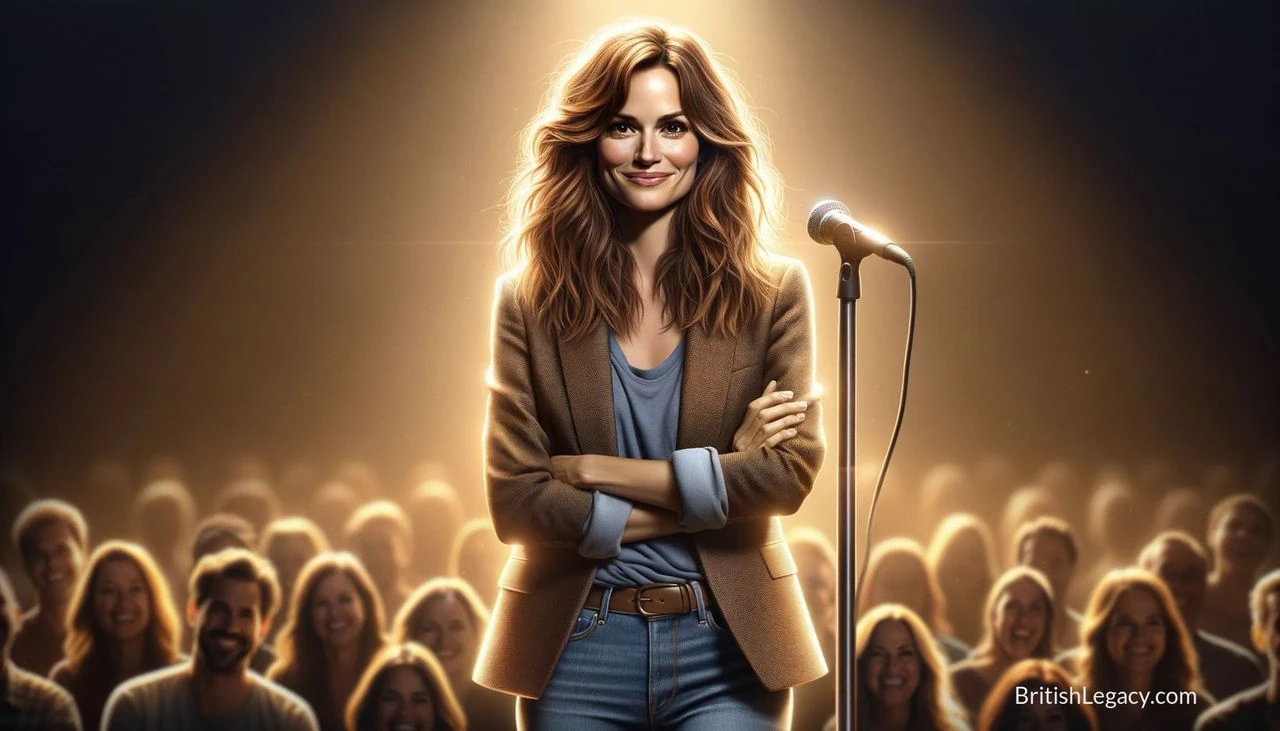
Miranda Hart made a comic persona out of being conspicuously out of step: physically ungainly, socially awkward and willing to let an audience see the joke coming. In her BBC sitcom Miranda, that persona became the centre of a self-written, semi-autobiographical comedy. The series made her a familiar television presence, while her role as Chummy in Call the Midwife showed her working in a very different register. Her career has also encompassed earlier sitcom roles, live performance, film and several books.
A route into comedy
Hart was born in Torquay, Devon, on 14 December 1972. She grew up in Petersfield, Hampshire, and attended Downe House, an independent girls’ boarding school near Thatcham, Berkshire. She studied political science at the University of the West of England in Bristol, graduating with a 2:1, and then completed postgraduate acting training at the Academy of Live and Recorded Arts in London.
Before she led a series of her own, Hart built experience through parts in British television comedy. She appeared in French & Saunders, Smack the Pony, Nighty Night and The Vicar of Dibley, among other programmes. In Hyperdrive, the BBC science-fiction sitcom, she played Teal across two series. On Not Going Out, she first appeared as an acupuncturist; producers subsequently developed the recurring role of Barbara, a sarcastic and clumsy cleaner, for her.
Hart also developed her work in front of live audiences, favouring character comedy over the conventional stand-up circuit. Her one-woman shows included Miranda Hart – Throbs, It’s All About Me and Miranda Hart’s House Party. She performed in Alecky Blythe’s play Cruising at the Bush Theatre in 2006 and later toured the UK and Ireland with My, What I Call, Live Show, her first tour, in 2014.
Building Miranda
The television series grew from Hart’s earlier radio comedy, Miranda Hart’s Joke Shop, broadcast on BBC Radio 2 in 2008. After pitching a comedy to the BBC in 2004, she developed the idea into Miranda, a sitcom she wrote and starred in. It began on BBC Two in November 2009. Hart played Miranda Preston, a fictionalised version of herself whose misadventures were shaped by her awkwardness and her habit of looking directly at the audience.
The ensemble included Sarah Hadland, Tom Ellis, Patricia Hodge, James Holmes and Sally Phillips. Hodge played Miranda’s mother, Penny, while Ellis played her friend Gary. The show’s direct address and visible comic self-awareness made the audience part of its rhythm: Miranda could share a reaction before the scene had fully moved on. The style was described as old-fashioned, but Hart’s performance and writing gave the sitcom its own pace and point of view.
The first series brought Hart the Royal Television Society award for comedy performance in 2009. The programme went on to win British Comedy Awards, including Best New TV Comedy and awards for Hart’s acting, and attracted BAFTA nominations. A second series began in 2010, and a third followed on BBC One from December 2012. Hart announced in 2014 that the story would conclude with two final episodes, which aired that December. A tenth-anniversary programme, filmed at the London Palladium and presented as a celebration rather than a new episode, was broadcast on BBC One on 1 January 2020.
Hart’s television work during these years was not confined to her own show. She appeared as a guest host on Have I Got News for You, presented the one-off programme When Miranda Met Bruce with her comedy hero Bruce Forsyth, and co-presented segments at the Diamond Jubilee Concert in 2012. In 2017 she presented the Royal Variety Performance in the presence of the Duke and Duchess of Cambridge. She was the first solo female presenter of the event in 105 years.
Chummy and other roles
From 2012 to 2015, Hart played Camilla “Chummy” Fortescue-Cholmondeley-Browne in the BBC period drama Call the Midwife. The part placed her in a more dramatic setting than Miranda, while retaining room for comedy. Chummy’s social awkwardness and kindness made the character a natural fit for Hart’s strengths, but the role also asked her to carry scenes of tenderness and emotional weight. Hart received a BAFTA nomination for supporting actress for the drama and won a National Television Award for outstanding drama performance.
Her screen work has included both comic and supporting parts in films. She appeared in the comedy Spy in 2015 and played Miss Bates in the 2020 film adaptation of Jane Austen’s Emma. Other work includes a voice role in Tales of the Riverbank and a cameo in The Infidel. On stage, she was announced in 2017 as the West End production of Annie’s Miss Hannigan, a part that brought her character-based comedy into a musical theatre setting.
Hart has also been involved in Comic Relief and Sport Relief programmes. In 2010, she joined six other television personalities cycling from John O’Groats to Land’s End for Sport Relief; the group raised more than £1 million. She won a Comic Relief edition of Celebrity MasterChef in 2011, and co-presented Sport Relief in 2012. Her charity work has included appearances and performances, rather than being limited to the screen roles for which she is best known.
Writing beyond the sitcom
Hart’s books extend the personal, conversational voice of her comedy into print. Is It Just Me?, published in 2012, combines anecdotes and advice. She followed it with Peggy and Me, published in 2016, and Miranda Hart’s Daily Dose of Such Fun! in 2017, produced in partnership with Comic Relief. Her other books include the children’s story The Girl with the Lost Smile and The Best of Miranda, a collection of scripts from the television series.
In 2024, Hart published her memoir, I Haven’t Been Entirely Honest with You. That year she also spoke publicly about a prolonged period of illness. In the book, she wrote that she had been diagnosed with Lyme disease and had experienced ME/CFS, describing how her health had affected her life. These details form part of her own account of her illness; they are distinct from the comic characters and performances that established her public career.
Why Miranda Hart deserves a place in British Legacy
Miranda Hart’s place in British Legacy rests first on the particular achievement of Miranda: a successful BBC sitcom that she created, wrote and led, rather than simply performing a part within someone else’s format. Its semi-autobiographical premise made room for a heroine whose awkwardness was not a problem to be tidied away before the story could begin. Hart’s direct address to the audience gave the comedy an unusually open relationship with viewers, while its recurring characters and domestic setting grounded the jokes in a recognisable sitcom world. The awards and nominations associated with the series mark its professional success; its longer significance lies in how clearly it expressed Hart’s own comic voice.
Her contribution is not confined to that one series. As Chummy in Call the Midwife, Hart carried a distinctive comic sensibility into a popular period drama and took on a role with both humour and emotional range. Her live shows, film work and books show a performer who has moved between forms while continuing to write from a personal perspective. Her participation in Comic Relief and Sport Relief also connects that public career with fundraising and charity broadcasting. Taken together, these achievements make her an identifiable part of modern British entertainment: an actor and writer whose work has reached audiences through the BBC, the stage, film and publishing, and whose best-known comedy turned social discomfort into a source of connection rather than embarrassment.
Sources
Miranda Hart — Wikipedia revision 1379411549 · Miranda Hart — Wikipedia
Adapted in part from Miranda Hart by Wikipedia contributors, under CC BY-SA 4.0. Text has been edited and combined with the existing article; this adapted text is shared under the same licence. Contributor history.