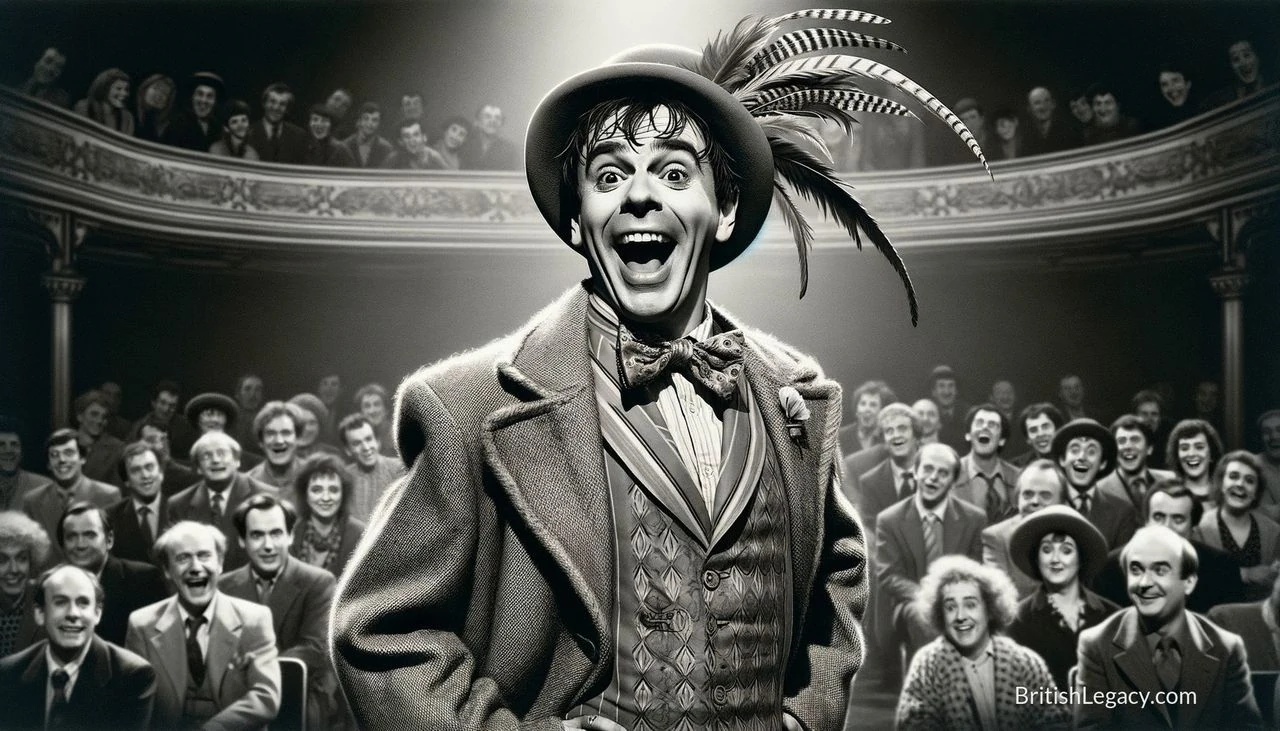
Harry Enfield’s characters have included a plasterer flaunting his earnings, a perpetually irritable teenager and a well-meaning upper-class innocent. Their comedy depends on recognition: an exaggerated voice or mannerism makes a social type instantly legible, then leaves room for the joke to turn on the audience’s own assumptions. Enfield developed that approach across television sketch shows, often working with Paul Whitehouse and Kathy Burke, and later carried it into sitcoms, films and other performances.
From Horsham to Saturday Live
Born Henry Richard Enfield in Horsham, Sussex, on 30 May 1961, he was the eldest of four children and the only son of journalist and presenter Edward Enfield and Deirdre Jenkins. He spent his childhood in Billingshurst, West Sussex, and was educated at Arundale School in Pulborough, Dorset House School, Worth School and Collyer’s Sixth Form College. He studied politics at the University of York, where he belonged to Derwent College. Before his comedy career took off, he squatted in Hackney and worked as a milkman.
Enfield began in comedy writing: after being recruited at the Edinburgh Fringe Festival, he wrote for three episodes of the Radio 4 programme Week Ending in 1982–83. In 1985 he took a voice-acting role in the satirical puppet series Spitting Image, alongside performers including Chris Barrie, Rory Bremner, Steve Coogan, Hugh Dennis and Ade Edmondson.
His public profile grew through Channel 4’s Saturday Live, where he appeared from 1986 to 1988 in characters created with Whitehouse. Stavros, a Greek kebab-shop owner with fractured English, was among them. So was Loadsamoney, an obnoxious plasterer who boasted about his earnings. The character was devised in reaction to the policies of the Thatcher government and became a conspicuous satire of money and materialism. Its popularity outgrew the sketches: Loadsamoney spawned a hit single in 1988 and a sell-out live tour. Enfield and Whitehouse also created Bugger-All-Money, a Geordie foil to the brash plasterer. They became concerned that audiences were taking Loadsamoney as a positive figure, rather than a satirical one; in a Comic Relief Red Nose Day sketch, he was run over after presenting Lenny Henry with an enormous cheque for ten pence.
A sketch-show world of recurring characters
Enfield developed Harry Enfield’s Television Programme for the BBC in 1990 with Whitehouse and Kathy Burke. The programme was later retitled Harry Enfield & Chums. Rather than following the alternative-comedy style prevalent at the time, the shows drew on the tradition of performers such as Dick Emery and Morecambe and Wise. The format gave Enfield and his collaborators room to return to characters and build their comic identities over time.
Among the best-known were Tim Nice-But-Dim, a genial but dim-witted upper-class figure; the Scousers, a trio from Liverpool whose confrontational manner and exaggerated speech were central to their sketches; and Wayne and Waynetta Slob, a deliberately grotesque couple. Kevin began as the Annoying Kid Brother before growing into Kevin the Teenager, whose sulks and outbursts turned the strains between adolescents and adults into a recurring comic premise. Other creations included the Old Gits, the ageing rock stars Smashie and Nicey, Mr You-Don’t-Wanna-Do-It-Like-That, and the old-fashioned presenters Mr Cholmondley-Warner and Grayson.
These figures were not simply a gallery of catchphrases. They made class, money, age and social behaviour available for comic scrutiny, although individual sketches relied on exaggeration and could be grotesque. The characters’ sharply defined voices and habits helped the audience recognise the type; the sketches then played with that recognition. Enfield’s success rested in part on the contrasts between them, from Loadsamoney’s self-display to Tim Nice-But-Dim’s complacent innocence and Kevin’s everyday adolescent resistance.
Beyond the sketch format
Enfield’s television work extended into sitcom and drama. He played Dermot in Men Behaving Badly, leaving after its first series, and appeared as Little Jim Morley in Gone to the Dogs. In 2002 he returned to the BBC as ageing rock star Gary Bloke in Celeb. He later played Jim Stonem in Skins, appearing across three series and directing two episodes of its second series. He also appeared as Alfie’s father in Bad Education, and in 2016 took the role of John Shakespeare, father of William, in Upstart Crow.
In 2007, Enfield and Whitehouse created and starred in Harry & Paul, initially titled Ruddy Hell! It’s Harry and Paul. Their work on the series earned them the 2009 BAFTA Television Award for Best Comedy Programme, shared jointly. They received further recognition for the series, including a British Comedy Award for Best Sketch Show in 2009. In 2015 the pair marked their 25-year partnership with An Evening With Harry Enfield and Paul Whitehouse. Enfield also played Prince Charles, later King Charles III, in Channel 4’s The Windsors; the role brought him a BAFTA nomination for Best Male Comedy Performance in 2017.
His film roles have included Kevin in Kevin & Perry Go Large (2000), King George VI in the historical satire Churchill: The Hollywood Years (2004), and Martin in The Bad Education Movie (2015). He also appeared in Swallows and Amazons (2016) as Mr Jackson. His work has ranged beyond scripted comedy, too: he fronted a Channel 4 documentary series about opera, narrated television documentaries and appeared in advertising, sometimes revisiting characters from his sketch shows.
Recognition and a continuing stage presence
Enfield and his collaborators received recognition for both writing and performance. Harry Enfield and Chums won the Writers’ Guild of Great Britain award for television light entertainment in 1995. Enfield was nominated for a National Television Award in 1997 and a BAFTA Television Award for Best Entertainment Performance in 1998. His later honours included the 2009 BAFTA and British Comedy Award wins for Harry & Paul, and a Royal Television Society Programme Award for comedy writing in 2015, shared with others.
His performance as Prince Charles in The Windsors also moved from television to the stage: in 2021 he appeared in The Windsors: Endgame at the Prince of Wales Theatre in London. In 2025 he launched the theatrical tour Harry Enfield and No Chums, with appearances in Australia and New Zealand later that year.
Enfield married Lucy Lyster in 1997; they have three children. The couple separated in August 2020. His career has remained closely associated with character comedy, but the range of his work—from early radio writing and puppet-show voices to sitcoms, films and stage performances—shows a performer working across formats as well as returning to the comic figures that first made him widely known.
Why Harry Enfield deserves a place in British Legacy
Harry Enfield deserves a place in British Legacy because his comedy made recognisable British social types a durable part of television sketch writing. Loadsamoney translated an argument about wealth and the politics of the 1980s into a character whose catchphrase, boasting and conspicuous spending could be understood immediately. Yet the story also shows the risks of satire: Enfield and Paul Whitehouse became concerned that audiences were reading the character as an endorsement rather than a criticism. That tension between the joke intended and the joke received is part of what makes the work worth remembering.
Across Harry Enfield’s Television Programme, Harry Enfield & Chums and Harry & Paul, recurring characters gave Enfield and his collaborators a way to explore class, money, age and social conduct through performance. The writing and acting were recognised with a Writers’ Guild award and later BAFTA and British Comedy Award wins, while Enfield’s work continued into sitcom, film, television drama and theatre. His British connection is specific: he built comic worlds from voices, habits and social types rooted in British life, and did so through programmes made for British television and performances on British stages. His career therefore represents not only a collection of familiar characters, but a sustained contribution to the country’s tradition of sketch and character comedy.
Sources
Harry Enfield — Wikipedia, revision 1378537933
Adapted in part from Harry Enfield by Wikipedia contributors, under CC BY-SA 4.0. Text has been edited and combined with the existing article; this adapted text is shared under the same licence. Contributor history.