
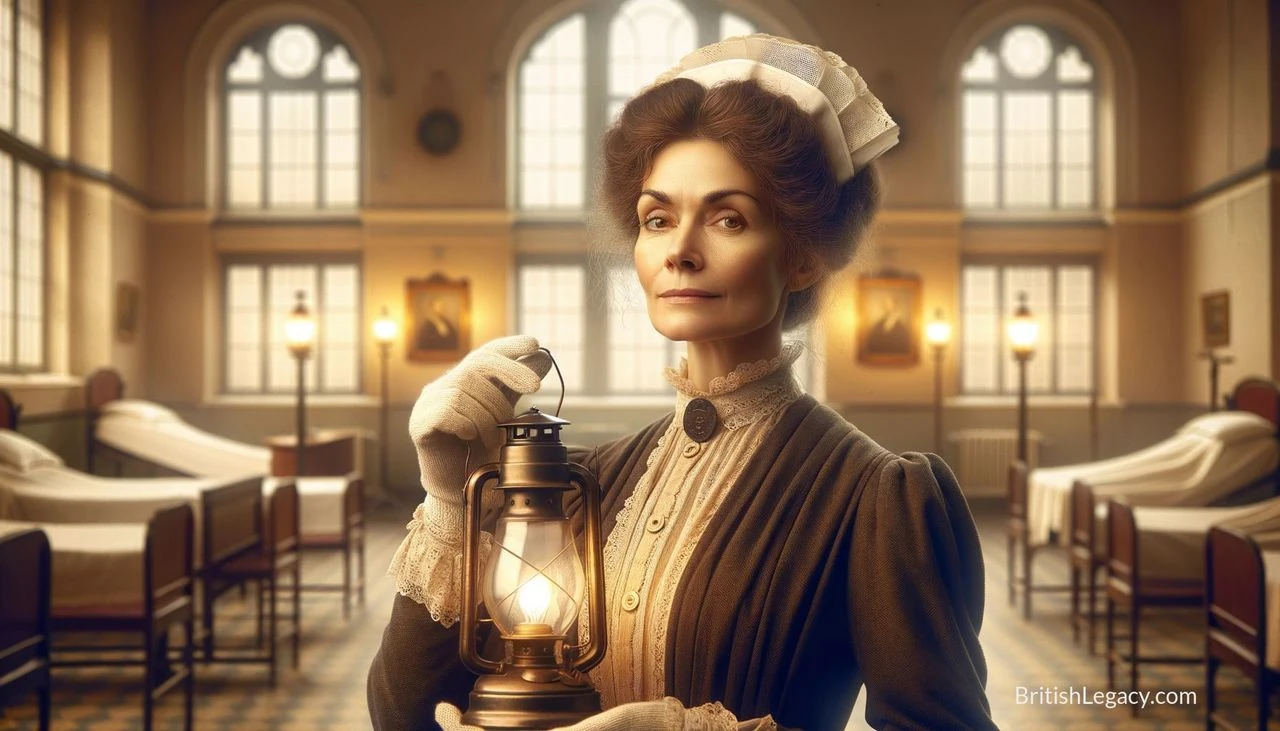
Florence Nightingale became famous as “The Lady with the Lamp”, but the image of her making night rounds at Scutari tells only part of her story. She helped establish professional nursing in Britain, pressed for sanitary reform in hospitals and homes, and used statistics to make the case for change. Her Crimean War experience mattered not simply as a tale of bedside care, but because it shaped a lifetime of work on how health services should be organised.
A vocation formed in a wealthy family
Nightingale was born in Florence on 12 May 1820, while her parents, William Edward and Frances Nightingale, were travelling in Europe. The family returned to England the following year. She grew up chiefly at Embley Park in Hampshire and Lea Hurst in Derbyshire, receiving a broad education that included mathematics, languages, history and literature. Her father taught her much of this curriculum himself.
In 1837, aged sixteen, she recorded what she later described as a call from God to service. It took years for that sense of purpose to become a commitment to nursing. The profession was not regarded as an appropriate career for a woman of her class, and her mother and sister opposed her plans. Nightingale nevertheless studied nursing and, in 1850, visited the Lutheran community at Kaiserswerth in Germany, where she observed care for sick and disadvantaged people and received four months of medical training.
In 1853 she became superintendent of the Institute for the Care of Sick Gentlewomen in Upper Harley Street, London. The post gave her practical responsibility before the Crimean War brought her work to wider public attention.
Scutari and the limits of a famous image
In 1854, after reports of poor conditions for wounded British soldiers reached Britain, Nightingale travelled to the Ottoman Empire with a group of nurses. They arrived at the military hospital at Scutari, near Constantinople, to find shortages of medicines and equipment, overcrowding, neglected hygiene and widespread infection. Nightingale organised nursing care in a difficult environment, while the familiar story of her carrying a lamp through the wards took hold in the British press.
The hospital’s high death rate was not a problem that nursing alone could solve. In the winter of 1854–55, more British soldiers died at Scutari from illnesses such as typhus, typhoid, cholera and dysentery than from battle wounds. The British government sent a Sanitary Commission in 1855; it cleared sewers and improved ventilation. Deaths fell sharply. Nightingale initially focused on such factors as poor nutrition, supplies and ventilation, and later concluded that unhealthy living conditions were central to the toll. She did not claim sole credit for the fall in deaths.
That distinction matters to her legacy. Her public reputation was built in part around a striking image, while her influence also came from collecting evidence, revising her understanding of what had gone wrong, and pressing for changes beyond the bedside. Her later work addressed the design and administration of hospitals as well as the conditions affecting health in homes and communities.
Training nurses and making evidence visible
After the war, a fund raised in recognition of Nightingale’s work helped establish a nursing school at St Thomas’ Hospital in London. The Nightingale Training School opened in 1860. Its programme helped make nursing a trained profession, with nurses taught to take responsibility for patient care and hospital organisation. Graduates went on to work in hospitals in Britain and overseas, carrying the training model beyond the school itself.
Nightingale also wrote for readers outside the profession. Notes on Nursing, first published in 1859, explained principles of care and health in accessible terms. Although associated with nursing education, it was written for people nursing at home as well as for professional nurses. Its subject was practical: how daily conditions could affect a patient’s chances of recovery.
Statistics were another instrument of reform. Nightingale used diagrams, including the polar area diagram often known as the Nightingale rose, to present patterns of mortality in a form that politicians and officials could grasp. She became the first woman elected to the Royal Statistical Society, in 1859. Her diagrams were not merely decorative illustrations: they helped turn tables of figures into arguments for action.
Her work widened beyond the army and the training of nurses. She investigated sanitation and health in India, arguing that drainage, clean water, ventilation and reduced overcrowding mattered to both soldiers and the wider population. She also supported the introduction of trained nurses into workhouses in Britain, where sick people had often been cared for by other poor residents rather than nursing staff with formal training. Her influence depended in part on her ability to use evidence and her access to officials who could act on it.
Reform, recognition and remembrance
Nightingale’s health was often poor after her return from the Crimea, and she spent long periods working from home. Even so, she continued to advise on nursing, public health and hospital planning. Her writing and campaigning addressed the organisation of care and the conditions that shaped illness, including in places far from the military hospitals that had first made her a public figure.
Her honours included the Royal Red Cross in 1883 and appointment as a Lady of Grace of the Order of St John in 1904. In 1907 she became the first woman awarded the Order of Merit. She died in London on 13 August 1910, aged ninety, and was buried at St Margaret’s Church in East Wellow, Hampshire.
Her name remains attached to institutions and commemorations linked to nursing. International Nurses Day is held on 12 May, her birthday, and the Florence Nightingale Medal recognises exceptional service in nursing. The Nightingale Pledge, used in some nursing ceremonies, also bears her name. These memorials continue to frame her as a pioneer, but the details of her work offer a more substantial account than the lamp alone: professional training, sanitary reform and the use of data to persuade decision-makers.
Why Florence Nightingale deserves a place in British Legacy
Nightingale’s place in British history rests on the institutions and methods she helped to build. The school at St Thomas’ Hospital made formal nurse training a lasting part of healthcare in London, and its influence extended through graduates who took professional nursing into hospitals elsewhere. Her work to bring trained nurses into workhouses also addressed a basic problem of care: sick people in poverty needed skilled attention, not simply the presence of another resident. These changes made nursing more organised and gave it a stronger professional standing.
She also showed how evidence could support practical reform. Her statistical diagrams made patterns of death easier for officials to understand; her work on sanitation in the army and in India connected health to drainage, water and living conditions. That combination of patient care, training, public health and clear presentation of evidence explains why her influence reached beyond the Crimean War. The lamp remains a memorable symbol, but her British legacy is more durable in the systems she helped shape and in the argument that healthcare improves when observation is turned into action.
Sources
Florence Nightingale — Wikipedia, revision 1375983362
Adapted in part from Florence Nightingale by Wikipedia contributors, under CC BY-SA 4.0. Text has been edited and combined with the existing article; this adapted text is shared under the same licence. Contributor history.
.jpg)