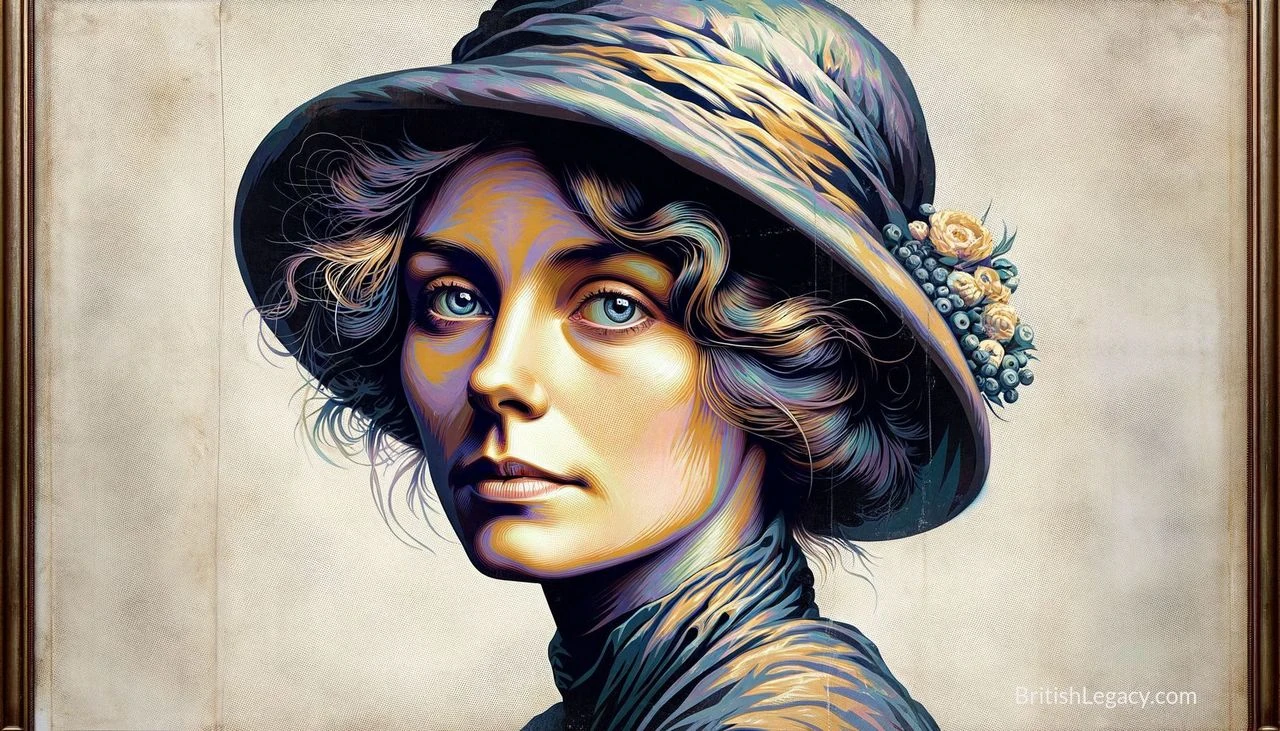
Virginia Woolf made the ordinary moments of a day carry the weight of memory, time and private thought. In novels such as Mrs Dalloway and To the Lighthouse, she loosened the grip of linear plot and followed consciousness as it moves: returning to the past, attending to passing impressions and shifting between lives. Her essays asked a related question of the world beyond fiction: what conditions allow women to think, work and write? The answers shaped a career that joined experimentation on the page with practical work as a publisher.
A writer formed by family, books and London
Born Adeline Virginia Stephen on 25 January 1882, Woolf grew up in South Kensington, London, in an affluent family with a large library and strong literary connections. Her father, Leslie Stephen, was a writer, historian, essayist and biographer; her mother, Julia Prinsep Jackson, was a philanthropist. Virginia was one of eight children in a blended household. Her sister Vanessa became a painter, and several of the siblings would remain central to Woolf’s life and work.
Woolf was educated largely at home, reading widely in her father’s library, and later received private tuition in Latin and Greek. She also attended lectures at the Ladies’ Department of King’s College London, where she encountered advocates for women’s education and rights. The contrast between the breadth of her reading and the limits placed on women’s formal education would become part of the world she examined in her essays.
The family spent summers at Talland House in St Ives, Cornwall, where the view across Porthminster Bay towards Godrevy Lighthouse left a lasting impression. Woolf later drew on those childhood summers in works including To the Lighthouse. Her mother died in 1895; her half-sister Stella died two years later. These losses marked a difficult period in Woolf’s youth. Her father’s death in 1904 brought another crisis, after which Virginia and her siblings moved to Bloomsbury.
Bloomsbury, marriage and a publishing press
In Bloomsbury, Woolf and her sister Vanessa began hosting gatherings with the intellectual circle around their brother Thoby. The group grew into the Bloomsbury Group, whose members included the writer E. M. Forster, the critic Lytton Strachey, the economist John Maynard Keynes, the painter Duncan Grant and the art critic Roger Fry. Conversation and argument within this circle gave Woolf a setting in which literary and artistic conventions could be questioned, though her distinctive methods were her own.
Woolf began publishing professionally in 1904, writing reviews and essays as well as fiction. Her first novel, The Voyage Out, appeared in 1915. She married Leonard Woolf in 1912. Together they established the Hogarth Press in 1917, beginning with a hand-operated printing press set up at their home. Its first publication, Two Stories, paired a story by each of them. The press gave Woolf greater control over publishing her own writing and became a home for work by other modern writers, including Katherine Mansfield, T. S. Eliot and E. M. Forster.
The Hogarth Press was more than a vehicle for the Woolfs’ own books. It published living avant-garde writers, translations of Russian literature and works of political argument. The press also issued the first translation of the complete works of Sigmund Freud. By bringing new writing directly to readers, it made publishing part of Woolf’s creative practice, not simply the final step after a book had been written.
Fiction that follows time and thought
Woolf’s novels of the 1920s made her an important modernist writer. Mrs Dalloway (1925) follows Clarissa Dalloway through a day in London as she prepares for a party. Its movement between present impressions and remembered experience also brings the reader close to Septimus Warren Smith, a veteran of the First World War suffering from shell shock. The novel places private consciousness beside the city’s public life and examines the war’s continuing effects on those who survived it.
In To the Lighthouse (1927), the Ramsay family’s visits to a house on the coast frame a more expansive meditation on time, loss and art. The novel’s structure gives passing years and changes in perception an importance usually reserved for action. In Orlando: A Biography (1928), Woolf turns to playful invention: its central character lives across centuries and changes from male to female. The book was inspired by Woolf’s friend Vita Sackville-West, with whom she had a close relationship. Its comic treatment of history and gender has made it a continuing point of discussion in feminist and queer literary criticism.
These works do not use one fixed formula. Woolf’s experiments include shifting points of view, lyrical description and the close rendering of thought. Her later novel The Waves (1931) pushes this approach further through the voices of six characters. Across her fiction, moments that might appear uneventful become a means of exploring how people experience one another, remember the past and understand themselves.
Making an argument for women’s intellectual freedom
Woolf’s essays gave direct form to questions also present in her fiction: who has the space, time and money to create, and whose work is taken seriously? A Room of One’s Own (1929) grew from lectures on women and fiction that she delivered at Cambridge. In it, she argues that a woman needs money and a room of her own if she is to write fiction. Her case turns on material conditions as well as talent: women’s opportunities had been restricted by their lack of education, income and private space.
The essay’s force comes partly from its method. Woolf combines literary criticism, historical reflection and an invented narrator to show how difficult it is to trace a history of women’s writing when so many women were denied the means to produce it. The argument is not simply that individual writers should be welcomed into an existing tradition; it is that the tradition itself reflects unequal access to the resources that make writing possible.
In Three Guineas (1938), Woolf connected women’s exclusion from professional and educational life with the wider forces of militarism and fascism. Her essays therefore extend beyond literary questions to consider the institutions and social arrangements that shape public life. She was a pacifist and a critic of war, and her writing repeatedly tested the relationship between private experience and political power.
Work, illness and the final years
Woolf lived with recurrent periods of serious ill health throughout her life. Her diaries and letters record how these episodes could interrupt work and strain her daily life; she also wrote about the importance of writing to her ability to keep going. It is important not to reduce her literary achievement to a diagnosis or to treat illness as a simple explanation for her art. Her work was sustained by close attention to craft, reading and revision as well as by her determination to keep writing.
During the Second World War, the Woolfs’ London homes were destroyed in the Blitz, and they made Sussex their permanent home. Woolf completed Between the Acts in early 1941. She died on 28 March that year, aged 59, after drowning in the River Ouse near Rodmell. Leonard Woolf buried her cremated remains in the garden of Monk’s House, their home in the village.
Why Virginia Woolf deserves a place in British Legacy
Woolf’s place in British literary history rests on more than the continued renown of a handful of novels. She altered what a novel could attend to: not only events and their consequences, but the movement of thought, the uneven passage of time and the private lives running alongside public history. Mrs Dalloway brings the aftermath of the First World War into the texture of an ordinary London day; To the Lighthouse makes time itself a structural force; and Orlando uses wit and historical fantasy to unsettle fixed ideas about identity. These are specific, lasting contributions to the form of the novel, not merely a reputation for innovation.
Her legacy also lies in making the conditions of cultural work part of the argument. In A Room of One’s Own, Woolf showed how money, education and private space govern who can write and whose work survives. Through the Hogarth Press, she and Leonard published her own work and helped bring writing by other modern authors to readers. The essay and the press together connect literary freedom to practical access: a voice needs both room to develop and a means of reaching an audience. Woolf’s British connection is grounded in her English life, her London and Sussex settings, and her role in the country’s modernist literary culture. Her writing still gives readers tools to consider who gets heard, how form shapes experience and what society must make possible for creative work.
Sources
Virginia Woolf — revision 1379643445
Adapted in part from Virginia Woolf by Wikipedia contributors, under CC BY-SA 4.0. Text has been edited and combined with the existing article; this adapted text is shared under the same licence. Contributor history.