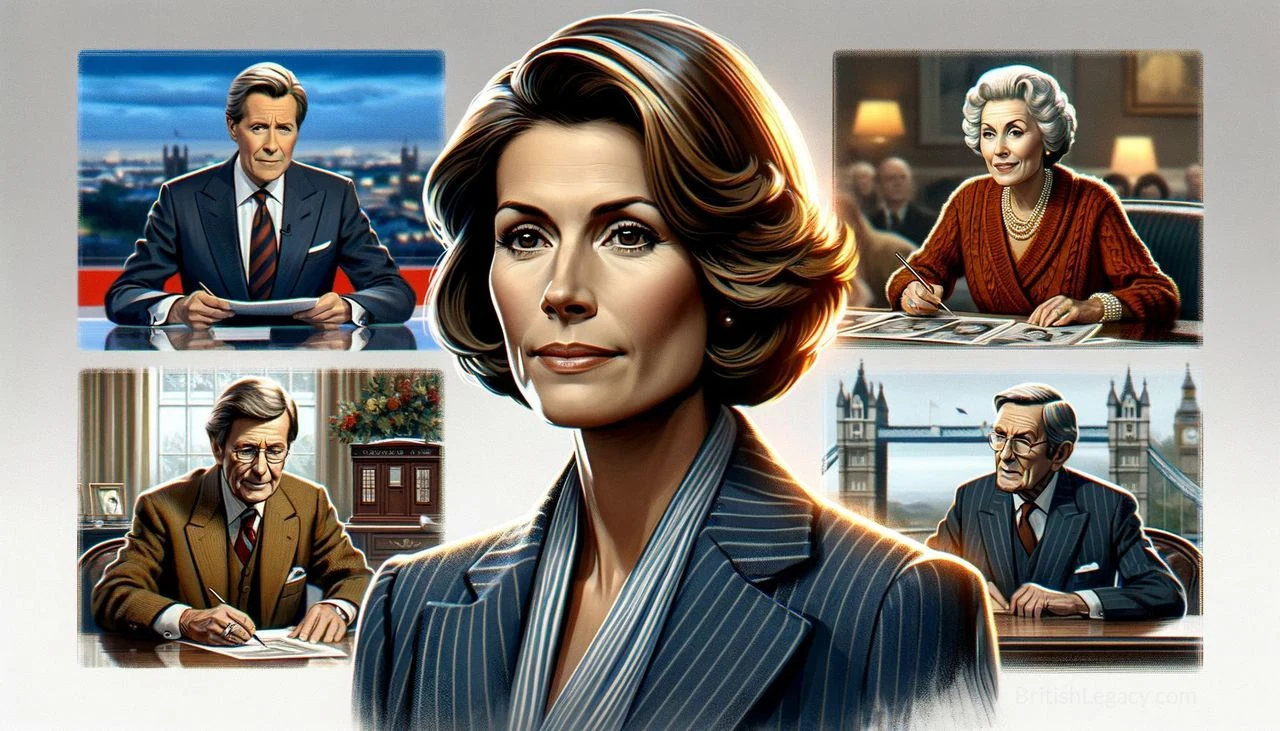
Fiona Bruce’s career has moved between the BBC newsroom, the antiques table and the contested ground of live political debate. Since joining the corporation as a researcher on Panorama in 1989, she has presented programmes ranging from Breakfast News and BBC News at Ten to Antiques Roadshow, Fake or Fortune? and Question Time. That range, built over decades in British television, is more revealing than any single presenting role.
Early life and a route into journalism
Bruce was born Fiona Elizabeth Bruce on 25 April 1964 in Singapore, then the State of Singapore, Malaysia. Her English mother and Scottish father, who had a long career at Unilever and became a regional managing director, raised a family that moved between places. Bruce spent part of her childhood on the Wirral, first in Port Sunlight and then Heswall, and attended Gayton Primary School and the International School of Milan. After moving to Brockley in south London, she went to Haberdashers’ Aske’s Hatcham College from the age of 14 to 18.
She read French and Italian at Hertford College, Oxford, graduating with an upper second-class degree. As a scholar, she also attended the University of London Institute in Paris, and speaks both languages fluently. Her first jobs after university were outside broadcasting: she worked for a management consultancy and then at advertising agencies, including Boase Massimi Pollitt. There she met her future husband, advertising company director Nigel Sharrocks.
A meeting with Tim Gardam, then editor of Panorama, led to a job as a researcher on the BBC current-affairs programme in 1989. Bruce became an assistant producer before moving into reporting in 1992 on Breakfast News. She then worked at BBC South East, appearing on Newsroom South East and the weekly programme First Sight. Between 1994 and 1995, she reported for the BBC Two programme Public Eye, followed by work for Panorama and Newsnight; she presented Newsnight from 1995 to 1998.
News and current affairs
Bruce moved on to presenting Breakfast News and the BBC Six O’Clock News in 1996. In 1999, during a major relaunch of BBC news output, she was named secondary presenter of the Six O’Clock bulletin. She covered for its main presenter, Huw Edwards, and regularly presented on Fridays. In January 2003, a reshuffle brought Bruce and Edwards to the BBC’s Ten O’Clock News. Bruce became the first woman to present that bulletin and continues to present it, now under the name BBC News at Ten.
She returned to the Six O’Clock News in 2007, presenting its Friday editions until stepping down in January 2019 after 11 years. Her other news and current-affairs work included presenting and reporting for the BBC One series Real Story from 2003 to 2007. After Jill Dando’s murder, Bruce became a co-presenter of Crimewatch alongside Nick Ross; both left towards the end of 2007, when Kirsty Young took over. Bruce also presented the BBC’s general election results programme in 2001.
Live current affairs brought both the demands of impartial presentation and public scrutiny. A 2004 programme interview with Matt O’Connor, founder of Fathers 4 Justice, drew criticism from people who believed Bruce’s views on domestic violence had compromised the programme. A BBC committee found weaknesses against the corporation’s journalistic values, but concluded that they did not amount to a serious breach of editorial standards and that the programme had made a valuable contribution to debate on parental rights.
In January 2019, Bruce succeeded David Dimbleby as the first full-time female host of Question Time. The job put her in front of a live audience and a panel of politicians and public figures, where the presenter must keep discussion moving while allowing competing views to be heard. The role has also brought controversy. In 2023, after comments during a discussion about an allegation concerning Stanley Johnson, Bruce apologised and said she had been required to provide legal context, not to express her own opinion. Refuge, the domestic violence charity for which she had been an ambassador for more than 25 years, confirmed that she stepped back from the role. Later that year, Bruce apologised to an audience member after identifying him on air as “the black guy”. In 2024, her interruptions of SNP politicians during programmes in Aberdeen and a subsequent edition drew criticism and complaints to the BBC.
Antiques, art and other television
Bruce’s presenting work has also taken her into cultural television. In 1998, she began presenting BBC Two’s Antiques Show, staying for two further series. In 2007, the BBC announced that she would replace Michael Aspel on Antiques Roadshow the following spring. The choice initially caused controversy, but average viewership rose during her first year as presenter. The programme’s encounters with objects and their owners gave her a different kind of television stage from a news bulletin: one built around individual stories, material history and expert judgement.
Since 2011, she has co-presented Fake or Fortune? with Philip Mould, a series examining the authenticity of works of art, including through modern technical methods. Her other documentary work has included a 2007 programme about Cherie Blair, a 2010 film about the love story of Queen Victoria and Prince Albert, and documentaries about the royal palaces and Leonardo da Vinci. She has also presented the BBC Four quiz Hive Minds and special editions of The Money Programme.
Bruce’s television career has included lighter appearances as well as news and factual work. She appeared on Top Gear, including in its “Star in a Reasonably-Priced Car” feature, and performed in the BBC’s annual Children in Need telethon. In 2007, her performance of “All That Jazz” as Velma Kelly led to an invitation to appear on stage at a London performance of Chicago. These appearances sit alongside, rather than replace, her sustained work in news and current affairs.
Public commitments and life beyond the studio
Bruce has publicly described herself as a feminist and has spoken about the continuing relevance of feminism. In a 2006 interview, she challenged the idea that women should be expected to disclose childcare commitments to prospective employers when men were not asked to make the same declaration. Her work has also included charity activity: she is an honorary vice-president of Vision Aid Overseas, voiced its Lifeline Appeal in 2005 and launched its annual review in 2007. She took part in a Women’s Aid campaign that year, and in 2009 the NSPCC inducted her into its Hall of Fame in recognition of her work on its behalf.
Bruce married Sharrocks in Islington in July 1994; they have two children. She has spoken about avoiding social media because of misogynistic abuse directed at women in public life. In 2010, she accepted the title of female Rear of the Year; the following year, she described accepting it as hypocritical and called the award demeaning. The change in her view offers a personal example of how public recognition can sit uneasily with arguments about women’s treatment and professional standing.
Why Fiona Bruce deserves a place in British Legacy
Bruce’s place in British broadcasting rests on a career that has crossed formats without abandoning journalism. She began behind the scenes on Panorama, moved into reporting and news presentation, and became the first woman to present the BBC’s Ten O’Clock bulletin. She later took on Question Time as its first full-time female host. Those milestones matter not as abstract symbols, but because they mark women’s presence in prominent roles across the BBC’s news and political output. Her work on programmes including Real Story, Crimewatch and the election results coverage also connects her career to the reporting and explanation of public affairs.
Her contribution is not confined to hard news. On Antiques Roadshow and Fake or Fortune?, Bruce has presented programmes in which objects open up questions of history, ownership and authenticity. That breadth has brought audiences into contact with political debate, daily news and cultural heritage through one familiar presenter, while her charity work has extended beyond television. The controversies surrounding her live presenting are part of the record too: they show the scrutiny attached to programmes that claim to host public debate, and the need for broadcasters to answer criticism. Taken together, her long service and varied work make Bruce a distinctive figure in British television history.
Sources
Fiona Bruce — revision 1376549344
Adapted in part from Fiona Bruce by Wikipedia contributors, under CC BY-SA 4.0. Text has been edited and combined with the existing article; this adapted text is shared under the same licence. Contributor history.