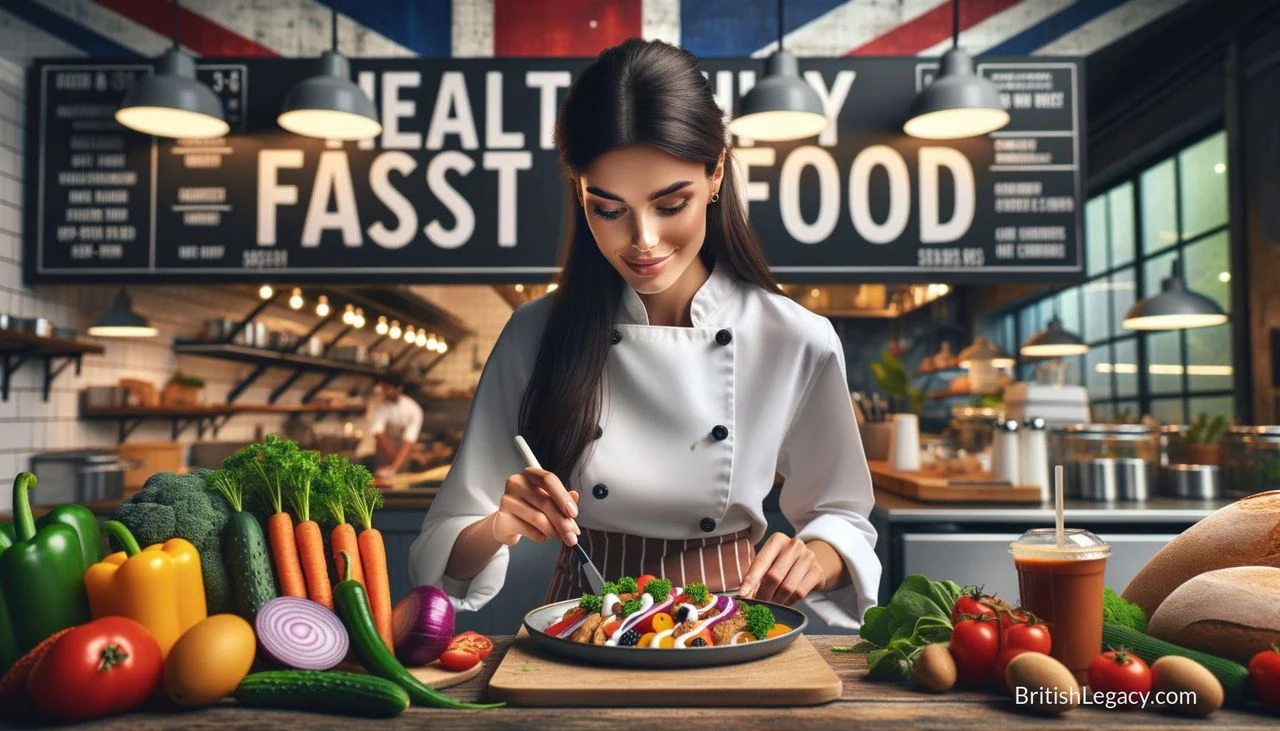
Allegra McEvedy’s career has moved between ambitious professional kitchens and a different question: how to make good food more accessible. Trained in classical French cooking, she worked in restaurants in London and the United States before co-founding Leon in 2004. The group’s healthy fast-food model made affordability and convenience part of her public culinary identity. She later turned increasingly to writing and broadcasting, carrying her interest in cooking beyond the restaurant kitchen.
Training and early kitchens
McEvedy was born in Hammersmith, London, on 23 November 1970, and grew up there. Her father, Colin McEvedy, was a consultant psychiatrist, historian and writer; her mother was a writer. She attended St Paul’s Girls’ School. In 1991 she completed classical French training at the Cordon Bleu in London and also gained the Higher Certificate from the Wine & Spirit Education Trust.
Her early professional work took her through a range of London establishments, including the Tabernacle in Notting Hill, Green’s, the Belvedere in Holland Park, Alfred’s, the Groucho Club and the River Café. At 24, she became head chef at Tom Conran’s restaurant, the Cow, in Notting Hill. That move gave her responsibility for a kitchen while she was still in the early stages of a career that would span restaurants, food writing and broadcasting.
McEvedy then worked in the United States. She cooked at Rubicon and Jardinière in San Francisco and ran the kitchen at Tribeca Grill in New York, where the restaurant regularly served 500 covers a night. She also catered for a Democratic Party fundraiser, cooking for President Clinton. The experience sharpened her interest in a less exclusive kind of dining. After returning to the UK, she joined the Good Cook group, first as head chef at the community restaurant the Tabernacle and later at the Good Cook in Kensington High Street.
Restaurants and the idea behind Leon
McEvedy’s work was not confined to restaurant kitchens. In summer 2000, she set up the first outdoor café in the Zaha Hadid Pavilion at the Serpentine Gallery. From 2002 to 2004 she was the inaugural chef in residence at the Institute of Contemporary Arts. These posts placed food within cultural and public settings as well as commercial restaurants.
In 2004, McEvedy co-founded Leon with Henry Dimbleby and John Vincent. Its first outlet opened on Carnaby Street. The founders set out to offer fast food that was also healthy, a proposition that combined speed and convenience with a focus on more considered eating. Leon was named Best New Restaurant in Great Britain at the Observer Food Monthly Awards six months after opening. The achievement marked a rapid reception for a restaurant concept built around affordable dining rather than the formal restaurant model.
McEvedy gave up her role at Leon in March 2009 to concentrate on writing and television, although she remained a shareholder. Her career at the group was therefore one important chapter, rather than the entirety of her work as a chef. In 2013 she opened Blackfoot, a pork-focused restaurant in Exmouth Market, London. It remained open until February 2016.
Books, broadcasting and food writing
McEvedy published The Good Cook in 2000, followed by Allegra McEvedy’s Colour Cookbook in 2006. The latter won the International Association of Culinary Professionals’ 2007 cookbook award in the Chefs and Restaurants category. She co-authored Colouring the Seasons: A Cook’s Guide with Fred Dickieson, then published Leon: Ingredients & Recipes in 2008. Further titles included Economy Gastronomy: Eat Better and Spend Less, written with Paul Merrett, Turkish Delights with Allegra McEvedy, Bought, Borrowed & Stolen, Big Table, Busy Kitchen and Around the World in 120 Recipes.
Her television work has ranged from historical cooking to practical household budgets and competitions. In the 2008 BBC series The Supersizers Go..., she cooked historical British dishes alongside Giles Coren and Sue Perkins, including eel pie, paraffin cake and tansy. The following year, she presented BBC Two’s six-part Economy Gastronomy with Paul Merrett; a book accompanied the series. McEvedy was also chef in residence at The Guardian, beginning in 2007, and contributed there until her last article appeared in February 2015.
In 2015 she replaced Mary Berry as one of the judges on the BBC’s Junior Bake Off, returning as a judge in 2016 alongside Nadiya Hussain. That year she also judged the Cook of the Year award at the BBC Radio 4 Food and Farming Awards. In 2018 she co-hosted the CBBC series Step Up to the Plate with Fred Sirieix. The programme tested young people on the skills needed to run a restaurant, bringing professional food work to a young audience.
Recognition and public work
McEvedy was appointed a Member of the Order of the British Empire in the 2008 Birthday Honours for services to the hospitality industry. She has also been a patron of the Fairtrade Foundation since 2012. These public roles sit alongside the restaurants and books in her career: one associated with the hospitality sector, the other with an organisation focused on fair trade.
Her path has not been a single progression from one celebrated kitchen to another. It has included head-chef work, a community restaurant, a gallery café, a restaurant group, a specialist restaurant, cookbooks, newspaper writing and television. The range matters because it shows how a chef can address different audiences: diners in a restaurant, readers following recipes at home and viewers encountering food through broadcast formats.
Why Allegra McEvedy deserves a place in British Legacy
McEvedy’s place in British Legacy rests in part on the practical challenge she took on with Leon. Co-founded in 2004 with Henry Dimbleby and John Vincent, the group brought a healthy fast-food proposition to a high-street restaurant setting, beginning with its first outlet on Carnaby Street. Its early recognition as Best New Restaurant in Great Britain at the Observer Food Monthly Awards showed that the idea found an audience soon after opening. McEvedy’s contribution to that venture connected professional cooking with an argument about access: that a quick meal need not be treated as separate from the question of how people eat well.
Her wider work extended that public reach. Cookbooks offered recipes and guidance for home cooks; Economy Gastronomy addressed eating better while spending less; and programmes such as Junior Bake Off and Step Up to the Plate introduced culinary skills and restaurant work to television audiences. Her early work in community and cultural settings, as well as her later restaurant projects, gives this record breadth. Together, these achievements make her a significant figure in contemporary British food culture: a chef who moved between the kitchen, the page and the screen, and who repeatedly made cooking relevant to audiences beyond fine dining.
Sources
Adapted in part from Allegra McEvedy by Wikipedia contributors, under CC BY-SA 4.0. Text has been edited and combined with the existing article; this adapted text is shared under the same licence. Contributor history.