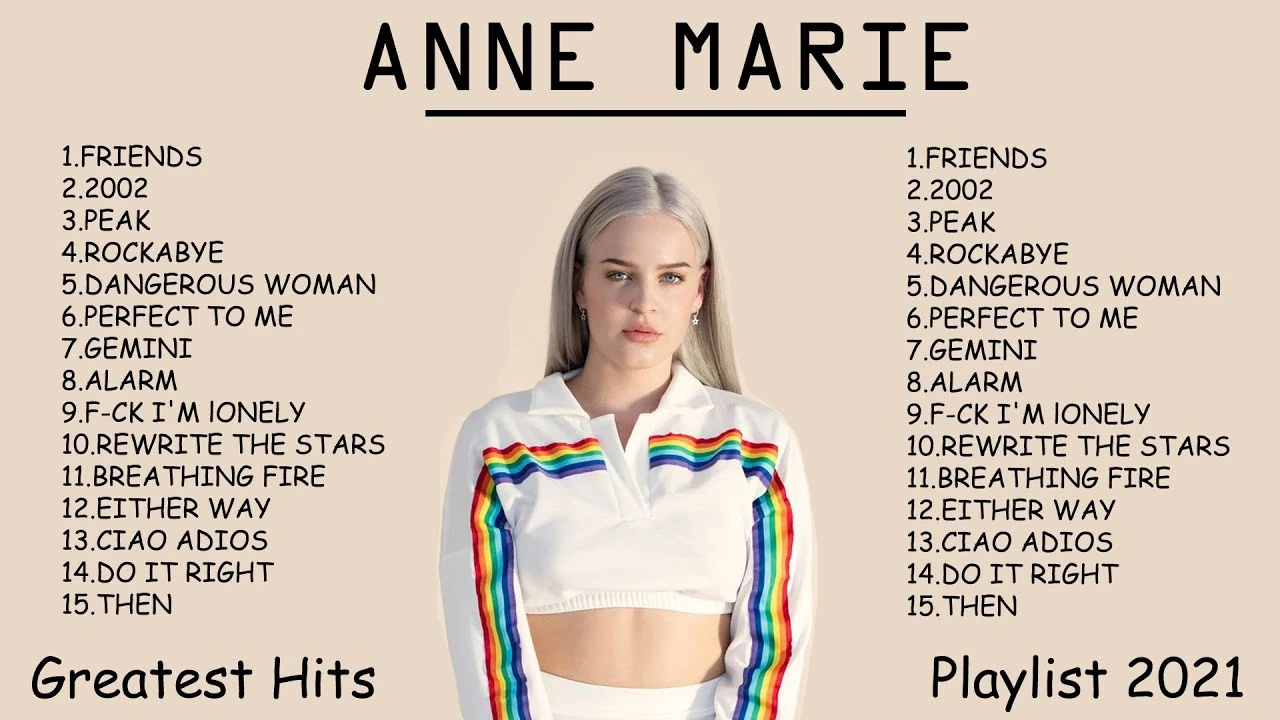
Anne-Marie’s supplied story brings together an Essex background, a breakthrough as a featured singer and a career described through both recording and television. The article identifies her as Anne-Marie Rose Nicholson, born on 7 April 1991, and says she had a background in performing arts and a black belt in karate. Its most striking chart claim concerns “Rockabye”: in 2015, she featured on the Clean Bandit single with Sean Paul, which the article says spent nine consecutive weeks at number one in the UK and became that year’s Christmas number one. It also discusses the songs “2002” and “Alarm”, award recognition and a reported coaching role on the UK version of The Voice.
Early life and performance
The account associates Anne-Marie with East Tilbury in Essex and gives her full name as Anne-Marie Rose Nicholson. It says she developed a background in performing arts and earned a black belt in karate. The source presents these interests as evidence of early discipline and determination, though that interpretation is not a separate account of how she entered the music industry. It provides no further detail about her training or the point at which she began pursuing a music career.
Those early-life details offer a brief introduction rather than a full biography. The article does not name schools or describe her family life; its focus is on the qualities it connects with performance and on the career milestones that followed. Keeping those claims distinct matters: the supplied details establish what the article reports about her interests, while its suggestion that they helped drive her success remains an interpretation.
“Rockabye”, “2002” and “Alarm”
The article dates Anne-Marie’s breakthrough to 2015, when she featured on “Rockabye” alongside Sean Paul, with Clean Bandit. It reports that the single topped the UK Singles Chart for nine consecutive weeks and became the year’s Christmas number one. The collaboration is presented as the event that brought her significant attention and preceded the other songs discussed in the account.
“2002”, co-written with Ed Sheeran, is described as looking back nostalgically to late-1990s and early-2000s pop culture. The source illustrates this with a lyric that brings together references to earlier pop songs:
“Oops, I got ninety-nine problems singing bye, bye, bye, hold up, if you wanna go and take a ride with me, better hit me, baby, one more time.”
The quotation supports the article’s description of the song’s references, while the account supplies no chart position or further release details. It also highlights “Alarm”, describing a story about the emotional turmoil of relationship betrayal, set against an anthemic pop sound. These descriptions frame the songs differently: “2002” through shared musical memories, and “Alarm” through a relationship narrative.
Awards, public image and television
The supplied article says Anne-Marie received nominations for the Brit Awards and MTV Europe Music Awards. It reports two Global Awards in 2019: Best Pop and Best Song for “2002”. No years for the nominations or additional ceremony details are given, so these are selected recognition claims rather than a complete awards record.
The source characterises her as down-to-earth and bubbly, and says she engages with fans on social media, sharing aspects of her life, creative process and struggles with mental health. It presents this openness as part of her connection with listeners. The descriptions of personality and influence are the article’s characterisations; the material offers no examples with which to assess them further.
Television is another strand in the account. It says Anne-Marie served as a coach on the UK version of The Voice, mentoring aspiring artists. No series dates or contestant examples are supplied. The reported role nevertheless places her work, as the article describes it, beyond songs and performances and into a programme in which singers receive guidance.
Why Anne-Marie deserves a place in British Legacy
Anne-Marie’s place in a British music story is grounded here in specific reported connections: the article associates her with East Tilbury in Essex and describes her contribution to “Rockabye”, a single it says led the UK chart for nine weeks and became the Christmas number one in 2015. It also identifies her as a co-writer of “2002”, a song whose references to earlier pop hits give the account a concrete example of how her writing engages with popular music’s shared memory.
The source also reports award recognition and a coaching role on the UK version of The Voice. Taken together, these details sketch a career across recorded pop and television, without requiring broader claims about her influence or the lasting impact of her work. For British Legacy, the value lies in preserving these identifiable milestones and the Essex connection, while distinguishing the reported achievements from the article’s more general praise. The account is concise, but it records a recognisable British pop trajectory: a local association, a prominent chart collaboration, songwriting and a public-facing role in music television.