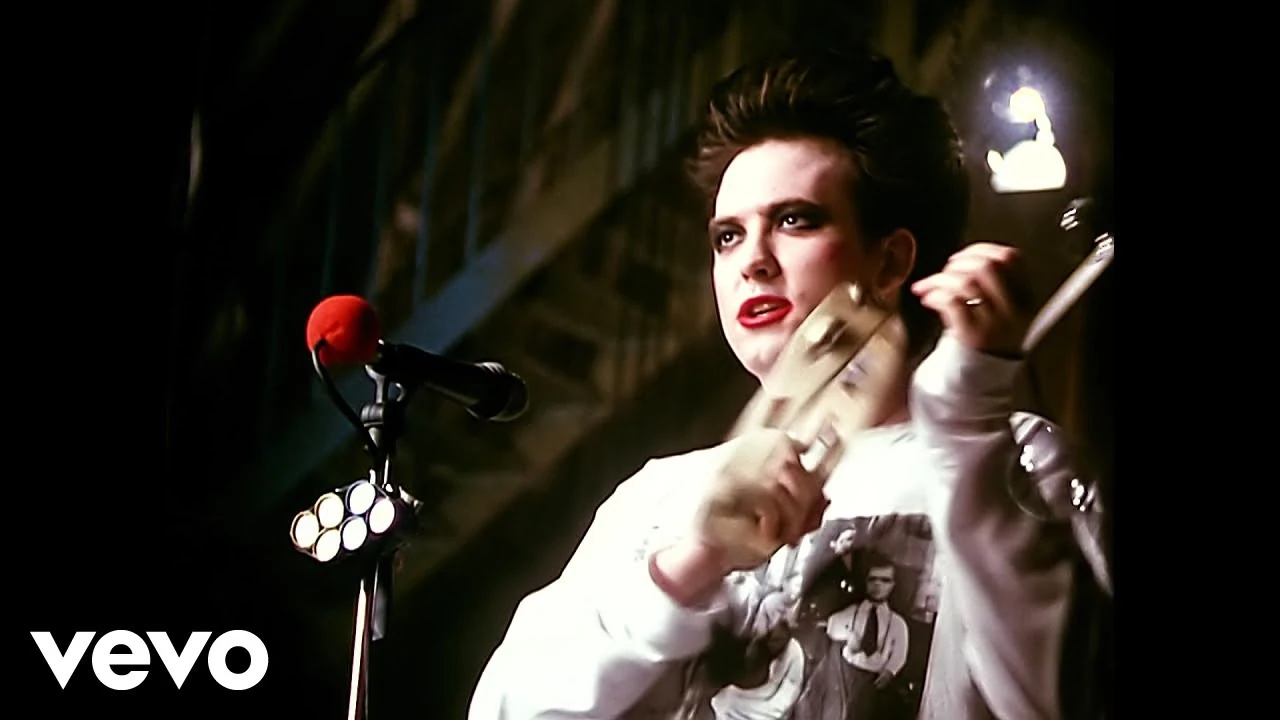
“Boys Don’t Cry” and “Friday I’m in Love” might seem to belong to different bands. One is associated with post-punk tension; the other, with bright, uncomplicated pop. Both are part of The Cure’s catalogue, a body of work that repeatedly moved between sombre atmospheres and accessible melodies. The band began in Crawley, West Sussex, in 1976. Its history includes early post-punk, a formative role in gothic rock, international chart success and a continuing refusal by frontman Robert Smith to be pinned down by genre.
School friends and a name in motion
The Cure’s roots were in a group of school friends in Crawley. Robert Smith and Lol Tolhurst formed the band in 1976; the early group was known as Malice before becoming Easy Cure in 1977. After several changes, Smith took on vocals, and the remaining trio adopted the name The Cure in 1978. This fuller account puts the band’s beginnings in a group’s evolving history, rather than making its formation the work of Smith alone.
The Cure signed with the German label Ariola-Hansa as Easy Cure in 1977, but the relationship ended the following year after the label rejected the group’s demos and wanted it to record cover versions. The band refused. A demo later reached Chris Parry, who signed it to Fiction, his new label, in September 1978. The first single, “Killing an Arab”, appeared that December. Its title provoked accusations of racism; the band said the song was based on Albert Camus’s novel The Stranger.
The debut album, Three Imaginary Boys, followed in 1979. The early single “Boys Don’t Cry” became one of the group’s best-known songs. Its lasting place in the catalogue is a useful reminder that The Cure’s reputation for darkness was never the whole story: the band’s music and public identity were developing, not fixed.
Darkness, pop and a widening audience
With Seventeen Seconds (1980), the music grew more atmospheric; the album’s “A Forest” became the band’s first UK hit single. Faith followed in 1981, and Pornography in 1982. The latter completed a notably dark run of records and helped establish The Cure as one of the emerging gothic rock genre’s defining bands. Around this period, the group adopted the towering hair and smeared lipstick that would become part of its familiar image.
Smith also began steering the band towards pop. “Let’s Go to Bed”, “The Walk” and “The Love Cats” marked a change in direction after Pornography. The contrast was not a temporary detour: The Cure continued to place upbeat singles alongside music of greater weight. The Head on the Door (1985) brought the two sides together, while the singles compilation Standing on a Beach helped widen the group’s audience in the United States and Canada.
The double album Kiss Me, Kiss Me, Kiss Me (1987) reached the UK top ten and was the band’s first album to enter the US top 40. Its “Just Like Heaven” became The Cure’s most successful single to that point in the United States. The 1989 album Disintegration returned to a darker sound and reached number three in the UK. It included “Lullaby” and “Lovesong”; the latter reached number two on the US Billboard Hot 100. The breadth of this period is captured in miniature by the four songs often used to introduce the band: “Boys Don’t Cry”, “Just Like Heaven”, “Lovesong” and “Lullaby”.
From Wish to a later return
Wish (1992) reached number one in the UK and number two in the United States. It included “Friday I’m in Love”, a bright pop hit that sits comfortably beside the band’s more brooding work. The song also gives the Cure’s history a useful counterpoint to its gothic reputation: the band’s sound could turn towards exuberance without erasing the moodier music that had come before.
The group’s subsequent studio albums included Wild Mood Swings (1996), Bloodflowers (2000), The Cure (2004) and 4:13 Dream (2008). After a long gap, Songs of a Lost World appeared in 2024, its first album of all-new material in 16 years. It reached number one on the UK Albums Chart, the band’s first chart-topping album there since Wish. The album brought renewed attention to a career built on change rather than a single signature mood.
The band’s personnel changed repeatedly over the decades, while Smith remained its constant member. In the 2026 account supplied for this edition, the line-up comprises Smith, bassist Simon Gallup, keyboardist Roger O’Donnell, drummer Jason Cooper and guitarist Reeves Gabrels. Perry Bamonte, a former member who had returned to the band in 2022, died in December 2025, aged 65, after a short illness. These changes form part of the group’s history, but its shifting sound and Smith’s continuing presence offer the clearest thread through it.
A British band with an international reach
The Cure’s British story is rooted in Crawley, but its music travelled widely. The band became one of the first alternative groups to achieve chart and commercial success before alternative rock broke into the mainstream. Its influence has been cited by artists across several styles, including bands associated with alternative rock, shoegaze and pop. That reach did not require The Cure to adopt a stable genre identity. Smith has rejected the band’s routine classification as gothic, while acknowledging the paradox that a group known for darker work is also recognised by many listeners for “Friday I’m in Love”.
The band’s visual identity became inseparable from its music videos, many directed by Tim Pope. Their collaboration began with “Let’s Go to Bed”; Pope’s playful approach brought out a comic side of the group as well as Smith’s more unsettling imagery. The videos helped expand The Cure’s audience during the 1980s, translating the band’s mixture of humour, unease and theatricality into a recognisable visual language.
Recognition followed on both sides of the Atlantic. The band won the BRIT Award for Best British Video for “Lullaby” in 1990 and Best British Group in 1991. It received the NME Godlike Genius award in 2009 and entered the Rock and Roll Hall of Fame in 2019. In 2026, The Cure won its first Grammy Awards: Best Alternative Music Album for Songs of a Lost World and Best Alternative Music Performance for “Alone”. The honours chart a long career, but the group’s more telling achievement is the ability to move between musical worlds without losing its identity.
Why The Cure deserves a place in British Legacy
The Cure deserves a place in British Legacy because its story connects a specific English starting point with a far-reaching musical contribution. Formed by school friends in Crawley, West Sussex, the band became an early British alternative act to achieve major commercial success. Its records helped shape gothic rock, but the group’s importance cannot be reduced to that genre. From the uneasy atmosphere of Pornography and Disintegration to the melodic lift of “Just Like Heaven” and “Friday I’m in Love”, The Cure made contrast central to its sound. That range gave listeners more than one way into the music and helped challenge the idea that alternative rock had to remain outside the mainstream.
The band’s influence is visible in the musicians who have cited it, in the visual style developed through its videos and in the durability of songs spanning several generations of listeners. Its British connection is not a vague claim of national character: it begins in Crawley, runs through a distinctive contribution to British post-punk and alternative music, and is reflected in its BRIT Awards. The Cure’s history also shows how a band can evolve without smoothing away its differences. It could be sombre, playful, unsettling or exuberant, sometimes within the same career arc. That combination of musical invention, popular reach and enduring recognisability is a substantial British legacy.
Sources
The Cure — Wikipedia revision 1371790574
Adapted in part from The Cure by Wikipedia contributors, under CC BY-SA 4.0. Text has been edited and combined with the existing article; this adapted text is shared under the same licence. Contributor history.