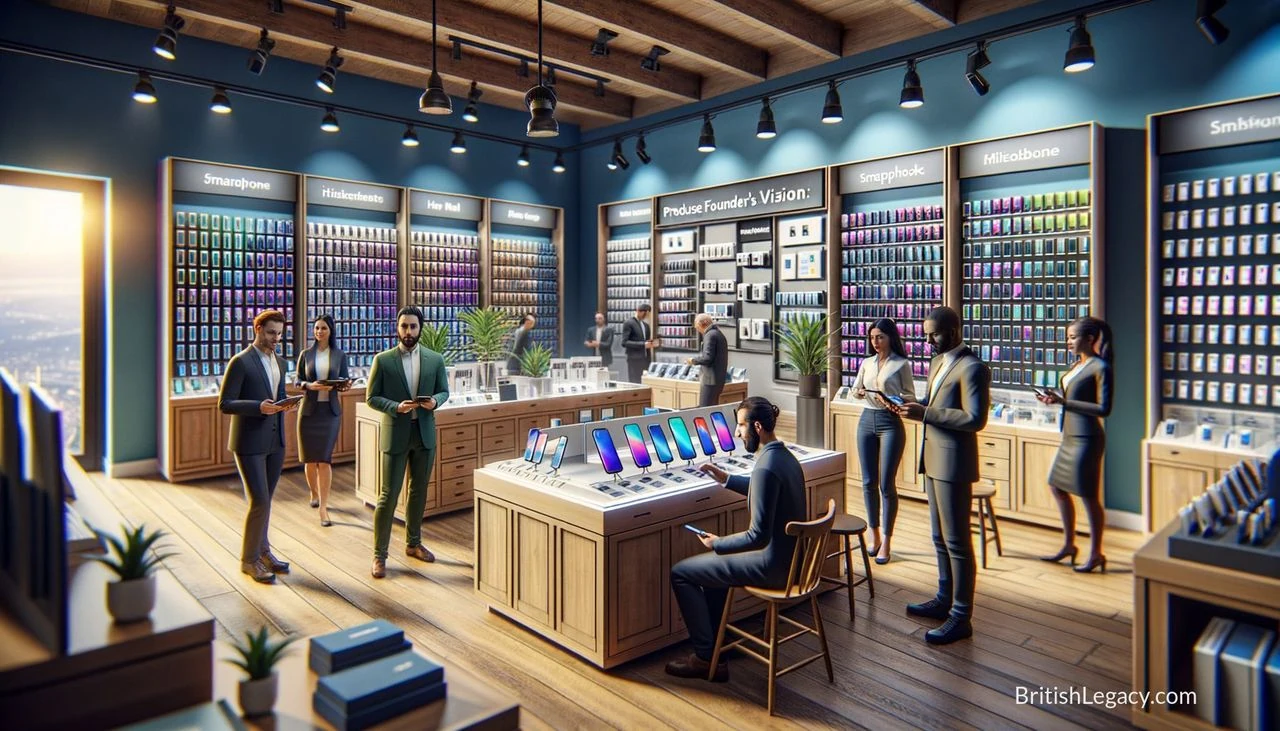
In 1989, Charles Dunstone began selling mobile phones from his flat on Marylebone Road, with £6,000 in savings and a conviction that the technology would reach far beyond large corporate customers. The business he started, Carphone Warehouse, grew into a major European retailer. Its history is also a story of how a market changed: handsets once cumbersome and chiefly bought by organisations became a product sold to small businesses, the self-employed and the wider public.
From sales work to mobile phones
Dunstone was born in Saffron Walden, Essex, on 21 November 1964. He attended Uppingham School and accepted an offer to study business at the University of Liverpool. Rather than begin his degree immediately, in 1983 he deferred for a year and took a sales job at Torch Computers in Cambridge. He stayed there instead of returning to university, then moved to NEC in 1986.
At NEC, Dunstone initially sold computers and later mobile phones. The handsets were large and cumbersome, and the main customers were big businesses and other large organisations. Those customers were well served, but smaller businesses, self-employed people and the general public had fewer routes into mobile communications. Dunstone saw an opportunity in that gap. He left NEC in 1989 to establish a business aimed at a broader market.
Starting Carphone Warehouse
Dunstone named the company The Carphone Warehouse, a name intended to suggest a broad range of products and low prices. He began selling from his flat, using £6,000 of his own savings. Rather than describing the business as a partnership, the biographical account identifies Dunstone as its founder; a claim that he co-founded it with Julian Brownlie is not supported by that account.
The company’s early purpose was to make mobile phones available to customers who had not been the industry’s principal market. That meant serving people and businesses outside the large organisations that had dominated early handset sales. In this way, Carphone Warehouse’s founding proposition was not simply to sell a new device: it was to bring mobile communications to a wider group of buyers.
Carphone Warehouse floated on the London Stock Exchange in July 2000. Its shares were issued at 200p, valuing the company at approximately £1.7 billion. The flotation marked a new stage in the business, giving it a public-market profile after its beginnings as a small operation in Dunstone’s flat.
From phones to household communications
Carphone Warehouse’s expansion went beyond mobile handsets. In 2002 it acquired Opal Telecom, and in 2003 established TalkTalk as a subsidiary using assets from that purchase. TalkTalk provided home telephone and broadband services in the UK. Its growth also involved acquisitions: one.tel, AOL, Tele2 and the UK arm of Tiscali became part of its customer and business expansion.
In March 2010, TalkTalk separated from Carphone Warehouse. The split changed the shape of the group: mobile-phone retail and home communications were no longer housed within the same business in the same way. Dunstone’s business interests thus extended from the retailing of mobile handsets into fixed-line telephone and broadband services, but the two operations developed as distinct entities.
Carphone Warehouse’s European reach expanded further through a partnership with the American electronics retailer Best Buy. In May 2008, the companies created Best Buy Europe. Best Buy acquired 50 per cent of Carphone Warehouse’s European and US retail interests for £1.1 billion. The new company’s assets included a retail operation of more than 2,400 stores across nine European countries, trading under the Carphone Warehouse and Phone House brands. Those markets were the UK, Belgium, France, Germany, Ireland, the Netherlands, Portugal, Spain and Sweden.
Other roles and honours
Dunstone also held positions outside his mobile-phone businesses. In 2005, he became a non-executive director of HBOS and served as a non-executive director of Daily Mail and General Trust. He was a non-executive director of Independent Media Distribution from 2002 to 2011, and served on the council of The Prince’s Trust, as well as chairing its trading subsidiary. His business activity later included backing the online estate agency Strike.
In 2005, The Daily Telegraph named him Business Person of the Year. He was made a Knight Bachelor in the 2012 Queen’s Birthday Honours for services to the mobile communications industry and charity. In 2015, he was appointed a Commander of the Royal Victorian Order for his work with The Prince’s Trust.
His public roles also included appointment in 2013 to the board of trustees of Royal Museums Greenwich. Reappointed in 2017, he resigned in February 2021 before the end of his second term. These roles give a sense of the range of institutions in which he became involved, from finance and media to charitable work and museums.
Why Charles Dunstone deserves a place in British Legacy
Charles Dunstone’s place in British business history rests first on the practical insight behind Carphone Warehouse. When mobile phones were mainly sold to large organisations, he saw that smaller businesses, self-employed people and the public could also become customers. Starting with £6,000 and sales from his flat, he built a retailer that helped bring handsets to a broader market. The later stock-market flotation and the scale of its European retail operation show how far that initial proposition travelled.
His business story also connects mobile retail with the everyday communications services people use at home. Through the creation and growth of TalkTalk, the enterprise expanded into home telephone and broadband; its separation from Carphone Warehouse in 2010 marked a distinct chapter in that development. The Best Buy Europe partnership, meanwhile, put the retail operation across nine European countries. Together, these developments show the breadth of the businesses Dunstone helped build, rather than relying on general claims about innovation or national character. His roles with The Prince’s Trust and Royal Museums Greenwich, and his honours for services to mobile communications and charity, add a public and charitable dimension to that record.
Sources
Charles Dunstone — Wikipedia revision 1379745298
Adapted in part from Charles Dunstone by Wikipedia contributors, under CC BY-SA 4.0. Text has been edited and combined with the existing article; this adapted text is shared under the same licence. Contributor history.