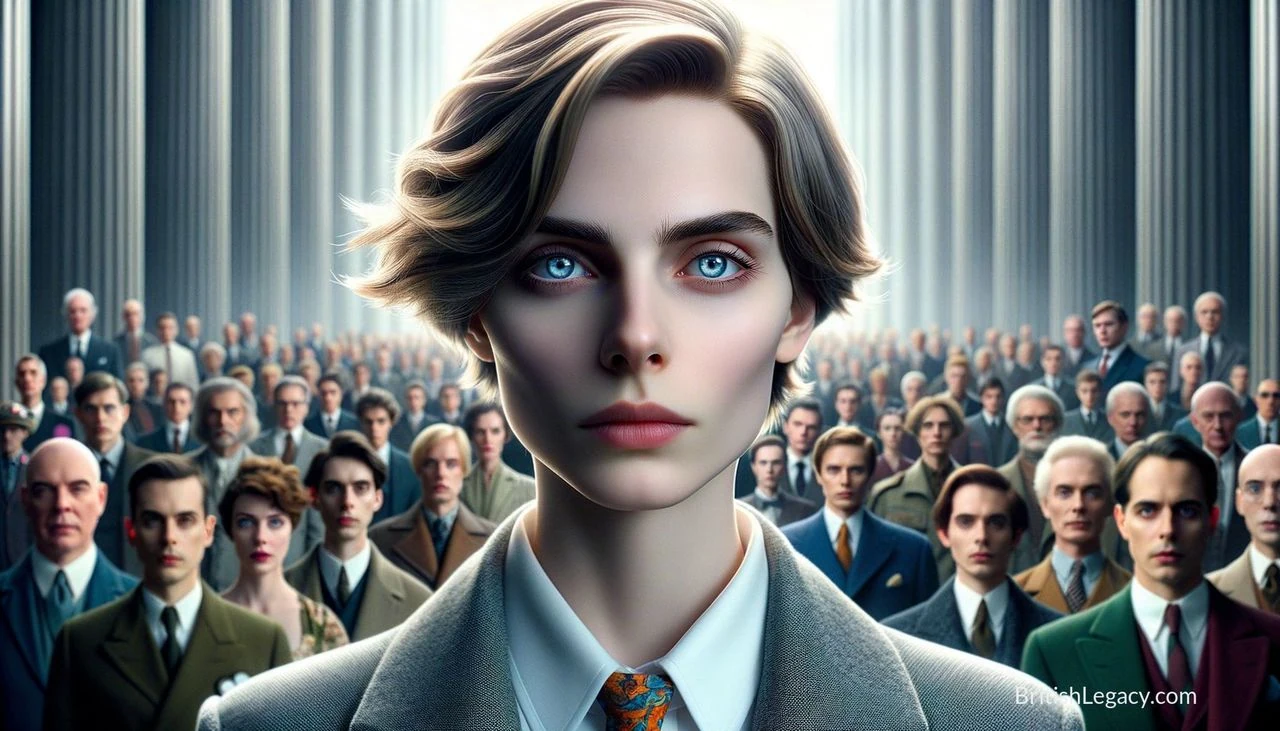
Tilda Swinton’s career has never depended on staying in one register. She moved from experimental films made with Derek Jarman to the title role in Orlando, an Academy Award-winning performance in Michael Clayton and large-scale productions including the Narnia films and Marvel’s Doctor Strange. Across those changes, she has continued to work with filmmakers whose projects make room for unusual forms and ideas.
London-born, Scottish by her own account
Katherine Matilda Swinton was born in London on 5 November 1960. She grew up at Kimmerghame House in Scotland, in a family with deep Scottish roots. Her father, Sir John Swinton of Kimmerghame, was a British Army major-general and later Lord Lieutenant of Berwickshire; her mother, Judith, Lady Swinton, was Australian. Although Swinton was born in England and attended schools there, she has described herself as Scottish, citing her upbringing and family background.
She attended Queen’s Gate School in London, West Heath Girls’ School and, briefly, Fettes College. At Cambridge, where she studied social and political sciences at New Hall, she began performing on stage. She graduated in 1983. Before university, she spent two years volunteering in South Africa and Kenya. Her later career would cross national and artistic boundaries, but her account of her Scottish identity remains a meaningful part of her public connection to Britain.
Early work with Derek Jarman
Swinton joined the Royal Shakespeare Company in 1984 and also worked with Edinburgh’s Traverse Theatre. Her first film role was in Jarman’s Caravaggio (1986), beginning a creative partnership that brought her into a distinctive strand of British independent cinema. She appeared in his The Last of England (1987) and War Requiem (1989), among other work. In 1991, she played Isabella of France in Edward II, winning the Volpi Cup for Best Actress at the Venice Film Festival.
Her work was not confined to film. In 1989, she performed in Joan Jonas’s video-art piece Volcano Saga, based on an Icelandic medieval story. She also appeared in Peter Wollen’s Friendship’s Death (1987), playing an extraterrestrial robot on a peace mission to Earth. These projects established an early pattern: Swinton was willing to take roles and work in forms that did not follow conventional expectations of screen acting.
That interest was especially visible in Sally Potter’s Orlando (1992), in which Swinton played the title character in an adaptation of Virginia Woolf’s novel. The role’s changes across time and gender presentation suited a performer whose screen presence resisted easy categorisation. In 1995, she developed The Maybe with producer Joanna Scanlan: a live-art installation in which she appeared asleep, or apparently so, inside a glass case at London’s Serpentine Gallery. She repeated the work in Rome in 1996 and at New York’s Museum of Modern Art in 2013.
Independent choices and wider recognition
In the early 2000s, Swinton’s work reached broader audiences without displacing her interest in independent film. She played the central role of a mother in Scott McGehee and David Siegel’s The Deep End (2001), earning a Golden Globe nomination. Other films from this period included Vanilla Sky, Adaptation and Young Adam; the last brought her a British Academy Scotland Award for Best Actress. In 2005, she took on two very different parts: the White Witch in The Chronicles of Narnia: The Lion, the Witch and the Wardrobe and a supporting role in Mike Mills’s Thumbsucker.
Her performance as corporate attorney Karen Crowder in Michael Clayton (2007) marked a major awards milestone. She won both the Academy Award and BAFTA for Best Supporting Actress. The character placed Swinton in a tense corporate thriller, but the award did not define the limits of her work. She went on to appear in the Coen brothers’ Burn After Reading (2008), and in films including I Am Love (2009) and We Need to Talk About Kevin (2011).
In Lynne Ramsay’s We Need to Talk About Kevin, Swinton played Eva, a mother confronting the aftermath of her son’s violence. The film’s difficult subject matter and her central performance brought her work to a new audience, while retaining the ambiguity and emotional intensity found in much of her earlier filmography. She later appeared as Minister Mason in Bong Joon Ho’s Snowpiercer (2014), shifting again into a stylised, dystopian world.
Building a film culture as well as a filmography
Swinton has also put energy into how films are seen and supported. In 2008, she founded the Ballerina Ballroom Cinema of Dreams, a film festival held in a ballroom in Nairn, on Scotland’s Moray Firth. The following year, she and filmmaker Mark Cousins took a portable cinema through the Scottish Highlands on a truck, hauling it manually and screening films as a travelling independent festival. Their journey became the documentary Cinema Is Everywhere; the festival was repeated in 2011.
These projects connect her screen career to the practical work of exhibition: bringing films to audiences beyond established venues. In 2013, she co-founded Drumduan Upper School in Findhorn with Ian Sutherland McCook. The school was intended to allow children to continue a Steiner education without grading or tests. Swinton resigned as a director in 2019. Her work in film culture also received recognition in 2020, when she was awarded the British Film Institute Fellowship for contributions that included film culture and independent film exhibition.
Her later screen roles continued to span sharply different styles. She played the Ancient One in Doctor Strange (2016) and Avengers: Endgame (2019), and appeared in Luca Guadagnino’s Suspiria (2018), in which she played three roles, one credited to Lutz Ebersdorf. She has also collaborated repeatedly with Wes Anderson, appearing in Moonrise Kingdom, The Grand Budapest Hotel, The French Dispatch and Asteroid City. In 2021, she starred in Apichatpong Weerasethakul’s Memoria; in 2022, she played both mother and daughter in Joanna Hogg’s The Eternal Daughter. Her 2024 work included Pedro Almodóvar’s The Room Next Door.
Recognition and an evolving body of work
Swinton’s honours reflect both performance and her contribution to cinema. Alongside the Academy Award, BAFTA and Venice’s Volpi Cup, she received the British Film Institute Fellowship in 2020 and the Honorary Golden Bear in 2025. The Museum of Modern Art gave her a special tribute in 2013. In 2022, she received the FIAF Award for work promoting archive film, film history and women’s role in it, as well as the Richard Harris Award from the British Independent Film Awards for her contribution to British cinema.
Her career has also made space for creative work beyond acting. She collaborated with the fashion designers Viktor & Rolf, who made her the focus of their 2003 One Woman Show, and took part in a 1996 music video for Orbital’s “The Box”. Such projects sit naturally alongside the installation art and film-festival work: they show a performer whose public work has repeatedly crossed between cinema and other creative practices.
Why Tilda Swinton deserves a place in British Legacy
Tilda Swinton deserves a place in British Legacy because her career demonstrates the range and reach of British film culture without reducing her to a single kind of role. Her early work with Derek Jarman and her award-winning performance in Edward II connected her to an important strand of independent British filmmaking. Her later success in Michael Clayton, the Narnia films and Marvel productions brought her work to audiences around the world. Rather than choosing between experimental projects and popular cinema, she has moved between them, sustaining a career that keeps both possibilities visible.
Her contribution also extends beyond performances. The Ballerina Ballroom Cinema of Dreams and the travelling cinema project with Mark Cousins brought film exhibition into community settings in Scotland, while her recognition from the British Film Institute and FIAF acknowledges wider contributions to film culture and its history. Swinton’s Scottish identity is part of this story: she has described herself as Scottish, grew up in Scotland and has helped organise cultural projects there. The combination of adventurous screen work and practical attention to how films reach people gives her British legacy specific substance. It is a legacy of artistic range, but also of widening the places and forms through which cinema can be encountered.
Sources
Tilda Swinton — Wikipedia revision · Tilda Swinton — Wikipedia
Adapted in part from Tilda Swinton by Wikipedia contributors, under CC BY-SA 4.0. Text has been edited and combined with the existing article; this adapted text is shared under the same licence. Contributor history.