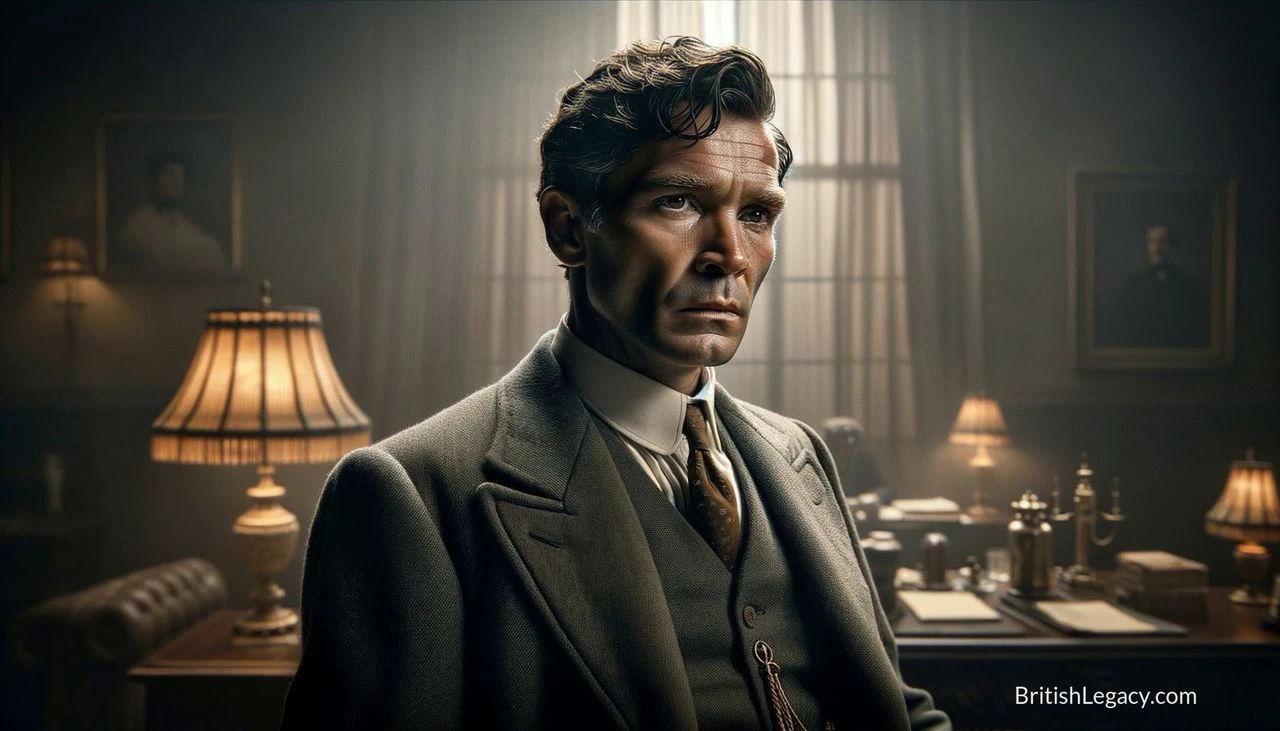
Daniel Day-Lewis has made relatively few films, but several have become defining works of British and international cinema. His performances in My Beautiful Laundrette, My Left Foot and There Will Be Blood established a reputation for close preparation and striking transformations. Three Academy Awards for Best Actor followed, alongside a career that repeatedly moved between stage, screen and extended breaks from acting.
London beginnings and theatrical training
Born in Kensington, London, on 29 April 1957, Daniel Michael Blake Day-Lewis was the son of poet Cecil Day-Lewis and actress Jill Balcon. His maternal grandfather, Sir Michael Balcon, was a leading figure at Ealing Studios. The family moved to Greenwich when Daniel was two. He attended local primary schools and, in 1968, was sent to Sevenoaks School in Kent. After two years he transferred to Bedales in Hampshire, where he developed interests in acting, fishing and woodworking.
Day-Lewis made his film debut as an uncredited child vandal in Sunday Bloody Sunday (1971). After leaving Bedales, he attended Bristol Old Vic Theatre School for three years. He performed in Bristol and joined the Royal Shakespeare Company, appearing as Romeo in Romeo and Juliet and Flute in A Midsummer Night’s Dream. In 1982 he took the lead in the stage play Another Country, then appeared in films including Gandhi and The Bounty.
His early career moved between television, theatre and film. The 1985 films My Beautiful Laundrette and A Room with a View brought wider notice for sharply different roles. In Stephen Frears’s My Beautiful Laundrette, written by Hanif Kureishi, he played a young Englishman in a relationship with a Pakistani youth in 1980s London. The film was later included in the British Film Institute’s list of the 100 greatest British films of the twentieth century.
Roles built through close preparation
For Philip Kaufman’s The Unbearable Lightness of Being (1988), Day-Lewis played a Czech surgeon and learned Czech during the eight-month shoot. His performance as Christy Brown in Jim Sheridan’s My Left Foot (1989) brought his first Academy Award for Best Actor, as well as a BAFTA Award. Brown, an Irish writer and painter born with cerebral palsy, could control only his left foot. Day-Lewis visited a Dublin clinic while preparing for the role and remained in character during filming. He later denied a rumour that he had broken ribs by holding a hunched position in his wheelchair.
In 1989, he also returned to the stage as Hamlet at the National Theatre in London. He left during a performance after breaking down in the scene with the ghost of Hamlet’s father and did not return to the stage. He later described the experience in relation to his own grief for his father; he has not appeared on stage since.
Day-Lewis’s screen work continued across a varied run of historical and contemporary parts. For The Last of the Mohicans (1992), he trained, camped, hunted and fished while preparing to play Hawkeye. In In the Name of the Father (1993), he played Gerry Conlon, one of the Guildford Four, and received an Academy Award nomination. He followed it with Martin Scorsese’s The Age of Innocence (1993), The Crucible (1996) and The Boxer (1997), for which he trained with former world boxing champion Barry McGuigan.
After The Boxer, Day-Lewis left acting for several years and went to Florence, where he apprenticed as a shoemaker with Stefano Bemer. He returned to film in 2002 as Bill “the Butcher” Cutting in Scorsese’s Gangs of New York. The performance earned him another Academy Award nomination and a BAFTA for Best Actor. In 2007, Paul Thomas Anderson’s There Will Be Blood brought his second Best Actor Oscar. He also won the BAFTA and Golden Globe for his portrayal of oilman Daniel Plainview.
Lincoln, a second retirement and a return
For Steven Spielberg’s Lincoln (2012), Day-Lewis spent a year preparing, including reading more than 100 books about Abraham Lincoln. He spoke in Lincoln’s voice throughout the shoot. The performance won him the Academy Award for Best Actor, making him the first person to win that award three times. His honours for the role included a fourth BAFTA for Best Actor and a second Golden Globe in the drama category.
After a break, he played a London dressmaker in Anderson’s Phantom Thread (2017), set in the 1950s. The film earned him another Academy Award nomination. Before its release, he announced that he was retiring from acting. This was not his first break: following The Boxer, he had stepped away from acting from 1997 until his return in 2000. In October 2024, it was announced that he would act again. He starred in and co-wrote Anemone with his son Ronan Day-Lewis, who directed the 2025 film.
British roots and a wider life in the arts
Day-Lewis has held British and Irish citizenship since 1993 and has described England as his country, while also maintaining a home in County Wicklow. He was appointed a Knight Bachelor in 2014 for services to drama. The honour recognised a career rooted in British training and theatre, even as much of his film work was made internationally. He received an honorary doctorate from the University of Bristol in 2010 and became an ambassador for The Lir Academy, the drama school at Trinity College Dublin.
His links to literature have also remained visible. In 2012, he donated papers belonging to his father, including drafts and correspondence, to the University of Oxford. He became honorary president of the Poetry Archive in 2015 and a patron of the Wilfred Owen Association in 2017. His father had edited Owen’s poetry, while his mother had been a vice-president of the association. These roles sit alongside, rather than overshadow, the screen performances for which he is best known.
Why Daniel Day-Lewis deserves a place in British Legacy
Daniel Day-Lewis’s place in British Legacy rests on a career that connects British acting training and theatre with some of the most widely recognised performances in modern cinema. He studied at Bristol Old Vic Theatre School, worked with the Royal Shakespeare Company and performed at the National Theatre before his film career reached a wider audience. My Beautiful Laundrette gave a distinctive picture of 1980s London, while its place in the BFI’s list of great British films records its continuing importance within British cinema. His three Best Actor Oscars, for My Left Foot, There Will Be Blood and Lincoln, mark an exceptional achievement, but the roles themselves show the range behind that distinction.
His contribution is not measured only in prizes. Day-Lewis has worked with British and Irish theatre, film and literary institutions, and his family history links him to both poetry and the development of British cinema through Cecil Day-Lewis and Michael Balcon. His donation of his father’s papers and his support for the Poetry Archive and Wilfred Owen Association extend that connection beyond acting. The films also offer audiences sustained, carefully researched portrayals of people and periods far beyond Britain. Taken together, his record gives British Legacy a specific story of craft: a London-born actor formed by British stages and training, whose selective performances carried that experience onto an international screen.
Sources
Daniel Day-Lewis — supplied Wikipedia revision
Adapted in part from Daniel Day-Lewis by Wikipedia contributors, under CC BY-SA 4.0. Text has been edited and combined with the existing article; this adapted text is shared under the same licence. Contributor history.