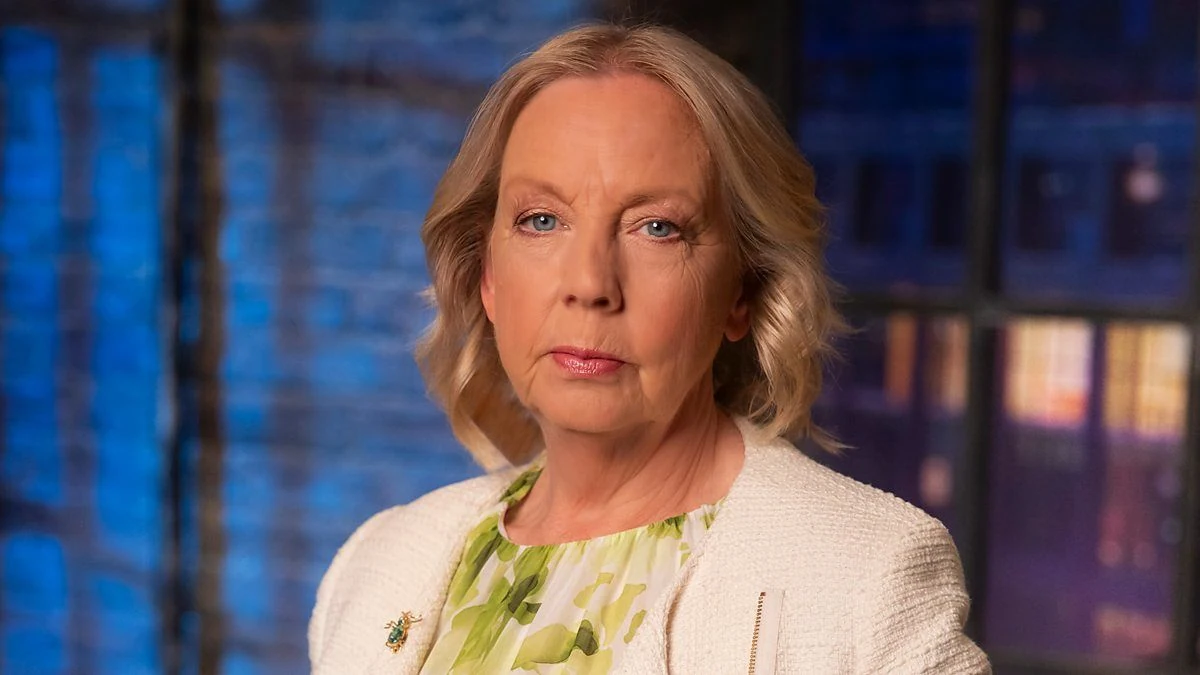
Deborah Meaden’s business career began with a company that failed. At 19, after studying business at Brighton Technical College, she moved to Italy and set up an export agency selling glass and ceramics to retailers including Harvey Nichols. It lasted 18 months. She went on to try a textile franchise, work in leisure and retail, and eventually take a leading role in her family’s holiday business. That company’s growth and sale established her as an investor; joining the BBC’s Dragons’ Den in 2006 brought her business experience to a much larger audience.
Early ventures and the family business
Meaden was born Deborah Sonia Charles in Taunton, Somerset, on 11 February 1959. After her parents divorced, her mother moved with Deborah and her older sister, Gail, to Brightlingsea in Essex. Her mother later married Brian Meaden, whom Deborah has described as becoming a true father to her. She attended Godolphin School in Salisbury for a short time, then Trowbridge High School, leaving at 16.
Business studies at Brighton Technical College led first to work as a sales-room model in a fashion house and then to her Italian export venture. After that agency closed, she and a partner bought one of the first Stefanel textile franchises in the UK, based in the West Country. She sold her share to her partner two years later for £10,000. Other early work included leisure and retail businesses, among them operating a prize-bingo operation at Butlin’s in Minehead.
In 1988, Meaden joined her family’s business to run its amusement arcades. Four years later she moved to Weststar Holidays, a family holiday-park operator based in Exeter, with its principal sites in south-west England. In 1999, she led a management buyout and acquired the majority shareholding. Weststar was providing holidays for more than 150,000 people a year by the time she began selling her stake.
The sale came in stages. In 2005, Phoenix Equity Partners bought Weststar in a deal valued at £33 million, giving Meaden a partial exit. In August 2007, her remaining 23 per cent stake was liquidated when Alchemy Partners bought the company for £83 million; her share was valued at about £19 million. The figures mark a substantial change from the small ventures with which she had started, but also show the importance of timing and ownership in the value of a business.
Building businesses beyond Weststar
Meaden’s work after Weststar included an investment in a business with a much longer industrial history. In 2009, she acquired Fox Brothers, a textile mill established in 1772 and still based in Wellington, Somerset, with fellow shareholder Douglas Cordeaux, formerly design director at Pepe Jeans London. That same year she launched The Merchant Fox, an online shop selling British-made luxury goods with provenance.
Her interests have also included events and regional promotion. In August 2009, she collaborated with BBC conductor Charles Hazlewood on Play the Field, a weekend of classical music held on his Somerset farm. She appeared in a short film promoting Somerset to businesses, commissioned by the inward-investment agency Into Somerset; she had recorded two earlier films for the agency in February of that year.
These ventures suggest a broader range than the shorthand of television investor might imply. The textile mill and online shop, in particular, put British-made products and their provenance at the centre of a commercial offer. The available account of her career also describes investments in GripIt, which makes plasterboard fixings, and Wool Couture, a supplier of craft kits. Those examples show different kinds of consumer business, but a list of investments alone cannot establish their financial performance or the results for the companies involved.
A familiar face in the Den
Meaden joined Dragons’ Den alongside Richard Farleigh in August 2006, at the start of the programme’s third series. She took over from Rachel Elnaugh and Doug Richard. The BBC Two format places entrepreneurs before investors to pitch their businesses and seek investment. Meaden’s place on the panel made her commercial experience a regular part of a popular television programme.
The original article described her as a direct mentor to countless hopeful entrepreneurs and praised her feedback as a lesson in business. Such claims are difficult to measure. What can be stated more precisely is that the programme put pitches, investment decisions and discussion of business ideas before a broad television audience. As of 2021, the Wikipedia account records that Meaden had agreed investments through the programme in 63 businesses, with a combined value of more than £3.3 million. The date matters: it is a snapshot, not a current total.
Her television work has not been limited to the Den. In 2013 she took part in the eleventh series of Strictly Come Dancing, paired with professional dancer Robin Windsor; she was eliminated on 26 October. She has also appeared on programmes including Would I Lie to You?, Have I Got News for You and Celebrity Antiques Road Trip. On radio, she co-presents The Big Green Money Show on BBC Radio 5 Live with Felicity Hannah. The weekly series began in March 2022 and looks at responses to climate change by businesses and individuals.
Books and public commitments
Meaden’s writing has addressed money for different age groups. Common Sense Rules was published in May 2009. In 2023 she published Why Money Matters, aimed at children aged six to nine and illustrated by Hao Hao. The following year came Deborah Meaden Talks Money, for young adults. The subjects extend the public-facing side of her work beyond television, although the books have distinct audiences and should not be treated as a single programme of instruction.
Her environmental and animal-welfare roles form another part of that public work. Meaden is a member of the World Wildlife Fund’s Council of Ambassadors and an ambassador for the Marine Conservation Society and Dogs Trust. She became an ambassador for the Tusk Trust in 2010 and joined its board of trustees in 2016. She also became an ambassador for the National Foundation for Retired Service Animals, launched in 2022 to support dogs and horses after their service with police, fire, prison and border-force organisations.
Her connection to the West Country runs through both business and home. She lives near Langport in Somerset, in a period property bought in 2006 after the Weststar sale. In 2009, a planning inspector criticised her evidence as “implausible” in an enquiry concerning village-green status for land on which a company in which she was a partner wanted to build 48 homes. That episode is part of the public record of her business activity, distinct from the achievements that brought her national visibility.
Why Deborah Meaden deserves a place in British Legacy
Meaden’s place in British business history is not founded on a single invention or one company. It rests on a documented sequence of work: a first export agency that failed, a textile franchise, ventures in leisure and retail, and then the management buyout and sale of Weststar Holidays. The scale of Weststar by the time of its sale—holidays for more than 150,000 people a year—shows the reach of the enterprise she helped lead. Her subsequent involvement with Fox Brothers, a Somerset mill founded in 1772, and the Merchant Fox also links her commercial career to the continuing sale and presentation of British-made goods.
Her television role gives that business history a further public dimension. As a long-standing investor on Dragons’ Den, Meaden has helped make the act of pitching a business and weighing an investment familiar to viewers across Britain. The programme does not prove that every contestant benefited, nor does celebrity itself amount to mentorship. But her recorded investments, alongside her appearances on television and radio, have made business decisions visible in a way that private company ownership alone could not. Her books and work with environmental and animal-welfare organisations add other strands to her public profile. Taken together, these specific activities—not claims of a golden touch or national supremacy—explain her relevance to British Legacy: an entrepreneur shaped by the south-west, a steward and seller of businesses, and a recognisable figure in the country’s popular discussion of enterprise.
Sources
Deborah Meaden · Deborah Meaden
Adapted in part from Deborah Meaden by Wikipedia contributors, under CC BY-SA 4.0. Text has been edited and combined with the existing article; this adapted text is shared under the same licence. Contributor history.