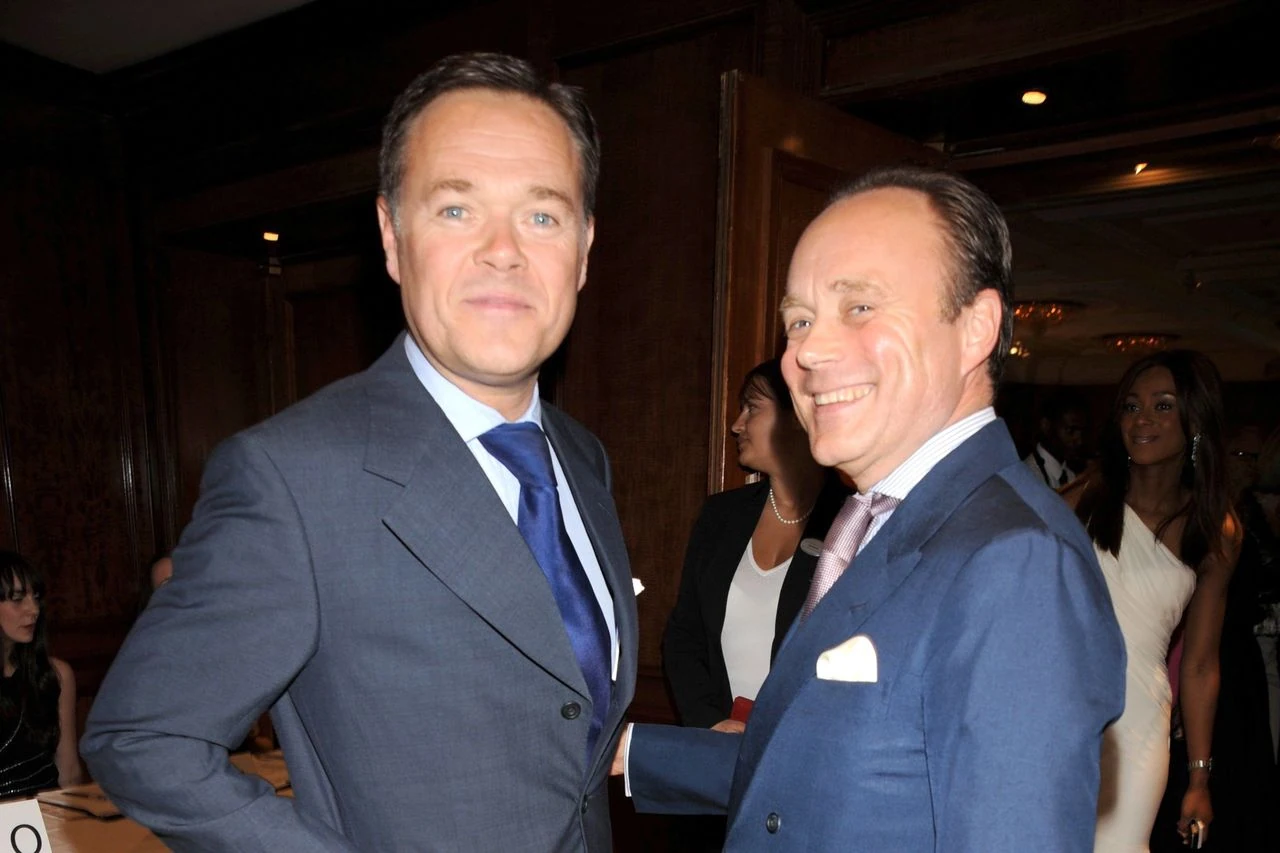
David and Frederick Barclay built a business empire through property, hotels, retail and newspapers. Their best-known holdings included the Ritz Hotel in Piccadilly and the Telegraph titles, but the story of their rise was not a simple ascent: an early shop failed, and their later ownership of prominent institutions ended in sales and disputes. Their long association with British business and public life was consequential, even as their preference for privacy left much of their work to be understood through the companies they controlled.
From family business to hotels
The identical twins were born in Hammersmith, London, on 27 October 1934, to Beatrice Cecilia Taylor and Frederick Hugh Barclay, a travelling salesman. They had eight siblings. Their father died when they were twelve, and in 1950 the boys left school and joined the accounts department of the General Electric Company. They later worked as painters and decorators.
By the end of the 1950s, they were running Candy Corner, a tobacconist and confectioner in Kensington. In 1960, the business failed after the landlord seized the shop over a breach of the lease. Frederick and their younger brother Douglas were declared bankrupt. David had meanwhile become a director of Hillgate Estate Agents in 1962. By 1968, Frederick was running the family businesses; David had paid his brother’s creditors, enabling Frederick to be discharged from bankruptcy.
The brothers redeveloped old London boarding houses as hotels, establishing a route into property and hospitality. In 1970, they bought Gestplan Hotels, operator of the Londonderry House Hotel in Park Lane. They also acquired interests in breweries and casinos. The hotel business was part of a broader pattern: buy established companies or properties, then reshape the holdings. In 1983, they bought the brewing and shipping group Ellerman for £45 million. They later sold its brewing division for £240 million and its shipping business to its management.
Other large deals extended their reach. In 1994, they spent £200 million on the Automotive Financial Group, a motor retail chain. In 2002, they bought the Liverpool-based retailer Littlewoods from the Moores family for £750 million, in a deal financed by HBOS. They combined it with their earlier purchase of The Very Group to form a home-shopping business. The department-store chain was closed and its properties sold or leased; among the buyers was Associated British Foods, which took a large group of sites for use chiefly by Primark.
The Ritz and a changing portfolio
The Ellerman sales helped fund the brothers’ 1995 purchase of the Ritz Hotel in London’s Piccadilly. They owned it until 2020, when it was sold to Abdulhadi Mana al-Hajri. The Ritz was one of the most visible properties in their portfolio: a hotel in a prominent central London location, recognised internationally as a luxury establishment. Its eventual sale marked the end of a quarter-century of Barclay ownership.
The brothers also bought the lease of Brecqhou, a small island beside Sark, in 1993. Their relationship with Sark became contentious. They challenged aspects of the island’s inheritance laws and later opposed the roles of its unelected seigneur and seneschal. Their legal challenge to the arrangements following Sark’s constitutional reforms was dismissed by the UK Supreme Court. The dispute connected their private property interests with wider arguments about the island’s government and residents’ political representation.
They were knighted in 2000 for their support of medical research. Between 1987 and 2000, they were estimated to have donated £40 million to that cause. Their wealth also attracted public attention: the 2020 Sunday Times Rich List put their combined fortune at an estimated £7 billion. They were known for avoiding publicity, and their business activities were often conducted through companies and complex ownership structures.
Newspapers and public influence
The brothers entered newspaper publishing in 1992, buying the European, a weekly title that later became a business-focused tabloid before closing in 1998. In 1995, they bought the Scotsman. They sold its publisher in 2005 to Johnston Press for £160 million, after a decade of ownership. In 1998, they bought and relaunched Sunday Business; it became the weekly magazine The Business in 2006 and was merged into The Spectator in 2008.
In July 2004, they bought the Telegraph Group, which included The Daily Telegraph and The Sunday Telegraph, after a contested bidding process. The titles had belonged to Hollinger, the group controlled by Conrad Black. The acquisition placed two nationally prominent newspapers under the brothers’ ownership. Their tenure was marked by newsroom upheaval: more than 100 journalists were made redundant in 2006, and a succession of editors followed. Peter Oborne resigned as chief political correspondent in 2015, protesting the paper’s editorial direction.
The ownership period ended amid financial and legal pressure. In 2019, the brothers were reported to be seeking a sale. In June 2023, after a dispute over unpaid debts, shares in the holding company that controlled the Telegraph titles and The Spectator were put up for sale by receivers. The Spectator was sold in 2024 to a company owned by Sir Paul Marshall. The Telegraph business was sold in 2025 to the American firm RedBird Capital Partners. These later changes underline that the brothers’ stewardship was a chapter in the history of the titles, not their permanent custodianship.
Family, fortune and the limits of control
David and Frederick’s business partnership lasted for decades, but the family and legal stories around it were not always private. In 2020, the High Court heard that Frederick and his daughter Amanda had been secretly recorded for several months in the Ritz conservatory. The proceedings concerned allegations of bugging and claims brought by family members; the reported dispute formed part of the circumstances around the hotel’s sale. It illustrates how closely business, family relationships and control of shared assets became entangled in the later years of the brothers’ partnership.
David died on 10 January 2021, aged 86, after a short illness. Frederick survived him. David’s death ended the twin partnership that had shaped their shared business interests, though the companies and assets they had built did not all remain in family hands. Their history includes commercial reversals as well as expansion: the collapse of Candy Corner, the sale of the Scotsman, the departure from the Ritz and the eventual transfer of the Telegraph titles.
Why David and Frederick Barclay deserve a place in British Legacy
The Barclays’ place in British business history rests on the scale and range of the enterprises they acquired and reshaped. From London hotels to Ellerman, Littlewoods and the Telegraph titles, their decisions affected businesses, properties and workforces across several sectors. The Ritz gave their portfolio a highly visible presence in central London; their ownership of the Telegraph Group placed them in the history of two influential British newspapers. These are not merely markers of wealth: they show how private ownership can shape the institutions and commercial landscape through which people encounter hospitality, retail and news.
Their record also merits a measured account rather than a story of uncomplicated preservation. The brothers’ ownership of the Telegraph ended with a sale, and the Ritz passed to a new owner in 2020. Newspaper redundancies and editorial changes formed part of their tenure; disputes over Sark connected their interests to questions of local government. At the same time, their reported donations to medical research were a substantial contribution to a field beyond their commercial holdings. Together, these achievements and tensions make the Barclays significant to a British Legacy feature: their careers demonstrate the reach of concentrated private ownership, the lasting importance of historic institutions, and the limits of any owner’s claim to control their future.
Sources
David and Frederick Barclay (revision 1379365603)
Adapted in part from David and Frederick Barclay by Wikipedia contributors, under CC BY-SA 4.0. Text has been edited and combined with the existing article; this adapted text is shared under the same licence. Contributor history.