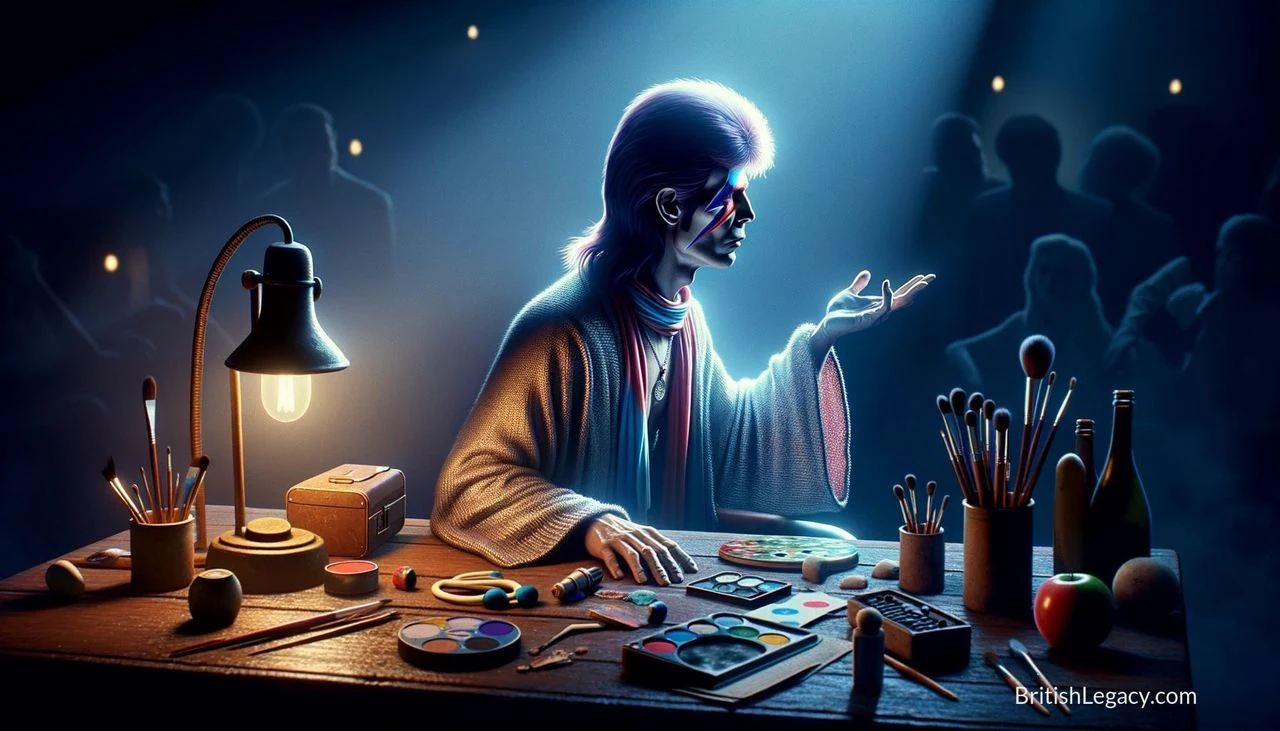
David Bowie built a career on refusing to stand still. Born David Robert Jones in Brixton in 1947, he moved from early London bands to the space-age narrative of “Space Oddity”, the theatrical force of Ziggy Stardust and the experimental records made in Berlin. Later, the success of “Let’s Dance” brought him to a new mass audience. Across those changes, music, performance and visual identity worked together: a song could arrive with a character, a look and a different idea of what a pop star might be.
From Brixton to “Space Oddity”
Bowie grew up in south London, attending schools in Stockwell, Bromley and Sundridge Park. At Bromley Technical High School he studied art, music and design. He formed his first band, the Konrads, in 1962, aged 15, and went on to play with a succession of local groups. Early singles and his 1967 debut album, David Bowie, did not establish him commercially. His decision to use the name David Bowie distinguished him from Davy Jones of the Monkees.
After working in music hall, folk and theatrical settings, Bowie released “Space Oddity” in July 1969, shortly before the Apollo 11 launch. Its story of the fictional astronaut Major Tom gave him his first major British success, reaching the UK top five. The song introduced a science-fiction frame that would recur in his work, but the following years did not follow a straight path to stardom. Albums such as The Man Who Sold the World (1970) and Hunky Dory (1971) shifted between hard rock, folk, art pop and melodic pop, finding a wider audience only gradually.
Ziggy Stardust and the art of transformation
In 1972, Bowie introduced Ziggy Stardust, an invented rock star from outer space, on stage and on the album The Rise and Fall of Ziggy Stardust and the Spiders from Mars. The character brought theatrical costume and narrative into a rock performance, with the Spiders from Mars providing the musical force. “Starman” helped establish Bowie’s breakthrough in Britain; “Suffragette City” became another of the album’s best-known tracks. A performance of “Starman” on Top of the Pops reached a national television audience and helped propel the single and album up the charts.
Ziggy was not a permanent identity. Bowie ended the character’s run on stage in 1973 and moved through further musical and visual changes. Aladdin Sane (1973), his first UK number-one album, carried the momentum into a new phase. Diamond Dogs (1974) brought a darker, post-apocalyptic setting and the character Halloween Jack. On Young Americans (1975), Bowie turned towards soul; “Fame”, made with John Lennon, became his first US number-one single. Station to Station (1976) introduced the Thin White Duke persona and pointed towards the art rock, electronic and ambient experiments that followed.
These changes were not simply new costumes laid over an unchanged sound. Bowie’s stage personas, records and public image developed together, making performance part of how audiences encountered the music. The characters also allowed him to approach fame and identity indirectly, though he later described the difficulty of separating himself from roles such as Ziggy and the Thin White Duke.
Berlin, pop success and another return
In 1976 Bowie moved to West Berlin with Iggy Pop. Working with producer Tony Visconti and musician Brian Eno, he made Low (1977), “Heroes” (1977) and Lodger (1979), later grouped as the Berlin Trilogy. The records moved between compact songs and instrumental passages, drawing on electronic and experimental music as well as rock and pop. “Heroes”, initially a relatively modest UK chart single, became one of his most enduring songs. The album’s title track has since been associated with the history of the Berlin Wall, though its importance rests also on the song itself: a direct, memorable vocal set against an expansive arrangement.
Bowie returned to a more direct pop sound with Let’s Dance (1983), co-produced with Nile Rodgers. The album reached number one in both the UK and the US, and its title track, “Modern Love” and “China Girl” all became major singles. “Let’s Dance” represented a striking change of scale from the Berlin records, but experimentation remained part of his career. After forming the hard-rock band Tin Machine in 1988, he returned to solo work in the 1990s, exploring electronic styles on albums including Outside and Earthling.
He continued recording and performing into the new century, though a heart attack in 2004 led him to reduce his public musical activity. In 2013, after a decade without a new studio album, he released The Next Day, which topped the UK chart. His final album, Blackstar, appeared on his 69th birthday, 8 January 2016. Bowie died in New York two days later, on 10 January. The album’s release so close to his death gave it a particular place in the story of his work, while its success in Britain and internationally brought his recorded career into renewed public view.
Beyond the records
Bowie also acted in film and theatre. His major film role as the alien Thomas Jerome Newton in Nicolas Roeg’s The Man Who Fell to Earth (1976) drew on the otherworldly presence already familiar from his music. Later roles included the Broadway production of The Elephant Man, the film Merry Christmas, Mr Lawrence and Jareth in Labyrinth. These projects extended his interest in character and performance beyond the stage, without displacing music as the centre of his career.
Visual art and design were further interests. Bowie painted and collected art, and his work with designers helped make clothing, make-up and stage appearance integral to his public presentation. He collaborated with Kansai Yamamoto in the early 1970s and Alexander McQueen in 1997. In 2013, the Victoria and Albert Museum’s exhibition David Bowie Is opened in London before travelling internationally, bringing costumes, objects and records together to show how his creative decisions crossed between sound and image.
He also explored the possibilities of new technology. BowieNet, launched in 1998, offered subscribers an online community and exclusive content; his 1996 single “Telling Lies” was among the early releases made available for download. In 1997, he created Bowie Bonds, securities based on royalties from recordings made before 1990. These ventures reflected a continuing interest in the ways musicians might reach audiences and manage their work beyond the conventional album release.
Why David Bowie deserves a place in British Legacy
Bowie’s British legacy is rooted in more than his birthplace or his success in the UK charts. His career began in London’s band scene and grew through a distinctly British combination of pop songwriting, theatrical performance and restless invention. “Space Oddity” turned a science-fiction story into a defining British hit; the Ziggy Stardust performances made character and visual design central to the experience of rock; and his later shifts, from the Berlin Trilogy to Let’s Dance, showed that popular success did not require him to repeat a settled formula. The scale and range of his work gave successive audiences different ways into his music.
His influence also travelled beyond recordings. Bowie’s use of costumes and invented personas expanded the possibilities of stage performance and self-presentation, while his acting, art and online projects carried that curiosity into other forms. The V&A’s London exhibition placed his working materials within a major British museum, recognising the importance of the connection between his music, image and design. Bowie’s story belongs in British Legacy because it shows how an artist working from Britain could alter international popular culture without being confined to one genre or generation. His achievement lies not in change for its own sake, but in repeatedly making change audible, visible and compelling to the public.
Sources
David Bowie — Wikipedia revision 1377341632
Adapted in part from David Bowie by Wikipedia contributors, under CC BY-SA 4.0. Text has been edited and combined with the existing article; this adapted text is shared under the same licence. Contributor history.