Helena Bonham Carter’s career began with roles that appeared to set a narrow course: young women in period dramas, framed by the familiar image of the “English rose”. She became uncomfortable with that label. Over the decades, she has moved between literary adaptations, independent films, fantasy, comedy and television, building a body of work in which an early reputation became a point of departure rather than a limit.
Early roles and an unwelcome label
Born in London on 26 May 1966, Bonham Carter grew up in Golders Green with her two older brothers. Her father, Raymond Bonham Carter, was a merchant banker; her mother, Elena, was a psychotherapist of Spanish and mostly Bohemian and French-Jewish background. After her father suffered a stroke following an operation, Bonham Carter helped her mother care for him. Her father died in 2004.
She attended South Hampstead High School and completed her A-levels at Westminster School. Bonham Carter had no formal acting training. In 1979, she won a national writing contest and used the prize money to join the actors’ Spotlight directory. She made her professional debut in a television commercial at 16, followed by a small part in the 1983 television film A Pattern of Roses.
Her first major film role was Lucy Honeychurch in A Room with a View (1985), which was released before Lady Jane (1986), in which she played the title character. The success of the earlier film brought attention, but many of her early parts were in period productions. The resulting “English rose” and “corset queen” labels made her feel typecast. That tension became an important thread in her career: she continued to take period roles, while seeking parts that challenged the image attached to them.
In the 1990s she appeared in films including Howards End (1992), Mary Shelley’s Frankenstein (1994) and Mighty Aphrodite (1995). Her portrayal of Kate Croy in The Wings of the Dove (1997) brought her first Academy Award nomination, for Best Actress. In Fight Club (1999), she played Marla Singer, a role that brought her an Empire Award for Best British Actress the following year. These performances showed a performer moving well beyond the restrained period persona audiences had first associated with her.
From Bellatrix to the Queen Mother
Bonham Carter’s work in the 2000s ranged from fantasy and animation to historical drama. She played Bellatrix Lestrange in the final four Harry Potter films, released between 2007 and 2011. The character’s cruelty and volatility made a sharp contrast with the young heroines of her early films. In 2005, she voiced Lady Tottington in Wallace & Gromit: The Curse of the Were-Rabbit, adding another kind of performance to a career that had never stayed in one register.
She also worked repeatedly with director Tim Burton, appearing in Big Fish (2003), Corpse Bride (2005), Charlie and the Chocolate Factory (2005), Sweeney Todd: The Demon Barber of Fleet Street (2007), Alice in Wonderland (2010) and Dark Shadows (2012). The films gave her room for comic, fantastical and darkly theatrical characters. Her performance as Mrs Lovett in Sweeney Todd earned a Golden Globe nomination; she also won the Evening Standard British Film Award for Best Actress in 2007 for that film and Conversations with Other Women.
In The King’s Speech (2010), she played Queen Elizabeth, later known as the Queen Mother. The role brought her a BAFTA Award for Best Actress in a Supporting Role and an Academy Award nomination in the same category. The film drew on a different kind of transformation: rather than a grotesque or fantastical creation, she portrayed a public figure within a story about King George VI and his struggle with his speech. Her subsequent screen roles continued to move between forms and periods, from Miss Havisham in Great Expectations (2012) to Madame Thénardier in Les Misérables (2012) and the Fairy Godmother in Cinderella (2015).
Television, style and public life
Bonham Carter’s television work has also brought her to historical figures. In the BBC Four film Enid (2009), she played children’s author Enid Blyton. The performance won the International Emmy Award for Best Actress in 2010 and earned a nomination for the British Academy Television Award for Best Actress. In Burton & Taylor (2013), she played Elizabeth Taylor. From 2019 to 2020, she portrayed Princess Margaret in the third and fourth seasons of The Crown, a role that brought two Primetime Emmy nominations.
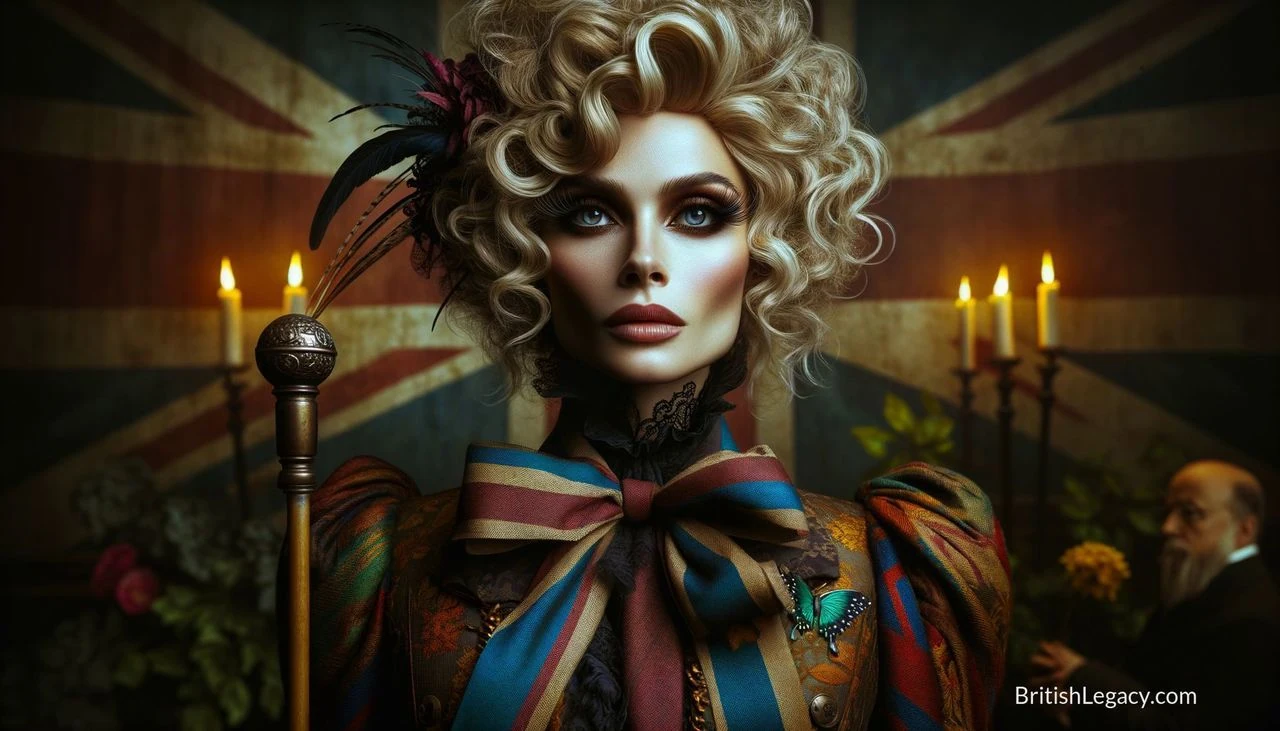
Her screen characters are only one part of her public profile. Bonham Carter is known for unconventional clothing and a dark, individual style, which has been recognised in fashion coverage and an advertising campaign for Marc Jacobs. In 2006, she launched a fashion line, The Pantaloonies, with swimwear designer Samantha Sage. Their first collection drew on Victorian garments, including camisoles, mob caps and bloomers.
In 2008, she became the first patron of Action Duchenne, a charity supporting people affected by Duchenne muscular dystrophy and their families. In 2022, she became the first female president of the London Library, where she had been a member since 1986. These roles offer a quieter measure of her public life alongside the visibility of film and television.
Why Helena Bonham Carter deserves a place in British Legacy
Bonham Carter’s British legacy is not simply a list of recognisable characters. It lies in the distance travelled between them. Her early success in A Room with a View made her closely associated with period drama, but her later choices repeatedly tested that expectation: Marla Singer in Fight Club, Bellatrix Lestrange in the Harry Potter films, Mrs Lovett in Sweeney Todd and Queen Elizabeth in The King’s Speech demand very different kinds of performance. Her BAFTA-winning role in the latter and her Academy Award-nominated performance in The Wings of the Dove mark two distinct achievements within that range.
Her career also connects British screen traditions to audiences around the world. She has worked in adaptations of British literary works, appeared in major film series and brought figures such as Enid Blyton and Princess Margaret to television. The changing scale and medium of her work—from a debut in television to international film productions and a long-running television drama—show how a British actor can move between popular entertainment and historically grounded stories without being confined to one type. Her contribution is both artistic and cultural: she has made the refusal of a single screen identity part of her lasting public presence.
Sources
Adapted in part from Helena Bonham Carter by Wikipedia contributors, under CC BY-SA 4.0. Text has been edited and combined with the existing article; this adapted text is shared under the same licence. Contributor history.