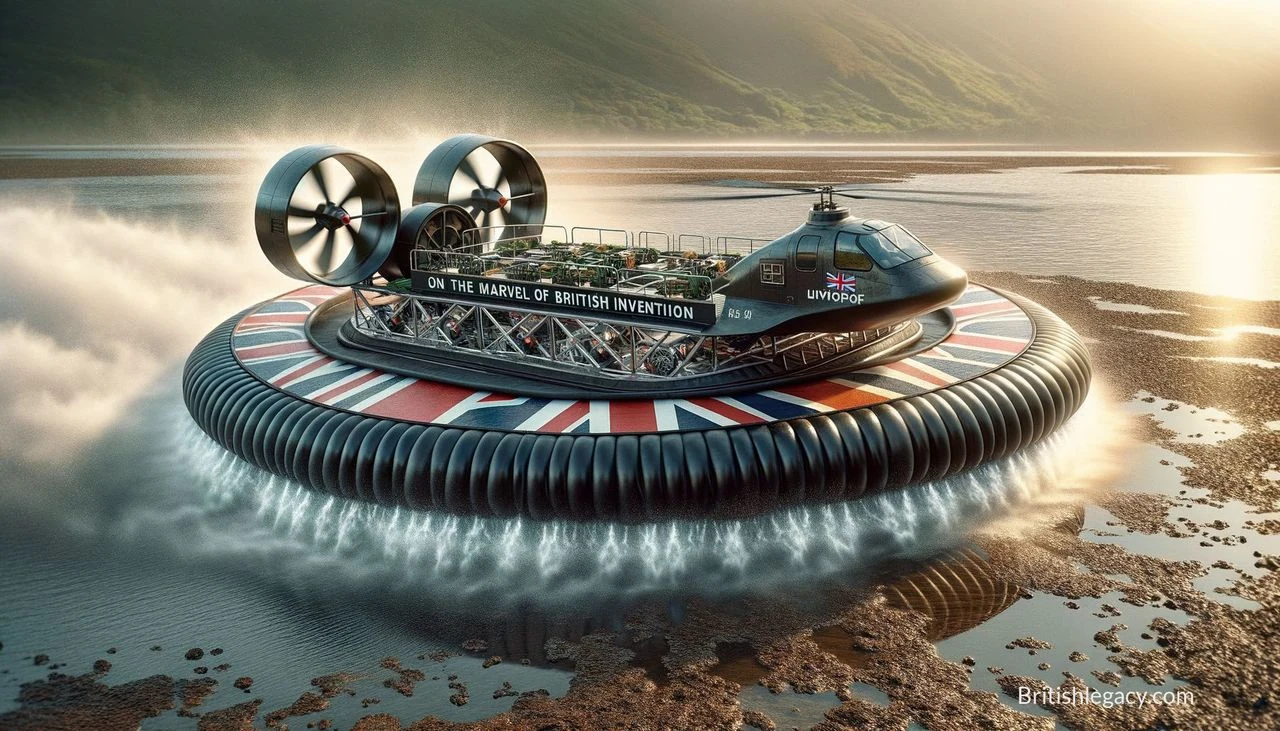
On 25 July 1959, the SR.N1 crossed the English Channel from Calais to Dover. It was neither an ordinary boat riding on a hull nor an aeroplane travelling on wings. Instead, it was lifted on a cushion of air and moved over the surface below. The crossing demonstrated the potential of a new kind of transport: the hovercraft, developed from Christopher Cockerell’s engineering work with backing from the National Research Development Corporation and built by Saunders-Roe on the Isle of Wight.
The hovercraft’s lasting importance lies in the terrain it can cross. A conventional vessel needs water; a wheeled vehicle can bog down on soft ground; aircraft require room to take off and land. An air-cushion craft can pass between shore and water, over mudflats and shallow ground. It did not replace ships, trains or aeroplanes, and it was not suited to every route. Its achievement was to make difficult transitions possible, then to find practical roles in passenger transport, rescue and military operations.
An engineer’s answer to the problem of escaping air
Christopher Cockerell was born in Cambridge in 1910, trained as an engineer and worked for Marconi from 1935 to 1950. His work there included television transmitters and radar. The hovercraft idea grew from an established engineering challenge: how to lift a vehicle on air without losing so much of that air around its edges that the lift became impractical. The broad idea of an air-cushion vehicle pre-dated Cockerell. His contribution was to devise a workable way of containing the cushion.
Rather than simply forcing a large volume of air beneath a vehicle, Cockerell’s approach used a fast-moving ring of air around the perimeter. He called this a “momentum curtain”. It helped contain a more stable cushion inside the ring and reduced the power needed to lift the craft. That engineering principle, rather than the novelty of a vehicle floating above the ground, was the important step towards a practical design.
The domestic experiment commonly associated with Cockerell made the idea tangible. Using small containers and a hairdryer, he demonstrated how controlling escaping air around the edge could help maintain the cushion. It was a model-scale test of a serious engineering proposition. The hovercraft’s origins are sometimes told as a story of sudden inspiration; the development that followed depended on testing, revision and understanding how airflow behaved.
From models to the SR.N1
Cockerell tested early models in Suffolk and tried to interest the authorities in the design. It did not fit established categories neatly. It was neither quite a ship nor an aircraft, which made its potential difficult for institutions and the armed services to assess. The idea was at one point treated as secret, but uncertainty about where it belonged was itself a practical obstacle: Britain had to consider supporting a type of machine that did not resemble familiar transport.
The National Research Development Corporation backed the construction of a full-scale craft and placed a contract with Saunders-Roe in 1958. The resulting SR.N1—Saunders-Roe Nautical 1—made its first public hover off the Isle of Wight on 11 June 1959. On 25 July it crossed the Channel. Chief test pilot Peter Lamb was at the controls, with Cockerell on board. The date marked the 50th anniversary of Louis Blériot’s aerial crossing, linking a major engineering demonstration with a well-known episode in the history of flight.
The Channel voyage was a striking proof of concept, but the hovercraft’s significance was not simply its speed or spectacle. A craft that could move from a beach or slipway onto water without relying on a conventional hull offered a different kind of access. Shallow water, tidal conditions and the transition between land and sea need not be treated in the same way as they are by an ordinary boat. The early hovercraft did not make older forms of transport obsolete; it offered an alternative where their limitations mattered.
Making the prototype useful
The SR.N1 also showed that a successful demonstration and a practical vehicle were not the same thing. In its early form, it hovered close to the surface, leaving it vulnerable to small waves and uneven ground. A flexible skirt, associated particularly with C. H. Latimer-Needham and refined by later engineers, extended the air cushion downwards. This gave the craft greater clearance and improved its ability to cope with obstacles and surface variations.
The distinction matters to the history of the invention. Cockerell’s contribution made efficient lift possible, but later design work helped turn that principle into a vehicle better suited to real conditions. The hovercraft’s development involved more than one person: the inventor, the public body that supported full-scale development, the manufacturer, test pilots and engineers responsible for subsequent improvements all contributed. The Channel crossing was a milestone, not the end of the engineering process.
With improvements to the skirt, hovercraft could deal more effectively with waves and obstacles. This refinement helped make the type credible for commercial and military purposes. The original insight and the later practical modifications belong in the same story: a powerful idea can begin an invention, but the details of materials, airflow and repeated redesign determine whether it can work beyond a demonstration.
Passenger routes and everyday use
After the first demonstrations, hovercraft moved into passenger service. Services appeared in the early 1960s, followed by larger designs. Among the best-known were the SR.N4 class of cross-Channel craft, which carried passengers and cars. They offered travellers a distinctive journey between Britain and France, combining features of ferry travel with the experience of a vehicle that skimmed over the water.
The hovercraft’s British story is not confined to those large crossings. Hovertravel has operated across the Solent since 1965, linking Southsea and Ryde. A technology first demonstrated as an experimental craft became part of a regular transport route. The service’s role connects the hovercraft not just with engineering history but with the daily movement of people between the mainland and the Isle of Wight.
That continuity points to a particular strength of the design: shore-to-shore travel without the same dependence on deep-water harbour infrastructure as a conventional vessel. The hovercraft is not the answer to every transport problem, but on a route where its ability to cross the boundary between land and sea is useful, it can offer a direct connection. In the Solent, that function has endured long after the excitement of the first Channel crossing.
Specialised strengths, real limits
Hovercraft did not become universal transport. Fuel use, noise, sensitivity to adverse winds and wear to the skirt all limited their wider appeal. Competition from other forms of marine transport and rising fuel prices also contributed to the end of the great cross-Channel era. These limitations help explain why a vehicle that looked capable of transforming transport instead found a more specialised place.
That is not the same as failure. Hovercraft have been used in amphibious military operations, rescue in shallow water and mud, survey work and difficult coastal environments. They can cross ground that may trap wheeled vehicles and move through shoreline transitions that can challenge ordinary boats. Their value depends on the conditions: where the surface or the route makes conventional options awkward, the hovercraft’s particular abilities can matter.
In Britain, the Hovercraft Museum at Lee-on-the-Solent preserves examples of the vehicles that followed Cockerell’s original work, from prototypes to passenger and military craft. Its collection helps show how the design developed beyond the first demonstration and how varied its uses became. The hovercraft is not only an idea or a patent: it is a family of machines, with a history of experimentation, service and practical engineering.
Cockerell was knighted in 1969. The honour recognised work that had moved well beyond a laboratory curiosity, though the hovercraft’s commercial history was more complex than its early promise. It never displaced established transport wholesale. Its influence is better understood through the particular tasks it made possible and the engineering development it inspired. The resulting history includes both a celebrated crossing and the less dramatic work of adapting a novel design to the demands of service.
Why the hovercraft deserves a place in British Legacy
The hovercraft deserves a place in British Legacy because it represents a specific and substantial engineering achievement. Christopher Cockerell’s work made an air-cushion vehicle more practical by addressing the problem of air escaping around its edges. The SR.N1 then carried that principle into a full-scale machine, backed by a British public development body and built by Saunders-Roe on the Isle of Wight. The craft’s 1959 Channel crossing made the result visible, but the invention’s value was not confined to a dramatic event. It offered a means of moving across the awkward margins between land and water: shallow shores, mudflats and other surfaces where conventional vehicles can be constrained. In an island country, a design that could cross these boundaries had a clear potential benefit.
Its legacy is also collective and ongoing. The flexible skirt and subsequent refinements helped turn the first working design into a more useful vehicle; passenger services, military applications and rescue work gave the type roles beyond the original demonstration. In the Solent, Hovertravel has maintained a regular route since 1965, connecting the invention with everyday British transport. The museum at Lee-on-the-Solent preserves the machines and the stages of development that made this possible. Taken together, these achievements show why the hovercraft belongs in a record of British invention: it joined a clear engineering insight to public support, manufacturing and continued practical use, while finding its proper place rather than pretending to serve every purpose.