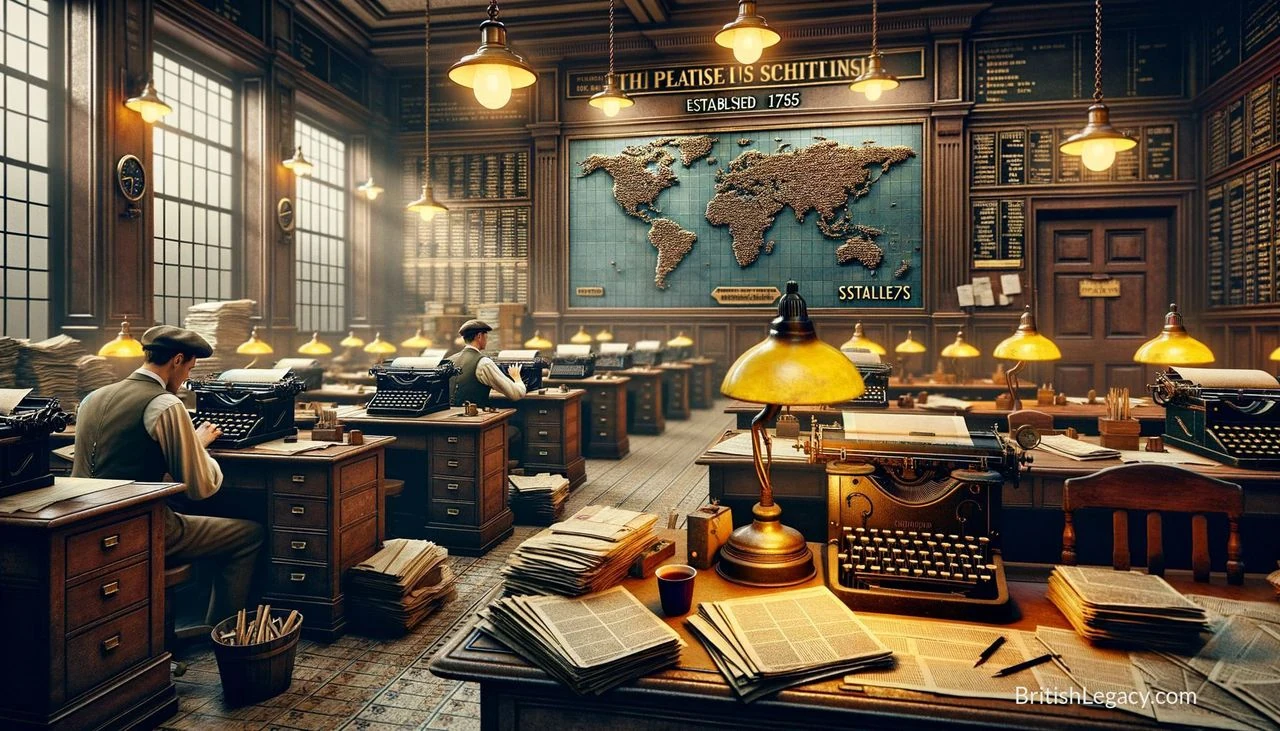
When The Times first appeared in London on 1 January 1785, it was called The Daily Universal Register. Three years later it adopted the shorter name that would become familiar around the world. Its history since then has not been a steady march of unbroken influence: the paper has changed hands, technologies and formats, and its record includes both consequential reporting and serious editorial failures.
A new title and a growing reputation
John Walter founded the newspaper and edited it in its early years. He had acquired a patent for logography, a proposed system of typesetting common words and groups of letters, and opened a printing house to use it. The method proved less efficient than promised, but the business he established endured. After 940 editions, the paper became The Times on 1 January 1788.
Walter's efforts to obtain news from continental Europe, particularly France, helped build the paper's reputation among policymakers and financiers. His work also brought legal consequences: he served 16 months in Newgate Prison for libels printed in the newspaper. In 1803 he handed ownership and editorship to his son, John Walter II. That transfer, rather than the 1795 date given in the earlier account, is the succession date recorded in the supplied historical reference.
The paper built its standing in part by paying well for information and writers at a time when competition was limited. Its contributors included figures from politics, science, literature and the arts. Thomas Barnes became general editor in 1817, followed in 1841 by John Thadeus Delane. Under their editorships, The Times gained considerable political influence and a reputation for forceful commentary. Journalists Peter Fraser and Edward Sterling were associated with the nickname “The Thunderer”, drawn from a line about the paper having “thundered out” an article on reform.
New presses, new readers
The Times began using a steam-driven cylinder press in 1814. Steam-powered printing increased the potential speed and volume of production, and the paper's circulation grew over the following decades: from 5,000 in 1815 to 9,800 in 1837 and 51,200 in 1854. The earlier article describes the newspaper as one of the first to adopt a steam press; the supplied historical account supports its use of the technology in 1814, but does not establish that comparative claim.
Reporting from abroad became another part of the paper's identity. The Times was among the first newspapers to send correspondents to cover wars. William Howard Russell's dispatches from the Crimean War were influential in Britain, giving readers reports from the conflict rather than relying solely on official accounts. This expansion of reporting was one way a London paper came to address a national readership and events beyond Britain.
In 1890 financial difficulties threatened the title, which was rescued under editor Charles Frederic Moberly Bell. In 1908 it was bought by Alfred Harmsworth, later Lord Northcliffe. The Astor family acquired it in 1922, and in 1966 sold it to Canadian publisher Roy Thomson. That year The Times and The Sunday Times came under common ownership, although the two newspapers had been founded independently.
Editorial choices and ownership changes
The paper's influence has brought scrutiny as well as prestige. In 1920, an editorial endorsed the antisemitic forgery The Protocols of the Learned Elders of Zion as a genuine document. The following year, correspondent Philip Graves exposed it as a forgery, and The Times retracted its earlier editorial. In the 1930s, the paper was associated with advocacy of appeasement towards Germany. Reports by its Berlin correspondent Norman Ebbut, which warned of Nazi warmongering, were rewritten in London to support that policy.
Ownership and editorial leadership changed again in 1981, when Rupert Murdoch's News International bought The Times and The Sunday Times from Thomson. Murdoch gave legal undertakings to maintain separate journalism resources for the two titles. The transition also accelerated changes in production. Between 1981 and 1982, the paper phased out hot-metal Linotype printing in favour of computer input and photocomposition. In 1986, during the Wapping dispute, The Times moved from its former premises near Fleet Street to new offices in Wapping.
The paper's relationship with political parties has varied over time. The supplied historical account records endorsements of different parties at different elections, including Labour in 2001 and 2005 and the Conservatives in 2010 and 2019. It made no party endorsement in the 2024 general election. The newspaper is therefore not well described by a single, unchanging political alignment.
From broadsheet to compact and online
In November 2003 The Times began producing both broadsheet and tabloid editions. The broadsheet was withdrawn from some regions the following year, and from 1 November 2004 the paper was printed solely in tabloid, or compact, format. The change marked a striking alteration in the physical appearance of a newspaper that had been a broadsheet for 219 years.
The paper's online history began earlier than the 1999 website launch stated in the previous article: the supplied reference records an online presence for The Times and The Sunday Times from 1996. In October 2010 the papers introduced a paywall for online readers who did not subscribe to print editions. The site remains part of a broader publishing operation that also includes digital editions and apps. In 2020 the titles launched Times Radio, extending the operation into audio news and discussion.
There have also been significant changes to the newspaper's typography. The Times commissioned the typeface Times New Roman, designed by Victor Lardent under the supervision of Stanley Morison. It first appeared in the paper on 3 October 1932 and was made available commercially a year later. Though the newspaper has used different typefaces since then, Times New Roman became one of its best-known contributions to print culture.
Why The Times deserves a place in British Legacy
The Times deserves a place in British Legacy not because longevity guarantees journalistic excellence, but because its history makes the changing role of a British newspaper unusually visible. Founded in London in 1785, it moved from the title The Daily Universal Register to The Times, adopted steam-powered printing in 1814 and later reported wars through correspondents such as William Howard Russell. Its circulation figures show the scale of its growth during the nineteenth century; its successive print and digital changes show how a national publication has adapted to new ways of producing and distributing news.
Its legacy also requires an honest account of influence and error. The paper's endorsement of a notorious antisemitic forgery, its coverage in the era of appeasement and the later retraction after Graves exposed the forgery belong in the same history as its reporting from the Crimea and its typographic innovations. That record offers readers and historians material for examining how editorial authority is built, used and challenged. The Times is a British institution with international reach, but its significance lies not in a claim to be beyond criticism. It lies in the evidence it provides about journalism's power in public life—and the responsibility that power entails.
Sources
The Times — supplied Wikipedia revision
Adapted in part from The Times by Wikipedia contributors, under CC BY-SA 4.0. Text has been edited and combined with the existing article; this adapted text is shared under the same licence. Contributor history.