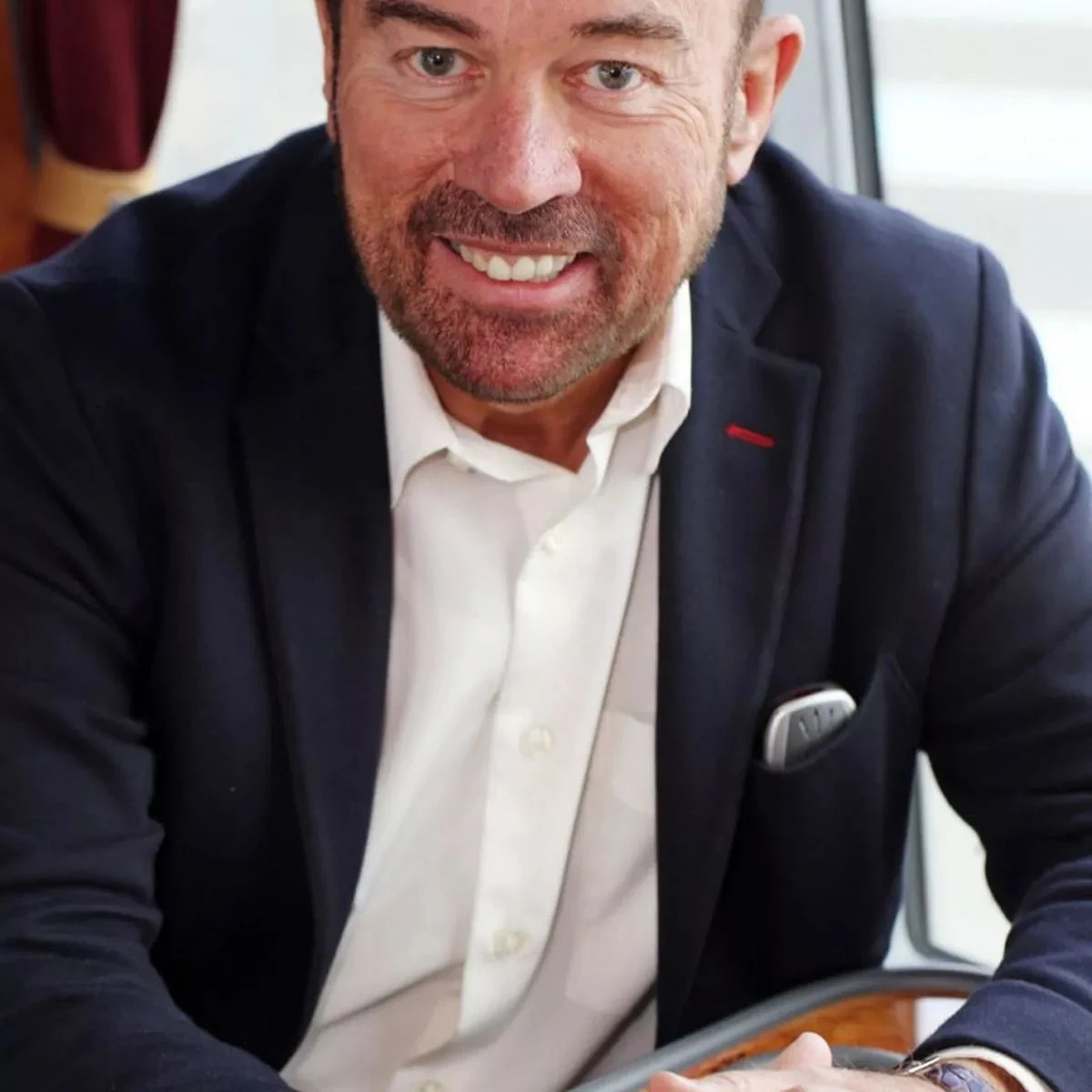
Brian Souter’s career joined accountancy to the practical business of moving people. With his sister Ann Gloag and brother-in-law Robin Gloag, he established Stagecoach in 1980, running buses between Dundee and London. The company grew through Britain’s changing bus market, then expanded into rail and overseas operations. Souter also founded Megabus, developed a portfolio of investments and helped establish a charitable trust. His influence was substantial, but not uncontested: his campaign against the repeal of Scotland’s Clause 2A, commonly known as Section 28, provoked strong opposition.
From Perth to accountancy
Souter was born in Perth, Scotland, on 5 May 1954. His father drove buses, and Souter travelled on routes with him as a child. At school, he developed an interest in economics and accounts. He later recalled that changing his timetable to include those subjects was one of the best decisions he had made.
He studied at Dundee Institute of Technology, intending to become a commerce teacher, and then at the University of Strathclyde in Glasgow. There he graduated with a diploma in accountancy and economics. After qualifying as a chartered accountant in 1984, he worked for Arthur Andersen & Co. The training gave him a grounding in finance before he entered the transport business with his sister and brother-in-law.
Stagecoach grows with a changing bus market
Stagecoach began in 1980, running buses from Dundee to London. Its expansion gathered pace after bus services in Great Britain were deregulated. In the late 1980s the company acquired former National Bus Company subsidiaries in Cumberland and Hampshire, followed by East Midlands, Ribble, Southdown and United Counties. It also bought operations in Scotland, Newcastle and London; Manchester was added a few years later.
The group’s growth involved more than buying operators. Stagecoach pursued low-fare and, at times, free services in competition with local rivals. In Darlington, its subsidiary Busways offered incentives to recruit drivers from the existing bus service and ran free buses in an effort to deter a rival bidder from taking over the service. The Monopolies and Mergers Commission described the practice as “predatory, deplorable and against the public interest”. That finding offers a necessary counterpoint to claims that expansion simply brought cheaper, better transport: competition and its consequences were part of the company’s record too.
In 1993, Stagecoach was valued at £134 million and floated on the London Stock Exchange, giving it access to capital for further opportunities in buses and trains. By the middle of the decade, its interests included Australia and New Zealand. It went on to acquire Citybus, which operated buses and ferries in Hong Kong, and Coach USA. The international businesses extended the group’s reach, although Souter’s most lasting public profile remained closely associated with British transport.
Railways, coach travel and leadership
After the flotation, Souter turned his attention to rail. An early experiment was a Scotland-to-London service branded Stagecoach Rail, using carriages attached to the Caledonian Sleeper. During the privatisation of British Rail, Stagecoach won the South West Trains franchise in 1996 and the Island Line Trains franchise later that year. It retained both when they were retendered in 2001 and 2006; the operations passed to South Western Railway in 2017.
Stagecoach’s other rail interests included a 49 per cent shareholding in Virgin Rail Group, which operated the CrossCountry and West Coast franchises. The company began operating East Midlands Trains in 2007. From April 2015 until June 2018, Virgin Trains East Coast, in which Stagecoach held a 90 per cent share, ran the InterCity East Coast franchise.
Megabus, added to the group in 2003, carried the low-cost inter-city approach into coach travel across the UK and Europe. A more unusual extension was the overnight sleeper service announced in 2013 for routes between Scotland and London. Its coaches cost £5 million to build and had 53 leather seats that could convert into 42 bunk beds. Passengers were given a onesie for the journey. The service ended in 2017 after consistently making a loss, and the coaches were used on daytime routes instead.
Souter’s role at Stagecoach changed as the company matured. In 2012 it was announced that he would become chairman on 1 May 2013, with finance director Martin Griffiths replacing him as chief executive. In December 2019, Souter announced that he would leave the chairmanship at the end of the year, remaining on the board as a non-executive director.
Business beyond the bus network
Souter established Souter Investments to manage a large portfolio of private investments across different asset classes, with a focus on private equity. He and Ann Gloag also formed Highland Global Transport in 2012. Its interests included Stagecoach, transport businesses in Turkey and Poland, the bus manufacturer Alexander Dennis, the biodiesel producer Argent Energy and the yacht maker Sunseeker. These holdings changed over time: some were sold, including PolskiBus in 2017 and most of Alexander Dennis in 2019.
In 2015, New Zealand transport businesses brought together under Highland Global Transport were organised as the InMotion Group. The group included bus and coach operators as well as ferries. Several businesses later ceased trading or were sold, while Fullers360 remained Souter’s New Zealand subsidiary in November 2019. The changing portfolio illustrates a business career that reached well beyond the company most closely associated with his name.
His work in accountancy also returned to the foreground. Souter became vice-president of the Institute of Chartered Accountants of Scotland in 2015 and its president in 2017. He received business and industry awards, including an honorary degree from Strathclyde in 1997, an honorary degree from Abertay in 1999 and a special recognition award for services to the bus industry in 2008.
Public causes, charity and criticism
In 1992, Souter and his wife, Betty, established the Souter Charitable Trust to support humanitarian projects in the UK and overseas. Its work has included malaria prevention and meals for schoolchildren in Africa. The trust has supported a wide range of causes, with a particular, though not exclusive, emphasis on Christian organisations. In 2009, after receiving a £1.6 million bonus, Souter said he did not think it right to keep the full amount in the economic climate. He donated £900,000 to the trust and gave most of the remainder to the staff pension fund.
His charitable activity sat alongside prominent political involvement. In 2000, when the Scottish Executive proposed repealing the law known in Scotland as Clause 2A, Souter led the Keep the Clause campaign. He spent £1 million on a privately organised postal ballot. Of the valid votes returned, 86.8 per cent favoured keeping the clause and 13.2 per cent favoured repeal, but the turnout was 31.8 per cent. The campaign did not prevent repeal. Critics challenged the poll’s legitimacy and its interpretation; gay-rights campaigners strongly condemned Souter’s position.
Souter also gave substantial financial support to the Scottish National Party. In 2007 he donated £500,000, saying he wanted to address what he saw as an imbalance in political funding. In 2011 he pledged to match funds raised by the party, up to £500,000, and in 2014 the BBC reported a £1 million donation to the campaign for Scottish independence. The donation and his opposition to Clause 2A’s repeal were part of the public debate surrounding his business and political influence.
His knighthood, awarded in the 2011 Birthday Honours for services to transport and the voluntary sector, also drew criticism. Scottish Labour politicians questioned whether political donations were relevant to the honour, while gay-rights campaigners objected to the recognition in light of his campaign against repeal. An independent report by Lord Fraser of Carmyllie cleared Alex Salmond of breaching the ministerial code in relation to the controversy. In 2019, Stagecoach Southeast’s sponsorship of the Turner Prize was ended by mutual agreement a few days after its announcement, following public criticism of Souter’s involvement.
Why Brian Souter deserves a place in British Legacy
Brian Souter’s place in British Legacy rests first on the scale and duration of his involvement in transport. Stagecoach began with services between Dundee and London and grew, following bus deregulation, through acquisitions across Britain and into rail. Its history helps explain how the restructuring of public transport created opportunities for ambitious private operators, while the Darlington case shows that expansion and low fares could also bring serious questions about competition. A considered account should retain both parts of that record rather than treating commercial growth as an uncomplicated public benefit.
His contribution also extended beyond Stagecoach. Megabus brought a low-cost inter-city offer to coach travel; rail franchises placed the group in the changing landscape of British railway privatisation; and his investment and charitable work reached transport businesses and humanitarian projects beyond the UK. At the same time, his campaign against Clause 2A’s repeal and the response to his knighthood show how wealth and business prominence can carry influence into contested public questions. Souter’s British legacy is therefore not a simple celebration of entrepreneurship. It is a record of company-building, changes to how people travelled, philanthropic giving and political activity that attracted sustained criticism. Those connected strands make his career significant to the history of modern British business and public life.
Sources
Brian Souter — Wikipedia revision 1367740396 · Brian Souter — Wikipedia
Adapted in part from Brian Souter by Wikipedia contributors, under CC BY-SA 4.0. Text has been edited and combined with the existing article; this adapted text is shared under the same licence. Contributor history.