James Goldsmith made his name in business by buying companies, reorganising them and challenging the way their assets were valued. Later, he brought the same appetite for confrontation into British politics. In 1994 he founded the Referendum Party, arguing that the United Kingdom’s relationship with the European Union should be decided by a national vote. His business methods attracted fierce criticism; his party won no seats at the 1997 general election. Yet his short political campaign made the referendum question a prominent part of British debate.
A childhood across countries
James Michael Goldsmith was born in Paris on 26 February 1933. His father, Frank Goldsmith, was a hotelier and former Conservative MP; his mother was Marcelle Mouiller. When Nazi Germany overran France in 1940, the family escaped and later relocated to the Bahamas. Goldsmith went to St Andrew’s College in Aurora, Canada, then attended Millfield and Eton in England.
He left Eton in 1949, aged 16, after winning £8,000 on a horse-racing bet. Rather than remain at school, he took over a small Paris business from his brother Teddy, selling a treatment for rheumatism and electrical plugs and sockets. Goldsmith served as a gunner in the British Army’s Royal Artillery during National Service and received an officer’s commission. These early years crossed countries, but his later business and political careers repeatedly brought him into British public life.
Building and reshaping businesses
Goldsmith’s first business ventures were precarious. During the 1950s and 1960s, his work as an entrepreneur and financier brought him close to bankruptcy more than once. He won the British franchise for Alka-Seltzer, introduced low-cost generic medicines to the UK and expanded from remedies into food. He also began a retail partnership with Selim Zilkha: they founded Mothercare in the early 1960s, but Goldsmith sold his share to Zilkha, who went on to develop the chain.
In 1965, with financial backing from Sir Isaac Wolfson, Goldsmith acquired food companies listed in London and brought them together as Cavenham Foods. The group added bakeries, confectioners and wholesalers, as well as small chains of shops. Goldsmith’s approach was to consolidate operations, close inefficient factories and change management. By 1971, Cavenham’s turnover had risen from £27 million to £35 million, while profits had increased to £2 million.
That year he bid for Bovril, a larger business with brands including Marmite, Ambrosia and Virol, as well as dairies, farms and ranches in Argentina. The contested takeover drew criticism from the financial press. After gaining control, Goldsmith sold the dairies and farms to Express Dairies, found buyers for the Argentine ranches and later sold the brand names to Beecham. He also acquired Allied Distributors, whose holdings included the Lipton shops.
Goldsmith’s activities increasingly reached beyond Britain. In 1973 he acquired a controlling stake in the American retailer Grand Union and set his colleague Jim Wood to reorganise its operations, meeting resistance from both management and unions. In 1980 he formed a partnership with merchant banker Roland Franklin. Through takeovers, their Cavenham Forest Industries became a major private owner of timberland in the United States. Goldsmith identified that some companies carried valuable timber assets on their balance sheets at very low recorded values; in the case of Crown Zellerbach, he judged the timberland alone to be worth more than the company’s market capitalisation.
His American operations also included an unsuccessful hostile bid for Goodyear in 1986, from which his companies reportedly made $90 million. He retired to Mexico in 1987 after selling assets ahead of that year’s market crash, but continued to invest and pursue corporate takeovers. His critics in the press described him as a corporate raider and asset stripper. Goldsmith rejected those labels, arguing that his reorganisations improved businesses and shareholder value. The disputes over his methods, and his determination to contest their portrayal, were part of his public profile.
Fighting with the press, entering politics
Goldsmith’s conflicts with British media included a long-running dispute with Private Eye. In 1976 the magazine accused him of involvement in a meeting intended to help the fugitive Lord Lucan. Goldsmith sued over the allegation and also pursued a criminal libel prosecution, a rare course of action. The civil suits were eventually settled. His clashes with the press continued, including a 1977 BBC Money Programme report on his business methods. In a subsequent programme, Goldsmith challenged the implication that his companies stripped assets, pointing to investment in their operations.
He also moved into publishing, buying the French weekly L’Express in 1977. In Britain he launched the news magazine NOW!, which closed in 1981 after 84 issues and failed to meet its circulation targets. In 1993 he gave a televised speech opposing the European Union, and the following year published The Trap, a critique of free-trade policies and the political direction of Western countries.
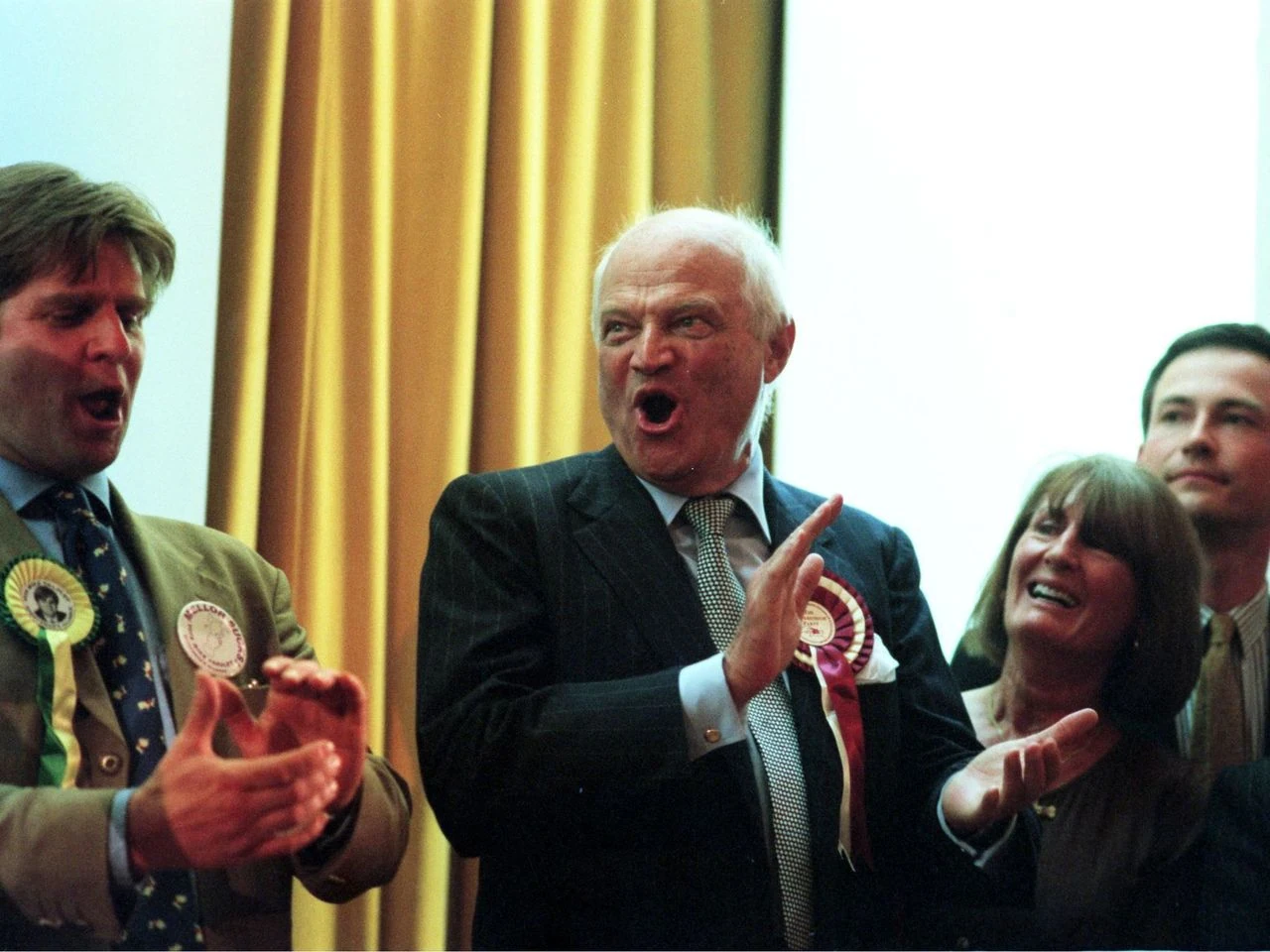
Goldsmith had been elected to the European Parliament in 1994 as a representative for a French constituency. In the same year, he founded and financed the Referendum Party in the UK. Its central demand was a referendum on British membership of the European Union. Goldsmith believed the decision should be put directly to voters, rather than settled by the established political parties. He led the new party through the 1997 general-election campaign, when it stood candidates across the country.
Goldsmith himself stood in Putney against former Conservative minister David Mellor. He received 1,518 votes, or 3.5 per cent, and lost his deposit. The party did not win a seat. During the campaign, Goldsmith sent a VHS cassette to around five million homes, offering voters his case outside the limits of broadcast political advertising. His illness was known only to a close personal circle; he was terminally ill during the campaign. The party ceased to exist after his death, although some of its supporters later joined successor campaigns against UK membership of the euro.
Death and the limits of a political legacy
Goldsmith died of pancreatic cancer on 18 July 1997, aged 64, at a farmhouse in Benahavís, southern Spain, two months after the election. His political project was brief, and the Referendum Party’s electoral performance was modest. The claim that it directly caused the 2016 Brexit referendum would go beyond what its election results alone establish. Its more clearly documented place in the story is as an early, well-funded campaign for a referendum on EU membership, and as a vehicle that brought that demand into British politics.
Goldsmith’s career resisted a simple verdict. His acquisitions and restructurings sometimes created profitable businesses, but his tactics drew sustained criticism and disputes with journalists. He was knighted in 1976, in Harold Wilson’s resignation honours. In business, he pursued opportunities across countries and sectors; in politics, he concentrated resources on a single constitutional question. The contrast between a party that quickly disappeared and an argument that remained in public discussion is central to assessing his significance.
Why James Goldsmith deserves a place in British Legacy
Goldsmith belongs in British Legacy because his story illuminates two distinct forms of influence on British life. In business, he built and reorganised companies with consequences for British retail, food and pharmaceuticals. Cavenham Foods grew through acquisitions and operational changes; his role in founding Mothercare connected him to a retail business that continued under his former partner. His career also exposed the disputes that surround corporate takeovers: Goldsmith saw restructuring as a way to improve productivity and value, while critics portrayed him as a raider who profited from dismantling companies. A useful account of his legacy has to retain both the results and the controversy.
His political contribution was different but equally relevant to Britain’s public record. The Referendum Party did not win parliamentary representation, and Goldsmith’s own Putney result was small. Nevertheless, he put substantial resources behind the demand that voters decide the country’s relationship with the European Union, and carried that case into the 1997 election through candidates and a direct-to-households video campaign. That does not make him the author of later events, but it does place him among the early, conspicuous campaigners for a referendum. Taken together, his business disputes, media battles and political intervention show how an individual with wealth and public reach could challenge established institutions, while also illustrating the limits of influence without electoral success.
Sources
James Goldsmith — Wikipedia revision 1375499620 · James Goldsmith — Wikipedia
Adapted in part from James Goldsmith by Wikipedia contributors, under CC BY-SA 4.0. Text has been edited and combined with the existing article; this adapted text is shared under the same licence. Contributor history.