James Goldsmith made his name by spotting value in businesses and assets that others thought worth less. He bought and reorganised companies in Britain and abroad, from food manufacturers to American timber holdings. The methods brought him wealth and influence, but also the label of corporate raider and sustained disputes with the press. In the final years of his life, he turned to politics, founding the Referendum Party to demand a referendum on Britain’s relationship with the European Union.
A childhood across countries
James Michael Goldsmith was born in Paris on 26 February 1933. His father, Frank Goldsmith, was a hotelier and former Conservative MP; his mother, Marcelle Mouiller, was French. The family left France after the German invasion in 1940, escaping by ship before relocating to the Bahamas. Goldsmith later attended school in Canada, then Millfield and Eton in England. He left Eton in 1949, aged 16, after winning £8,000 on a horse-racing bet. He used the money to take over a Paris business from his brother Teddy, selling a remedy for rheumatism and electrical goods.
After National Service as a gunner in the Royal Artillery, Goldsmith developed the small business into a pharmaceutical operation. He secured the British franchise for Alka-Seltzer and moved into generic prescription medicines. A publicity stunt involving an arthritic racehorse helped boost sales of the Paris business, whose workforce grew from two to more than a hundred. He also acquired the distributorships for Slimcea and Procea low-calorie breads, an early step towards the food industry. In the early 1960s, he and Selim Zilkha founded the retail chain Mothercare; Goldsmith later sold his share to Zilkha.
Building a business empire
In 1965, with financial backing from Sir Isaac Wolfson, Goldsmith acquired food companies listed on the London Stock Exchange and brought them together as Cavenham Foods. The group expanded into bakeries, confectionery and retailing. Goldsmith rationalised operations, closed factories he considered inefficient and changed management practices. By 1971, Cavenham’s turnover had risen from £27 million to £35 million, while profits reached £2 million.
That year he made a contested bid for Bovril, whose businesses included the Marmite, Ambrosia, Virol and Jaffajuice brands, dairies and cattle ranches in Argentina. After gaining control, he sold the dairies and farms to Express Dairies and found buyers for the ranches. Sales of other parts of the business recovered much of the £13 million purchase cost; he later sold the brand names to Beecham for £36 million. He also took over Allied Distributors, which owned grocery businesses including the Lipton shops.
Goldsmith’s approach was to buy assets he believed the market undervalued, then reorganise or sell parts of a business. He argued that restructuring improved productivity and shareholder value; critics described him as an asset stripper. In the early 1970s, he began shifting some dealings into private companies, including Générale Occidentale in France and General Oriental Investments, registered first in Hong Kong and later in the Cayman Islands. In 1973 he acquired a controlling stake in the American retailer Grand Union and set Jim Wood, who had worked on his British retail operations, to rationalise the chain. The work met resistance from management and unions.
His investments were not confined to retail and food. During the 1960s and 1970s he received finance from Slater Walker and became its chairman after the company’s collapse and rescue during the 1973–75 secondary banking crisis. In 1980 he partnered with merchant banker Sir Roland Franklin, who managed Goldsmith’s American business. Between 1983 and 1988, their Cavenham Forest Industries built a large timberland portfolio. Goldsmith’s analysis of company accounts led him to conclude that Crown Zellerbach’s timberland was worth substantially more than the company’s market value. He also profited from an unsuccessful 1986 attempt to take over Goodyear, although he considered the return inadequate because the bid did not succeed.
Goldsmith anticipated the 1987 market crash and retired to Mexico after liquidating assets, but continued to invest and pursue takeovers. In 1989 he joined Kerry Packer and Jacob Rothschild in an attempt involving British-American Tobacco. He exchanged American timber assets for a substantial stake in Newmont Mining, remaining on its board until selling his shares in 1993. From 1990, he also ran a lower-profile international investment operation. His business career involved considerable risk: during its earlier decades, he came close to bankruptcy several times.
Public disputes and political campaigning
Goldsmith’s business methods and wealth brought him into conflict with the press. In 1976, satirical magazine Private Eye falsely accused him of taking part in a meeting about the fugitive Lord Lucan. Goldsmith pursued civil actions against the magazine’s editor and a journalist, and sought a criminal libel prosecution. The dispute contributed to a long and costly legal battle and to a continuing antagonism between Goldsmith and parts of the British media. In a 1977 BBC Money Programme broadcast, he defended his record against claims of asset stripping, pointing to investment in the businesses he owned.
He also entered publishing. In 1977 he bought the French weekly L’Express, and from 1979 to 1981 published the British magazine NOW!. It failed to meet its circulation targets and closed after 84 issues. Goldsmith was knighted in 1976, in Harold Wilson’s resignation honours.
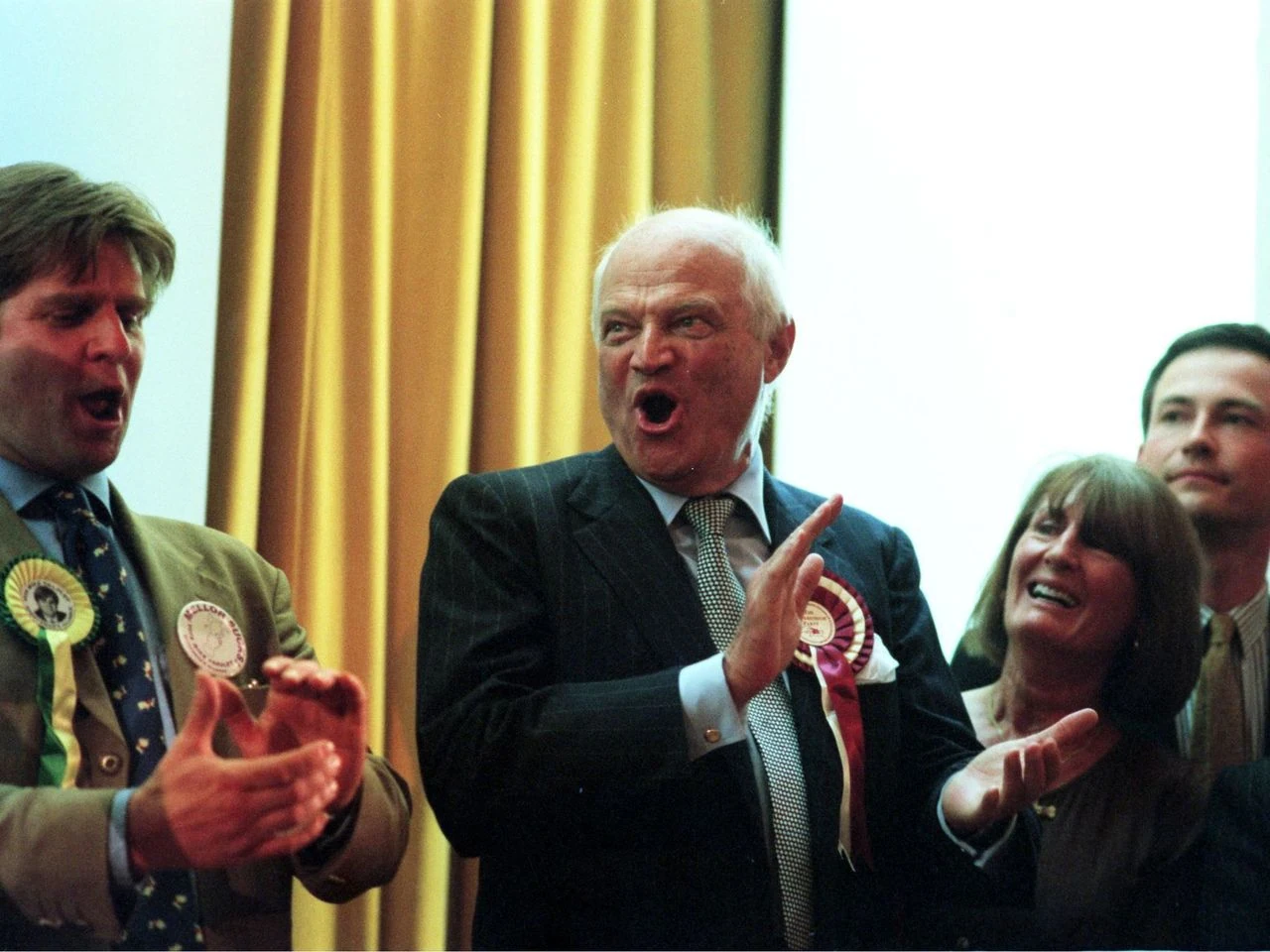
By the 1990s his attention was increasingly on European politics. He publicly opposed the European Union in a televised Channel 4 lecture in 1993 and published The Trap, a book setting out his political and economic arguments. In 1994 he was elected as a Member of the European Parliament for a French constituency. That year he founded and financed the Referendum Party in the United Kingdom. Its central aim was a referendum on Britain’s membership of the European Union. Goldsmith led the party until 1997 and sought to communicate directly with voters, including by sending a video cassette to millions of homes during the general-election campaign.
At the 1997 general election, Goldsmith stood for the Referendum Party in Putney against former Conservative minister David Mellor. He received 1,518 votes, or 3.5 per cent. The party won no seats and ceased to exist after Goldsmith’s death. Some of its activists and supporters later joined the Referendum Movement, which became the Democracy Movement.
Death and political afterlife
Goldsmith died of pancreatic cancer on 18 July 1997, aged 64, at a farmhouse in Benahavís, southern Spain. His business career had ranged from pharmaceuticals and food to retail, timber and mining; his political career was shorter, but gave him a prominent platform for his opposition to European integration.
In 1999, filmmaker Adam Curtis included Goldsmith in The Mayfair Set, a BBC documentary series about business figures and the financial culture of the period. The series presented him as a speculator and corporate raider. That portrait sits alongside Goldsmith’s own defence of his methods: that he identified neglected assets, challenged complacent management and sought to improve the companies he acquired. The gap between those accounts is part of his public record, not a settled verdict on every transaction.
Why James Goldsmith deserves a place in British Legacy
James Goldsmith belongs in a history of British business because his career shows how ownership, finance and corporate restructuring changed in the late twentieth century. He built Cavenham Foods by acquiring a varied group of businesses, then expanded through takeovers and asset sales. His interventions in companies such as Bovril and Grand Union made him a conspicuous figure in debates over what a new owner owed to a business, its shareholders and its workforce. Supporters could point to improved productivity and profits; critics saw closures and asset stripping. His record is significant partly because those competing interpretations cannot be reduced to a simple story of entrepreneurial success.
His political legacy is also specifically connected to Britain. Goldsmith founded and financed a British party with a focused demand: that voters decide the country’s relationship with the European Union through a referendum. The Referendum Party did not win seats in 1997, and it ended after his death. Its campaign nevertheless formed part of the history of British Euroscepticism and of arguments about parliamentary authority, popular consent and European integration. It should not be treated as a direct or inevitable cause of the 2016 referendum; the evidence supports a more measured point. Goldsmith made a referendum central to his own political project and helped keep that demand in public debate. Together, his corporate contests and his political campaign offer a portrait of a businessman who challenged established institutions, while leaving a disputed record of the costs and consequences of doing so.
Sources
James Goldsmith — Wikipedia, revision 1375499620
Adapted in part from James Goldsmith by Wikipedia contributors, under CC BY-SA 4.0. Text has been edited and combined with the existing article; this adapted text is shared under the same licence. Contributor history.