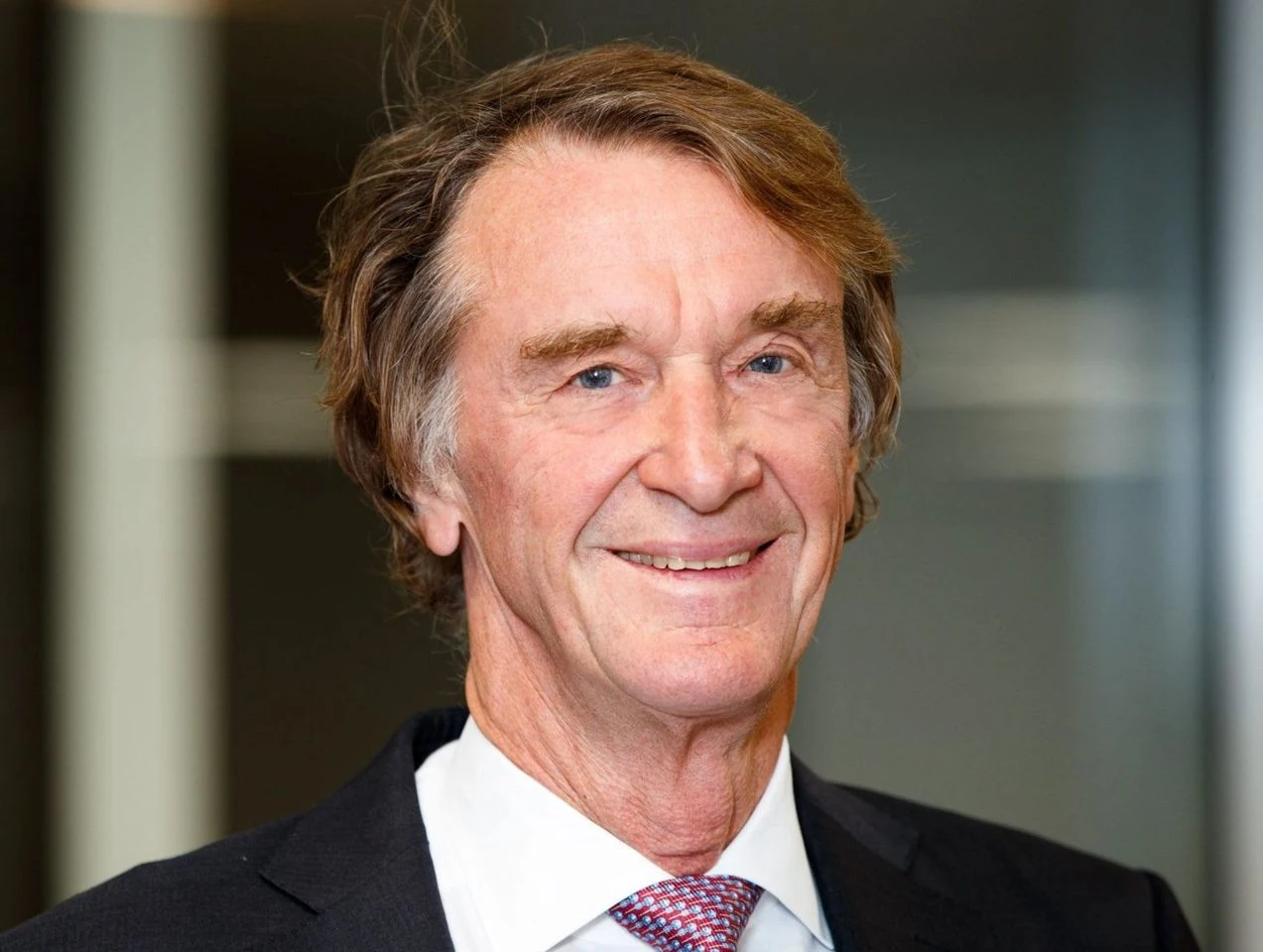
Jim Ratcliffe’s business career has been built around acquiring and developing industrial operations. In 1998, he formed INEOS in Hampshire to buy out Inspec and the freehold of a chemical site in Antwerp. From that small base, the company expanded through further acquisitions into an international chemicals group. Its history links Ratcliffe’s rise as an industrialist to a changing British manufacturing landscape: one in which established businesses and assets could be reshaped by new ownership, investment and strategy.
From Failsworth to chemical engineering
Ratcliffe was born in Failsworth, then in Lancashire and now in Greater Manchester, on 18 October 1952. His father worked as a joiner before running a factory that made laboratory furniture; his mother worked in an accounts office. The family lived in a council house in Failsworth until Ratcliffe was ten, then moved to East Yorkshire. He attended Beverley Grammar School and studied chemical engineering at the University of Birmingham, graduating in 1974 with a 2:1.
His first job after university was at BP, where he was dismissed after three days. The account of his career states that eczema, which BP had not identified before he joined, was given as the reason: the condition made him unsuitable for work around toxic chemicals. He then became a trainee accountant at a pharmaceutical company. Later, at Esso, he worked while the company funded his MBA at London Business School between 1978 and 1980. He went on to work for chemicals and fabrics producer Courtaulds, then joined the private-equity firm Advent International in 1989.
Building INEOS through acquisitions
Before founding INEOS, Ratcliffe was a co-founder of Inspec, which leased the former BP Chemicals site in Antwerp. In 1998, he formed INEOS in Hampshire to buy out Inspec and acquire the freehold of that site. The company’s expansion was not a single leap: Ratcliffe pursued acquisitions of operations that larger groups, including ICI and BP, no longer wanted. The stated rationale was to select businesses with the potential to double their earnings over five years, using debt to finance deals.
A major step came in 2006, when INEOS bought BP’s Innovene refining and petrochemical arm. The transaction brought refineries and plants in Scotland, Italy, Germany, France, Belgium and Canada into the group. In 2007, INEOS acquired Norsk Hydro’s polymers business, strengthening its position in the European market, particularly in polyvinyl chloride. These deals illustrate the company’s growth by taking on established industrial assets and integrating them into a larger group.
INEOS’s UK presence and Ratcliffe’s business base have not been the same thing. In 2010, he moved the company’s head office from Hampshire to Rolle in Switzerland, a move described as reducing the company’s tax bill. In 2015, INEOS opened a UK headquarters for its chemicals and energy group in Knightsbridge, London, alongside gas and oil trading and other functions. Ratcliffe said he was pleased to be returning to the UK as a business base. The company reported full-year 2015 EBITDA of €577 million, compared with €253 million in 2014.
Ratcliffe has also publicly argued for a less restrictive regulatory environment for industry. In 2019, he criticised the rules governing suspension of fracking in Britain after a tremor, describing the government’s position as “pathetic”. That stance sits alongside the practical significance of the company’s UK assets: in February of the same year, INEOS announced plans to invest £1 billion in the UK oil and chemical industries, including an overhaul of the Forties pipeline system, which transports a significant share of the country’s North Sea oil and gas.
From chemical products to the Grenadier
INEOS makes chemicals used across sectors including healthcare, construction, automotive and consumer goods. Ratcliffe extended the group’s reach into vehicle manufacturing through INEOS Automotive. He initially wanted to continue production of the Land Rover Defender after its original model was discontinued and unsuccessfully approached Jaguar Land Rover about buying the tooling. Instead, in 2019, he established partnerships with BMW and Magna Steyr to develop a new vehicle, known during development as Projekt Grenadier.
The five-door Grenadier Station Wagon entered production in October 2022, followed by the Quartermaster utility vehicle in 2023. Ratcliffe described his aim as creating a successor to the Defender, but the Grenadier is a new product, not a continuation of Land Rover production. The project adds an automotive business to a career rooted in chemicals and industrial acquisitions, while drawing on a recognisable British vehicle tradition.
INEOS has also announced plans to invest in green hydrogen. In 2021, Ratcliffe said the group would put more than €2 billion into electrolysis projects across Europe. The first projects were planned for Norway, using renewable electricity, followed by Germany and Belgium, with further investment intended for France and the UK. These are announced investment plans; they should not be confused with evidence that every project has been completed. The company has also undertaken small bioethanol projects, although its US plant was sold in 2017 after technical problems with the process.
Business, sport and public profile
Ratcliffe’s sporting interests have extended beyond sponsorship. He completed the Marathon des Sables across the Sahara in 2013 and supported the INEOS 1:59 Challenge, in which Eliud Kipchoge ran the marathon distance in under two hours. Through INEOS, he has backed professional cycling: after buying the Team Sky franchise in 2019, the team became Team INEOS and later INEOS Grenadiers. Its riders won the 2019 Tour de France and the 2021 Giro d’Italia with Colombian cyclist Egan Bernal.
His other sporting investments include Lausanne-Sport, which he bought in 2017, and French club Nice, acquired by INEOS in 2019. In 2023, Manchester United announced that Ratcliffe had acquired a 25 per cent stake; the transaction was completed in February 2024, with INEOS Sport taking responsibility for football operations. His proposed purchase of Chelsea in 2022 did not succeed. His activity in sport therefore ranges from elite teams and club ownership to a charity, Go Run for Fun, which organises events intended to encourage children aged five to ten to be active.
Ratcliffe was appointed a Knight Bachelor in the 2018 Birthday Honours for services to business and investment. The Institution of Chemical Engineers granted him an honorary fellowship in 2009, citing his leadership in building INEOS, and he received the Petrochemical Heritage Award in 2013. His career has also involved choices and positions that complicate any uncomplicated celebration of business success: the company moved its head office to Switzerland, and Ratcliffe changed his tax residence from Hampshire to Monaco in 2020. Those details form part of the public record of a businessman whose companies have substantial British industrial connections but whose personal and corporate arrangements have also crossed borders.
Why Jim Ratcliffe deserves a place in British Legacy
Ratcliffe’s place in a record of British business rests most clearly on the scale and character of the industrial group he founded. INEOS began in Hampshire in 1998 with the purchase of Inspec and the Antwerp site, then grew through acquisitions that included major operations from BP and Norsk Hydro. The company’s assets have included plants in Scotland and other parts of the UK, while the Forties pipeline investment announced in 2019 connected its plans to infrastructure carrying North Sea oil and gas. This is a specific industrial legacy: building a multinational business by taking on and developing manufacturing operations, rather than relying on a single invention or product.
The Grenadier adds another dimension. Ratcliffe’s attempt to acquire the Defender’s tooling failed, but he pursued a new vehicle through INEOS Automotive and partnerships with BMW and Magna Steyr. Production began in 2022, giving the group a foothold in vehicle manufacturing and extending a British connection to a familiar tradition of rugged four-wheel-drive vehicles. His sporting investments, including the INEOS cycling team and Manchester United stake, have also made the group visible well beyond the chemical sector. Together, these ventures show how modern British industrial influence can be expressed through manufacturing, infrastructure and sport. The record is not simply one of national loyalty: Ratcliffe’s business and tax arrangements have been international. Its significance lies in the durable industrial activity and British-based projects associated with his companies, alongside the global reach he built from a Hampshire foundation.
Sources
Jim Ratcliffe — Wikipedia revision 1376164734
Adapted in part from Jim Ratcliffe by Wikipedia contributors, under CC BY-SA 4.0. Text has been edited and combined with the existing article; this adapted text is shared under the same licence. Contributor history.