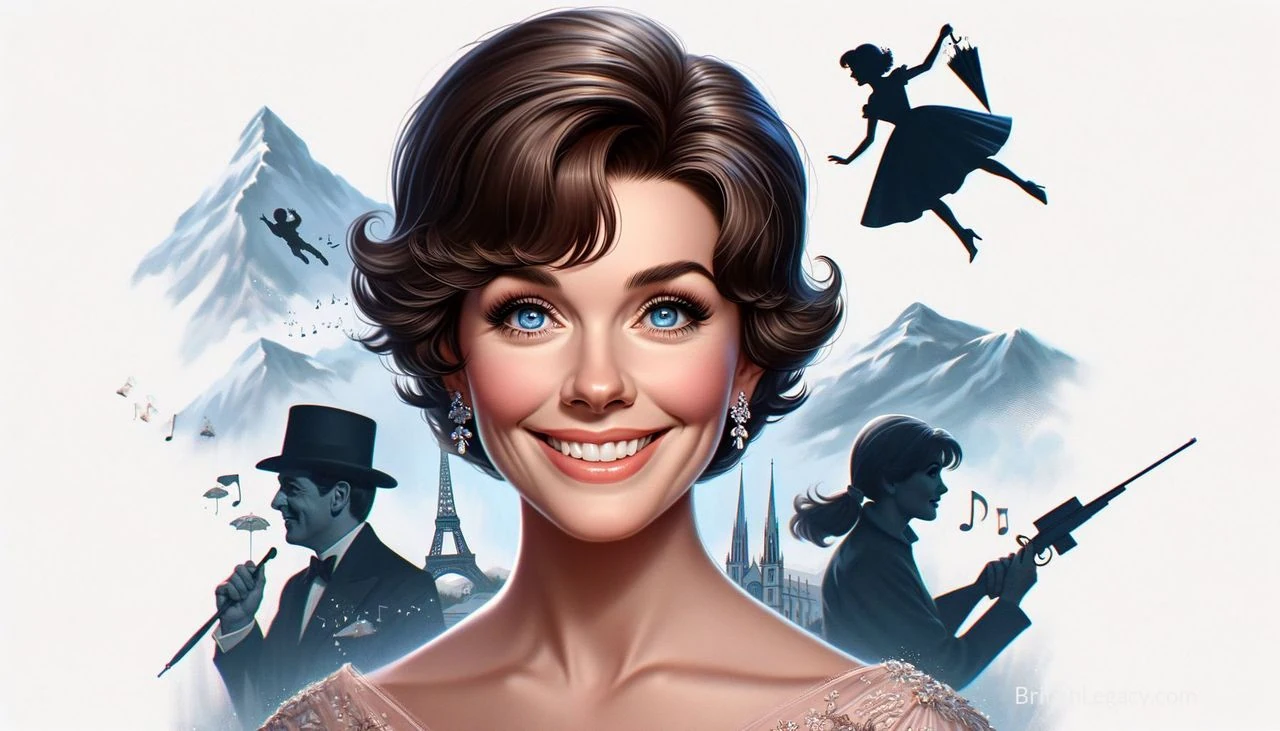
Julie Andrews was already a working performer before audiences knew her as Mary Poppins. Born Julia Elizabeth Wells in Walton-on-Thames in 1935, she began appearing on stage with her parents as a child, made her professional solo debut at 12 and reached Broadway before her twentieth birthday. Her career would span West End and Broadway musicals, celebrated films, television, voice work and books. The path from a young British stage performer to an internationally recognised actor and singer was not uninterrupted: after surgery in 1997, she lost the singing voice that had helped make her famous, and found other ways to work.
A child performer finds her stage
Andrews was born on 1 October 1935 in Walton-on-Thames, Surrey. Her mother, Barbara, married Ted Andrews, a teacher of metalwork and woodwork, in 1943. Andrews later recalled difficult years during the war and described her stepfather as violent and an alcoholic. He also sponsored her performing-arts training: she studied at Cone-Ripman School and took singing lessons with the soprano Lilian Stiles-Allen. Andrews later recalled that Stiles-Allen had a considerable influence on her, although she did not believe her voice was suited to opera.
From 1945, Andrews performed on stage with her mother and stepfather, initially without billing. At 12, she made her professional solo debut at London’s Hippodrome, singing an aria from Mignon in the revue Starlight Roof. In 1948, aged 13, she appeared in the Royal Variety Performance at the London Palladium. Radio and television followed, including a regular part in the BBC radio comedy Educating Archie from 1950 to 1952.
Her first major Broadway role came in 1954, when she played Polly Browne in The Boy Friend. Two years later, she originated Eliza Doolittle in My Fair Lady, a role that brought her wide acclaim. She then played Queen Guinevere in Camelot and starred in the 1957 television musical Cinderella, written for her by Richard Rodgers and broadcast live. These stage and television roles established her as a performer able to carry demanding musical parts before her film career began.
Mary Poppins, Maria and the films that followed
Andrews made her film debut as Mary Poppins in Disney’s 1964 musical. Walt Disney had seen her in Camelot and offered her the part; production waited while she gave birth to her daughter. The film combined live action and animation, and Andrews’s performance earned her the Academy Award for Best Actress, as well as a Golden Globe. Her Broadway role as Eliza Doolittle had not transferred to the screen: the film version of My Fair Lady went to Audrey Hepburn. Andrews later said she wished she had been able to record her stage performance for posterity.
In The Sound of Music (1965), Andrews played Maria von Trapp in Robert Wise’s adaptation of the Rodgers and Hammerstein musical. The film became the highest-grossing film of its year. Andrews received a Golden Globe for her performance and an Academy Award nomination. The story is set in Austria against the rise of Nazi rule; the film’s songs and Andrews’s portrayal made it one of the best-known musical films of the period.
She resisted being confined to the role of the musical nanny. In The Americanization of Emily (1964), she appeared opposite James Garner in a comedy-drama set during the Second World War. Later film work included Hawaii and Alfred Hitchcock’s Torn Curtain (both 1966), Thoroughly Modern Millie (1967), and Victor/Victoria (1982). For the last, she won another Golden Globe and received her third Academy Award nomination. Her screen career also included 10, That’s Life! and Duet for One, as well as a return to family films as Queen Clarisse in The Princess Diaries (2001) and its sequel.
New forms of work
Andrews’s career was not limited to film. She appeared in television variety programmes and specials, including The Julie Andrews Hour, which won seven Emmy Awards, and had a long-running working relationship with Carol Burnett. She later voiced Queen Lillian in the Shrek films and Marlena Gru in the Despicable Me series. From 2020, she narrated the Netflix drama Bridgerton as Lady Whistledown. These parts made her voice familiar to audiences who knew her from different generations of screen entertainment.
In 1997, Andrews developed hoarseness while performing in the Broadway production of Victor/Victoria and underwent surgery on her vocal cords. She has said that the problem was a muscular strain rather than cancer or nodules. The operation left permanent damage and did not restore her singing voice. She later sued the doctors who had operated on her; the case was settled in 2000. The change curtailed her singing, but not her work. She continued acting, recording voice roles and appearing in projects that did not require her to sing as before.
Writing became another substantial part of her career. Andrews and her daughter, Emma Walton Hamilton, have co-authored numerous children’s books, including The Very Fairy Princess. Andrews also published two memoirs: Home: A Memoir of My Early Years (2008), which covers her childhood and early performing career, and Home Work: A Memoir of My Hollywood Years (2019), written with Walton Hamilton. Her theatre work also continued behind the scenes: she directed stage productions, including a revival of The Boy Friend and adaptations of her children’s book The Great American Mousical.
A British honour and an international career
Andrews’s career was rooted in British performance. Her early work took place on London stages and British radio, and she carried that training into major productions in New York and Hollywood. Her international career was recognised in Britain when she was made a Dame Commander of the Order of the British Empire in the 2000 New Year Honours for services to the performing arts. The title recognises a specific contribution; it does not make the work that followed any less varied or international.
Her honours also include the Kennedy Center Honors in 2001, the Screen Actors Guild Life Achievement Award in 2007 and the American Film Institute Life Achievement Award in 2022. In 2002, she was ranked 59th in the BBC’s poll of the 100 Greatest Britons. Such distinctions sit alongside the less easily summarised span of her work: stage musicals, television, film, directing, narration and children’s literature.
Why Julie Andrews deserves a place in British Legacy
Julie Andrews deserves a place in British Legacy because her career shows how a performer’s training can travel across forms and borders without losing its connection to its beginnings. She grew up and started performing in Britain, progressed through London stages, radio and television, and developed into a leading figure in Broadway musicals before her film success. Her work in Mary Poppins and The Sound of Music brought her to a global audience, but those films were part of a wider career that included dramatic roles, television, voice acting and directing.
Her story also includes adaptation in a practical sense. When vocal surgery permanently damaged her singing voice, Andrews continued to act, narrate, record and write rather than relying on the ability that had first brought her to prominence. Her books, many written with her daughter Emma Walton Hamilton, extended her work into children’s storytelling; her memoirs recorded the change from early performance to Hollywood career. The British honour she received in 2000 recognises her services to the performing arts, while the international reach of her films and later roles illustrates how a career begun on British stages can become part of shared popular culture. That combination of British beginnings, sustained reinvention and work across generations makes her legacy more substantial than any single celebrated role.
Sources
Julie Andrews — Wikipedia revision 1379020750
Adapted in part from Julie Andrews by Wikipedia contributors, under CC BY-SA 4.0. Text has been edited and combined with the existing article; this adapted text is shared under the same licence. Contributor history.