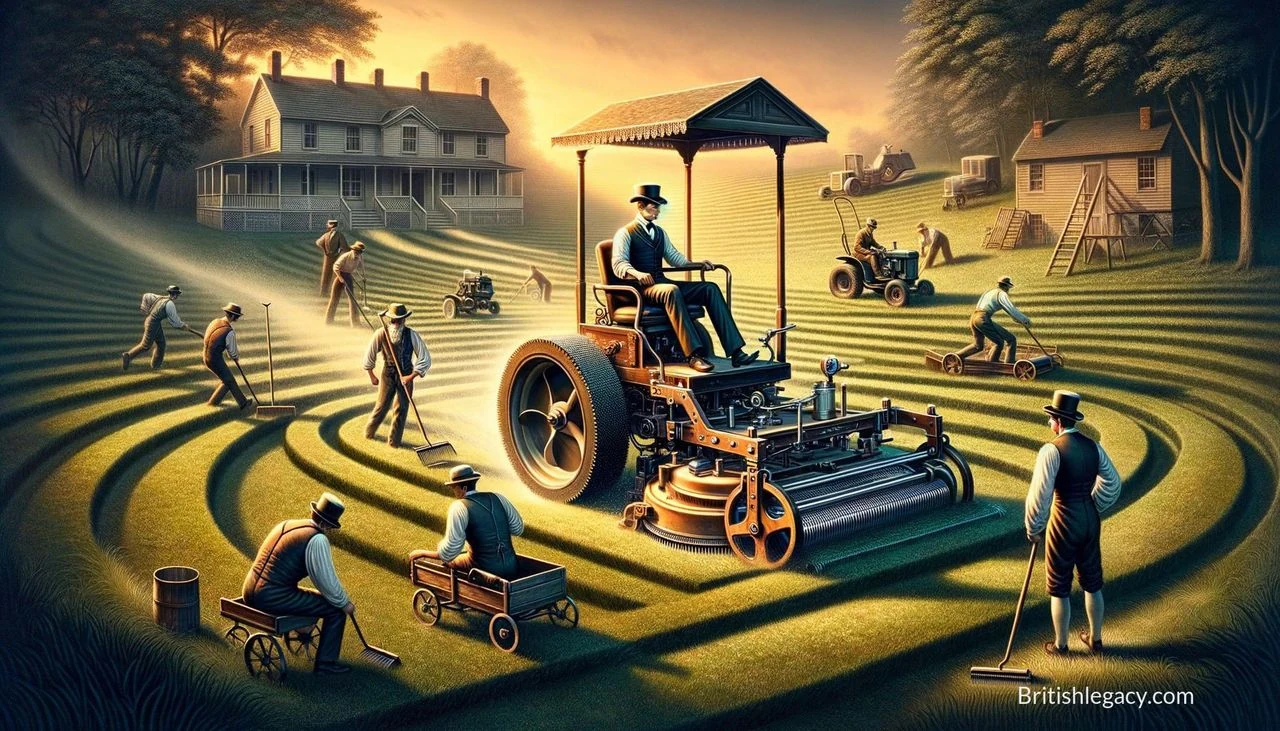
Before the lawn mower, a closely cut stretch of grass required sustained hand labour, grazing animals or a tolerance for a rougher surface. Edwin Beard Budding, a machinist in Stroud, Gloucestershire, saw a way to mechanise the task. In 1830 he applied the cutting principle used to finish woollen cloth to grass, developing a push machine whose revolving cylinder sheared vegetation against a fixed blade. The result was more than a labour-saving device: it helped make a consistent lawn possible across gardens, parks and sports grounds.
A Stroud workshop and a textile idea
Budding’s invention grew from the industries around him. Stroud was associated with woollen manufacture and ironworking, and Budding worked as a machinist at the Phoenix Iron Works of John Ferrabee. The supplied account describes him as familiar with rotary blades used in cloth finishing: they trimmed the raised nap to leave an even surface. He recognised that the same basic arrangement could cut grass. The transfer was practical rather than abstract: take a working mechanism from one trade and apply it to a different material.
The connection between the two processes helps explain why the mower worked. In a cylinder, or reel, mower, blades fixed around a rotating cylinder pass close to a stationary lower blade. Their meeting action shears the grass, much as scissors cut material. Budding’s design did not depend on simply striking or tearing at the growth. It offered a controlled cut, useful where an even finish mattered.
The dates in the supplied material give a sense of how quickly the idea became a business proposition. An agreement between Budding and Ferrabee is dated 18 May 1830; the mower was patented on 31 August that year. The agreement concerned patenting and manufacturing a machine for cropping or shearing the surface of lawns, grass plots and pleasure grounds. Ferrabee was to finance the undertaking and share in its profits. The partnership joined Budding’s mechanical insight to the workshop resources and commercial support needed to make and sell a product.
What the first mower did
The supplied historical description presents Budding’s first machine as recognisably close to the later push mower. It was 19 inches wide, had a wrought-iron frame and was pushed from behind. A rear roller drove the cutting cylinder through cast-iron gears, at a stated ratio of 16:1. A separate roller could be raised or lowered to adjust the cutting height, while a box at the front collected the clippings. These details describe a machine designed not simply to cut, but to offer some control over the finish.
That mechanical arrangement matters because it shows the invention as a usable tool rather than a loose precursor. The cylinder’s rotation was linked to the mower’s movement across the ground; the operator supplied the effort by pushing. The design brought the cutting mechanism into regular contact with the grass and allowed the height of cut to be changed. Those features made a repeatable result possible, even though operating an early machine still required human labour.
The distinction between a reel mower and other designs remains relevant. The supplied account contrasts cylinder mowers, which shear against a fixed blade, with rotary mowers, whose fast-spinning blade cuts on a vertical axis. Different designs suit different uses, but the cylinder principle has endured where a particularly even finish is wanted. Budding’s invention therefore belongs not only to the history of an everyday domestic tool; it is also part of the continuing history of turf maintenance.
From institutional grounds to wider use
Budding’s mower was first aimed at sports grounds and extensive gardens, rather than the ordinary small back garden. That early market makes sense: large institutions and landowners had substantial areas to maintain and could benefit from a more systematic method of cutting. The supplied account names Regent’s Park Zoological Gardens and Oxford colleges among the places where early machines were used. In such settings, a mower could help keep broad lawns and grounds in more consistent condition than hand cutting alone.
The change was not simply that grass could be cut faster. A machine capable of producing a more even surface altered what could reasonably be expected of a lawn. The Science Museum account, as represented in the supplied material, connects the mower with the development of smooth, consistent turf for gardens and sports including cricket and bowls. The lawn became easier to maintain to a standard, and that mattered both to the appearance of a place and to the use of its playing surface.
Access broadened over time, but the supplied evidence does not suggest that domestic lawns suddenly became universal in 1830. Instead, the mower helped make closer-cut grass more practical, while manufacture and later developments widened the possible market. By 1862, the supplied historical description says that Ferrabee’s company was producing eight models with different roller sizes and had made more than 5,000 machines before production ceased in 1863. Ransomes of Ipswich is identified as one of the early licensed makers that helped carry the design into wider commercial production.
That gradual expansion is important. Budding’s invention did not instantly put a neat lawn within everyone’s reach. It provided a mechanical basis on which later production and changing patterns of gardening could build. The mower helped shift the balance between the labour required and the area that could be kept trimmed, making the maintained lawn more achievable beyond the largest estates.
A design that led to many machines
The mower did not remain a single fixed design. The supplied survey traces developments from Budding’s gear-driven machine to Thomas Green & Son’s lighter, quieter chain-driven Silens Messor in the 1850s. It then describes steam-powered machines in the 1890s and, in the twentieth century and beyond, petrol, electric, hover and robotic models. Those changes reflect different answers to questions of power, weight, noise and ease of use. The family of machines became diverse, but the problem that Budding addressed remained recognisable.
Modern rotary and cylinder mowers illustrate that variety. A rotary mower’s fast-spinning blade makes it useful for many everyday lawns; a cylinder mower’s scissor-like action is suited to a close, consistent finish on fine turf. The supplied account notes the continuing use of cylinder machines on high-quality playing and ornamental surfaces. Budding’s idea was not the last word in mowing technology, but the cutting principle he introduced remains part of the options available to groundskeepers and gardeners.
The mower also became a familiar feature far beyond the place where it was devised. Parks, public gardens, institutions and private homes in many countries came to rely on machinery for keeping grass under control. The supplied material describes this as a global spread, while also stressing that the invention’s origins remain legible: textile knowledge, ironworking and workshop practice converged in Stroud. The machine’s later ubiquity can obscure that local beginning.
Remembering an everyday invention
Edwin Beard Budding is less widely recognised than the object associated with his name. That is partly the nature of successful practical invention. A tool becomes ordinary, then its original design choices and the circumstances that produced it fade from view. The lawn mower is encountered as a routine machine, whether on a private patch of grass, a public lawn or a sports ground. Yet its familiarity rests on an earlier answer to a specific problem: how to cut grass evenly over an area without relying entirely on hand tools or animals.
The supplied material says that Budding’s patent drawings and early examples are preserved at the Museum in the Park in Stroud, and that the Science Museum also holds an early mower. Such objects make the engineering tangible. They connect a device now found in many forms with the workshops and industrial skills from which its original mechanism emerged. The story is not only one of invention, but of adaptation, partnership, manufacture and the gradual spread of a useful design.
Why The Lawn Mower deserves a place in British Legacy
The lawn mower deserves a place in British Legacy because its history shows how an insight rooted in local industry can change everyday life. Budding worked in Stroud, where cloth manufacture and ironworking formed part of the industrial setting. He adapted a cutting action used in textile finishing to a new task, creating a machine that could shear grass in a controlled, repeatable way. His achievement was specific and practical: it made the maintenance of close-cut lawns less dependent on slow, skilled hand work and more feasible across larger grounds.
The effects reached beyond the machine itself. More manageable turf supported the appearance and use of gardens, parks and sports grounds, including surfaces associated in the supplied account with cricket and bowls. As manufacture developed, the mower could serve more kinds of users and places. The later range of machines—from chain-driven and steam-powered models to petrol, electric and robotic versions—shows how productive the original problem-solving idea proved to be, while the continuing place of cylinder mowers on fine turf reflects the durability of its cutting principle.
This is a British connection grounded in evidence of place, work and invention, not a general claim about national character. Budding’s story brings together a Gloucestershire workshop, the knowledge of textile machinery, a manufacturing partnership with Ferrabee and an invention whose descendants are still used around the world. The mower is easy to overlook precisely because it became so familiar. Remembering its origin restores the ingenuity behind an everyday object and the lasting benefits it brought to shared and domestic outdoor spaces.